If you are shopping for the best titanium cookware, the first thing to know is that “titanium” is currently five different products wearing one label. Shoppers have moved fast: search data tracked by Rising Trends shows “titanium cookware” reaching an estimated 74,000 US searches a month by mid-2026 — up 814% in a year — while “PFAS free cookware” fell 70% over the same period. Buyers stopped naming a chemical they wanted to avoid and started naming a material they wanted to buy. The problem: that material word covers everything from a genuinely coating-free titanium surface to an ordinary nonstick coating with titanium particles mixed into it.
So this guide is an audit before it is a ranking. Every pick below is labelled by what its “titanium” actually is — pure surface, molecularly bonded, in the alloy, a clad interior layer, or a coating ingredient — and we say plainly which ones have no coating at all. One honest note about method: this is a research-based guide. We have not yet cooked on these pans ourselves, so every performance claim is credited to the tester who published it — principally Prudent Reviews’ five-pan titanium test series (October 2026), Business Insider’s category test (May 2026), and the specification audit at Pan & Provision (checked November 5, 2026). Where those sources disagree, we say so, and no scores have been invented.
First, the Audit: Five Constructions Hiding Behind One Word
1. Solid titanium surface. The pan’s cooking face is titanium itself — in practice, a titanium layer over a heat-spreading base, because titanium alone conducts heat poorly and is only weakly magnetic. Nothing is coated, so nothing can flake. This is what the direct-to-consumer pure-titanium brands sell.
2. Molecular titanium bonded to steel. Titanium alloy is bonded into a stainless steel surface at the molecular level (Hestan’s NanoBond process vaporises titanium and chromium alloys and bonds them to stainless, per Prudent Reviews’ explainer). There is no coating layer to wear through — the titanium is in the surface, not on it.
3. Titanium inside the alloy. The cooking surface is 316Ti stainless steel: a steel alloy strengthened with titanium (and molybdenum), sold by Heritage Steel since 2013 — long before the search term existed. It cooks like stainless steel, because it is stainless steel, with better corrosion resistance.
4. Titanium-interior clad. A three-layer pan — stainless exterior, aluminium core, pure titanium cooking surface — where the titanium layer carries a micro-textured pattern that sheds food without any coating chemistry. This is Our Place’s Titanium Always Pan Pro.
5. Titanium-particle coating. The cheapest construction, and the one to watch for: an ordinary nonstick coating — PTFE or ceramic sol-gel — with titanium particles or a titanium constituent added for abrasion resistance. The titanium is real; so is the coating. It wears out like every coating, and it is not coating-free, whatever the box implies.
How We Judge Titanium Cookware
Five criteria, in the order that matters. Construction verification first: read the maker’s own specification of what the titanium is, and distrust any listing that will not say. Egg release, with and without fat, at a stated preheat — the test Prudent Reviews runs on every pan in this category, because it separates real release from marketing release. Metal-utensil tolerance: a coating-free surface should shrug off a steel spatula and a whisk. The induction magnet test: pure titanium will not stick to a magnet, so a “titanium” pan works on induction only through a ferromagnetic base — check which part of the pan does that job. The spin test: a pan that rocks or spins on a flat surface has a bowed base and will never cook evenly, whatever its surface is made of. And acid and salt resistance: a long tomato-sauce simmer and salted water are where weak surfaces pit and stain. When our own test units arrive, this is the protocol we will publish results against; until then, the findings below belong to the named testers.
Best Titanium Cookware at a Glance
- Our Place Titanium Always Pan Pro — Best Coating-Free Everyday Pan
- Hestan NanoBond 11-inch Skillet — Best Documented Construction, Best for Searing
- Heritage Steel Titanium Series 12-inch Fry Pan — Best Stainless-Steel Behaviour, Made in the USA
- Plateful 12-inch Uncoated Titanium Fry Pan — The Genuinely Pure Titanium Pan
- Gotham Steel Ti-Cerama 12-inch Fry Pan — The Honest Budget Coating (Not Coating-Free)
What’s Actually Wrong With the Cookware in Most Kitchens — and What Buyers Are Switching To
Almost nobody shops for titanium cookware out of curiosity. They shop because the pan they already own failed — the coating went dull, the base started spinning on the glass top, the “lifetime” warranty turned out to exclude the only thing that wore out. So before the picks, here is the failure record buyers are walking away from, with the sources named, because it explains exactly which constructions are worth switching to and which are the same purchase in a new costume.
A Coating Is a Countdown, Not a Surface
Every nonstick coating is a wear layer with a lifespan, and the published numbers are short. Guides that track owner reports put PTFE nonstick at roughly 3–5 years and ceramic nonstick at 1–3 years (Titanella, October 2026; Modern Kitchen Cookware, April 26, 2026) — and the slickness usually goes before the pan does, with owners commonly reporting ceramic release fading within 6–18 months of regular use (Techodom complaint roundup, 2026; Pan & Provision, September 27, 2026). The end stage is visible: the coating blisters, bubbles, then flakes, and once a scratch cuts through it, the aluminium underneath can react with acidic food (Xtrema replacement guide, updated August 31, 2026). Those guides converge on the same retirement triggers — peeling, flaking, deep scratches, exposed metal, sticking that survives cleaning. If you are asking how long do nonstick pans last, that is the honest answer: a few years, and the last of them is spent fighting the pan.
Heat Is What Kills It — and the Warranty Won’t Save You
The main accelerant is temperature. PTFE begins to degrade at about 500°F / 260°C, a temperature an empty pan on a high burner reaches in minutes, and that breakdown is what produces the micro-cracks, blistering and flaking (Modern Kitchen Cookware, April 26, 2026). At high temperatures the fumes from overheated PTFE are documented to cause polymer fume fever — the “Teflon flu” of fever, chills and chest tightness that resolves in a day or two (science review by Jill Carnahan, August 14, 2026, citing EWG testing). And when heat does the damage, the paperwork offers no rescue: Pan & Provision’s warranty audit (September 2026) found overheating damage excluded by every brand it checked — and, more quietly, that no coated-pan warranty it examined covers coating wear at all. Calphalon states that exclusion outright inside a “lifetime” warranty. What warranties do honour is handles and bases — the parts that were never the problem. Hold that thought against the lifetime warranties on the uncoated picks below.
The Label Problem — and What the Science Actually Shows
The chemistry argument is where buyers feel most misled, so here it is with the sources attached and both sides kept. Start with the label: PFOA was phased out of US manufacturing in 2015, yet most pans sold as “PFOA-free” are still coated in PTFE — which is itself a PFAS under the OECD and EPA structural definition. The Ecology Center’s Healthy Stuff Lab tested 14 nonstick cooking pans and 10 baking pans (2020) and found 79% of the cooking pans were PTFE-coated, several of them hiding behind alternative trade names. Consumer Reports (2022) screened three pans for 96 PFAS compounds and measured an average of 4 ppb of PFOA in a PTFE pan sold as “PFOA-free” — a finding the distributor disputed. On the regulatory record: in December 2023 the WHO’s IARC classified PFOA as a Group 1 carcinogen, and the earlier C8 Science Panel (2011–2012) reported a “probable link” between PFOA exposure and several diseases, including kidney and testicular cancer. The particle evidence is separate and physical: researchers at Flinders University and the University of Newcastle (Luo et al., 2022) used Raman imaging to count roughly 9,100 plastic particles released by a single scratch in a PTFE coating, and up to about 2.3 million from a broken one.
Now the counterweight, because a guide that prints only the frightening half is marketing, not research. The best direct food-contact study we found — Cole et al. (2024, Science of the Total Environment) — ran a jelly food simulant through realistic cooking steps and reported no demonstrated migration of PFAS chemicals from PTFE cookware into the simulant; what it counted was particles, shed mostly by old, worn plastic utensils and boards. A November 2025 OECD synthesis sounds the same caution: particle-shedding and chemical-release findings are often spliced together from different studies as if they were one result. Our reading of the record: the case against coated pans does not need exaggeration. The coatings demonstrably wear out, they shed particles as they do, and they sit inside a chemistry class regulators are restricting — while the strongest migration study found no chemical transfer into food. Buyers are not panicking. They are doing arithmetic.
The Failures Nobody Blames on the Coating
Cookware also fails mechanically, and these failures follow you to any replacement built the same way. Warping: bases dome or bow from thermal shock — a hot pan under cold water is the most-cited cause — from burners far smaller than the pan, and from overheating an empty pan; the result is a pan that wobbles or spins on a flat cooktop, pools oil at its edges and cooks in hot spots (Tasting Table, January 2026; EngineerFix, January 2026). Hot spots: even unwarped, thin bases and poor conductors heat unevenly — and here is the honest case against part of this guide’s own category: pure titanium conducts heat at roughly 21.9 watts per metre-kelvin, against aluminium’s ~205 and copper’s ~401 (figures compiled by MyKitchenHints, May 2026), so a thin, pure titanium pan hot-spots and sears weakly. That is why every serious pick below is clad or bonded — a core of aluminium or steel does the heat-spreading the titanium cannot. Induction failure: aluminium, copper, glass and non-magnetic stainless simply do not respond to an induction hob, and pure titanium is non-magnetic too — it works only through a magnetic steel base, which is why the magnet test in our criteria matters (A Grateful Kitchen induction guides, updated September 2026). Loose handles: rivets work loose under years of heat cycling and load — a wobble is the early warning — while welded handles skip the warning and can fail suddenly instead (CyCookery, November 2026). Dishwashers: alkaline detergents corrode rivets and anodised layers and strip release performance, which is why makers so often print “dishwasher safe” on the box while their warranty guidance says otherwise (Pan & Provision warranty audit, September 2026). None of these is a titanium defect or a coating defect; they are construction defects — and construction is what the audit in this guide grades.
The Rules Are Moving, Too
Regulators have started deciding what labels would not. Minnesota’s Amara’s Law banned the sale of cookware with intentionally added PFAS from January 1, 2025 — the Minnesota Pollution Control Agency states plainly that “as a PFAS, Teflon™ will be prohibited from use in cookware” — and Colorado and Maine followed with cookware bans effective January 1, 2026, with further states scheduled for 2027–2028 (Aleph Co. regulations guide, checked against state statutes October 19, 2026). California took the disclosure route instead: AB 1200, in force since January 1, 2023, requires makers to publish the intentionally added chemicals on a pan’s food-contact surface — and in the EWG’s July 2026 read of those disclosures, roughly 40% of 210 companies acknowledged PFAS in their products. Europe is slower and more political: France’s 2025 PFAS law dropped cookware from its final text after lobbying by Groupe SEB, Tefal’s owner, and the EU-wide restriction that does cover cookware is expected to reach a decision in 2027. A different material failure made the same point from the safety side in 2025: the FDA’s alert on imported aluminium and brass cookware leaching lead began with one pot on August 13, 2025, grew to 21 named products by December 3, 2025, and ended in a formal recall of four items in January 2026 (FDA alert timeline as reported by RecipeHeaven, updated October 2026; 360 Cookware, January 15, 2026). The common thread is verifiability: a named material from an accountable maker can be checked. An unmarked alloy or an unnamed “coating” cannot.
What Buyers Are Switching To
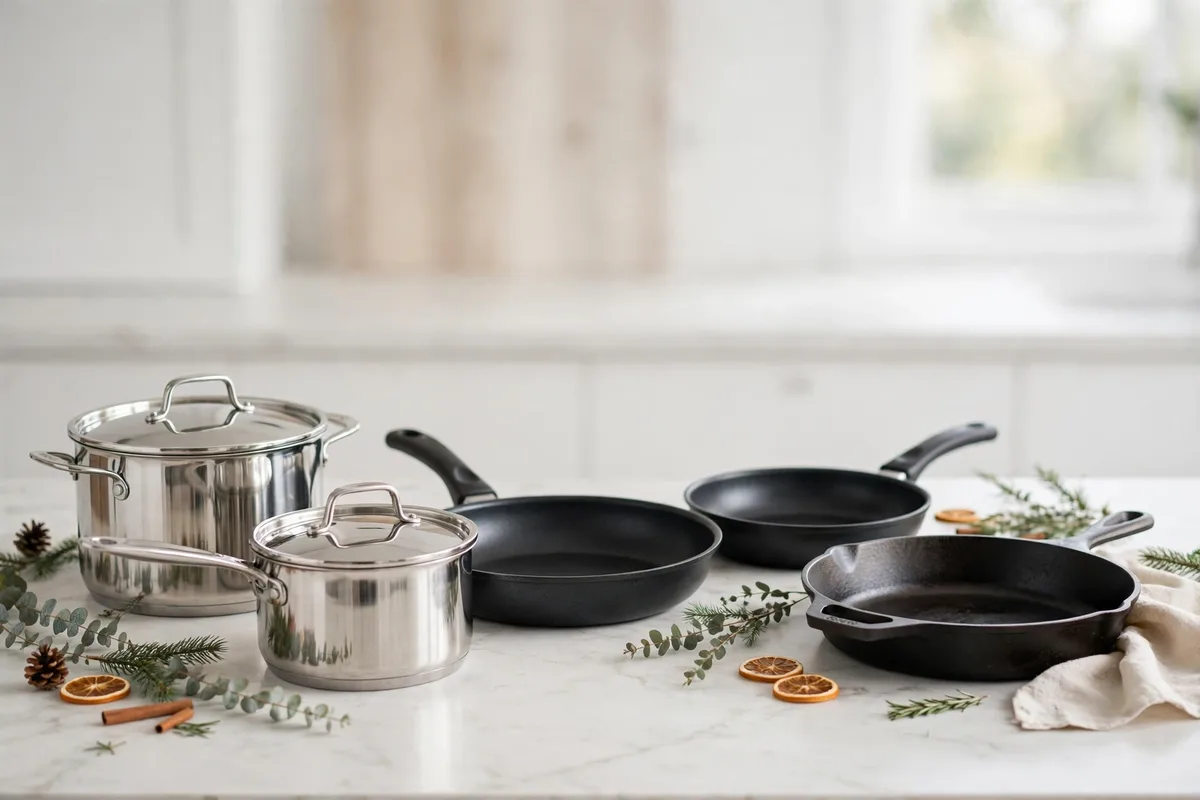
The demand that replaced the old one is specific. Expert guidance for shoppers leaving coatings behind converges on bare-metal surfaces — cast iron, carbon steel, stainless steel and coating-free titanium interiors — for one structural reason: there is nothing on them to flake, peel or wear thin (CupIndy non-toxic cookware guide, reviewed October 2026). Where buyers still want verification rather than adjectives, the checkable claim is “PTFE-free,” not “PFOA-free,” backed by the maker’s AB 1200 disclosure page (EWG, July 2026; Ecology Center guidance via Popular Science, March 2026). And the economics have flipped the premium argument: at one coated pan roughly every two years, a decade of cooking runs through about five pans — and the fifth one wears out too (replacement-cycle math, Titanella, October 2026) — while a coating-free pan bought once, with a real lifetime warranty behind it, is the same purchase made a single time. That is the standard the five picks below are graded against: not how slick the pan is in month one, but what is left of it in year ten. Sorted by construction, here they are.
How we score
The scores in this guide are CookSmartPicks’ own editorial ratings. We set them from our research of the expert reviews and sources listed in this post — they are our ratings, not scores quoted from another publication.
1. Our Place Titanium Always Pan Pro — Best Coating-Free Everyday Pan
The pan that built this category is construction number four: a 10.5-inch, fully clad three-layer pan — 430-grade stainless steel outside, an aluminium core, and a pure titanium interior — with a micro-pattern of dots pressed into the titanium (Our Place calls the surface NoCo). The pattern makes the metal hydrophobic, so food releases without any coating existing to scratch, chip or wear away. Pan & Provision’s specification audit (November 5, 2026) records it as 3 mm fully clad, oven safe to 1000°F per the maker, dishwasher and metal-utensil safe, with a limited lifetime warranty — and Prudent Reviews confirms the warranty even covers performance issues such as food sticking, an unusually confident promise. The line is a going concern, not a one-off experiment: Our Place expanded its Titanium Pro collection in September 2025 around the same coating-free NoCo interior (PW Consulting category milestone summary, 2025).
The test results justify most of it. In Prudent Reviews’ five-pan titanium test (October 2026) — eggs with and without fat, metal spatulas and a stand-mixer whisk dragged across surfaces, a boiling salt-water corrosion test — the Always Pan Pro was the only pan that released an egg cleanly with no oil or butter at all, a result the tester called extremely rare. Its longer single-pan review is more measured: eggs in a greased pan do not stick, eggs without oil can stick lightly but clean easily, and the pan boiled water in 2 minutes 41 seconds against a 2 minute 37 second test-field average. Now the trade-offs. Business Insider’s Stella Totino, testing the category in May 2026, put the learning curve plainly: “You really need to crank the heat before you add ingredients if you want to prevent sticking.” Prudent Reviews disliked the original handle (uncomfortable, slippery) and a lid that vented steam onto the hand — Our Place redesigned both in March 2025 — and noted that whisking directly on the textured surface makes a loud grinding noise, harmless but genuinely unpleasant. Treat it as a pan with a technique, not a nonstick replacement, and it is the strongest everyday answer here.
Yay · Pros
- Genuinely coating-free: pure titanium interior over a clad body — nothing to flake or wear out
- Only pan in Prudent Reviews’ five-pan test to release an egg with zero fat
- Oven safe to 1000°F per the maker; dishwasher and metal-utensil safe
- Lifetime warranty that covers sticking/performance, per Prudent Reviews
Hmm · Cons
- Real learning curve — skip the preheat and food sticks (Business Insider)
- Whisking on the textured surface is loud; polished finish shows smudges (Prudent Reviews)
- Original handle and lid drew criticism; redesigned March 2025 — check for current stock
Check Price on Amazon Check Price on Amazon
2. Hestan NanoBond 11-inch Skillet — Best Documented Construction, Best for Searing
NanoBond is construction number two, and the most thoroughly documented titanium claim in the category. The cooking surface is 18/10 stainless steel with molecular layers of titanium bonded into it, over a tri-ply body with an aluminium core. Pan & Provision’s audit lists the 11-inch skillet at 2.68 lb with flush rivets, an 8-inch induction contact area, and a published oven, broiler and grill ceiling of 1050°F — the highest in this guide. Because the titanium is bonded into the surface rather than sprayed onto it, there is no coating lifespan to wonder about, and the surface is dishwasher safe and metal-utensil tolerant. Hestan publishes its process and its numbers, which is more than most of this category manages. The line is still growing at the top end: in December 2025 Hestan launched a 41-piece Titanium × Tyler Florence set built on the same NanoBond surface (Hestan Culinary, December 2025).
What it is not is nonstick — and the testers are blunt about it. Business Insider’s May 2026 category test said of the NanoBond, “It’s not very nonstick,” and that is the correct expectation to buy with: this is a stainless pan with a harder, more scratch- and stain-resistant surface, and it sears and browns exactly like good stainless. Prudent Reviews’ October 2026 testing backs the durability half — the NanoBond cooks like traditional stainless but held up extremely well to deliberate abuse, including metal utensils and the whisk test. If your goal is a stainless skillet that tolerates metal tools, a dishwasher and years of high-heat searing, this is the pick. If your goal is eggs sliding around a dry pan, buy pick number one — or buy an honest nonstick pan and accept replacing it.
Yay · Pros
- Titanium bonded into the surface — no coating, nothing to wear out, fully documented construction
- Published 1050°F oven/broiler/grill ceiling — the highest here
- Extremely abuse-resistant in Prudent Reviews’ scratch and corrosion testing
- Dishwasher safe, metal-utensil tolerant, flush rivets that do not trap food
Hmm · Cons
- “Not very nonstick” (Business Insider) — it behaves like the stainless it is
- The most expensive construction in this guide by a wide margin
- Preheat discipline required, exactly as with any stainless pan
Check Price on Amazon Check Price on Amazon
3. Heritage Steel Titanium Series 12-inch Fry Pan — Best Stainless-Steel Behaviour, Made in the USA
Heritage Steel is the quiet answer to the hype: construction number three. Its Titanium Series — sold since 2013, a decade before “titanium cookware” was a search term — uses 316Ti stainless steel for the cooking surface, an alloy strengthened with titanium and molybdenum, in a five-ply fully clad body with a published 3.0 mm thickness on the 12-inch pan The pans are made at the company’s factory in Clarksville, Tennessee (from globally sourced materials, which the maker states openly). The titanium’s job here is not release; it is corrosion resistance — the maker claims the 316Ti surface resists salt corrosion far better than ordinary 18/10 stainless, the failure mode that pits lesser pans used for brines and tomato sauces.
Expect stainless behaviour, honestly labelled. There is no coating and no release trick: eggs need fat and a preheated pan, exactly as Prudent Reviews found across the stainless-behaving end of its titanium testing, where Heritage Steel was noted as the durable alternative once the marketing was stripped away. What you get in exchange is the most conventional, best-documented pan in this guide: published thickness, published construction, a lifetime warranty, and a family-owned maker that has answered for its products for over 40 years. For a cook really asking “what is the toughest stainless pan I can buy once,” this — not a coated pan with titanium in the name — is the answer.
Yay · Pros
- 316Ti alloy surface: titanium doing durability work, with published 5-ply, 3.0 mm construction
- Made in the USA (Clarksville, TN); lifetime warranty
- No coating, no PFAS, nothing to wear out — and no release promises it cannot keep
- Strong corrosion resistance claim aimed at sauces, brines and salt water
Hmm · Cons
- Cooks exactly like stainless steel — sticks if you skip the preheat or the fat
- No nonstick-style release of any kind; it is not trying to be that pan
- Costs more than mainstream stainless, for a benefit (corrosion resistance) that shows over years, not weeks
Check Price on Amazon Check Price on Amazon
4. Plateful 12-inch Uncoated Titanium Fry Pan — The Genuinely Pure Titanium Pan
If what you want is construction number one — an actual uncoated titanium pan, the metal itself as the cooking surface — the Plateful 12-inch is one of the few genuinely sold that way. Pan & Provision’s audit records it as SGS-certified uncoated titanium per the maker, published oven safe to 750°F, induction compatible and dishwasher safe, sold with a lid. Pure titanium brings real traits: it cannot rust, it is light, and there is no coating chemistry to ask questions about — titanium metal is chemically inert at cooking temperatures, which is the entire safety argument for this corner of the market.
Buy it with both eyes open, though, because this corner’s listings are the sloppiest in the category. The same audit found the Plateful’s own listing giving its capacity as 3.7 quarts in one field, one litre in another, and 12 inches in a third — and publishing no thickness, no weight and no warranty at all. No maker of uncoated titanium pans publishes a heat-distribution figure, and that silence matters: titanium spreads heat poorly on its own, so how a thin unclad pan handles a burner hotspot is the question nobody will answer with data. The direct-to-consumer pure-titanium brands (Taima is the loudest) add a second caution: a homepage that always shows a countdown timer and “up to 60% off” is telling you the list price is fiction, as Rising Trends documented in September 2026. Judge pure titanium on construction and documentation, never on the discount.
Yay · Pros
- The real thing: an uncoated titanium cooking surface — nothing applied, nothing to flake
- Published oven safe to 750°F per the maker; induction compatible; includes a lid
- Titanium cannot rust and is naturally light to handle
Hmm · Cons
- Listing contradicts itself on capacity and publishes no thickness, weight or warranty (Pan & Provision audit)
- No heat-distribution data exists for this construction — evenness is an open question
- Pure titanium needs a ferromagnetic base for induction; the titanium itself does not do that job
Check Price on Amazon Check Price on Amazon
5. Gotham Steel Ti-Cerama 12-inch Fry Pan — The Honest Budget Coating (Not Coating-Free)
Every “best titanium cookware” list should include one of these, labelled correctly, because this is what most of the search results are actually selling. The Gotham Steel Ti-Cerama is construction number five: an aluminium pan with a ceramic nonstick coating in which titanium is one constituent. Pan & Provision records it as published oven safe to 500°F with a ten-year limited warranty, and the maker publishes PFOA, PFOS and PTFE-free claims for the Ti-Cerama surface — which puts it in the ceramic coating family, not the PTFE one. As a cheap, big, lidded nonstick pan bought with open eyes, it is honest value. As “titanium cookware” in the coating-free sense, it simply is not that product.
The distinction is the whole buying decision: the titanium in this pan does not change what wears out. The coating is the consumable, it will lose release over time like every ceramic coating, and no maker in this construction publishes a lifespan. The same caution covers the wider budget shelf — titanium-reinforced PTFE pans and the inexpensive “titanium” sets — where testing of the thin bodies is unkind (Sorted Food’s testers watched a budget titanium nonstick dome into a warp after its second cook, sending oil pooling to the edges). If you want easy release for a couple of years at the lowest cost, buy this construction knowingly and treat it as a consumable. If you are here because you never want to replace a pan again, this is the one pick in the guide to skip.
Yay · Pros
- Genuine nonstick-style release today, at the lowest cost in this guide
- Maker publishes PFOA, PFOS and PTFE-free claims for the coating
- Large 12-inch pan with a lid; ten-year limited warranty
Hmm · Cons
- It is a coating with titanium in it — not coating-free, and the coating is what wears out
- No published coating lifespan; release will fade like any ceramic nonstick
- 500°F oven ceiling — far below the metal-surface pans above
Check Price on Amazon Check Price on Amazon
Beware “Titanium-Washing”: When Titanium Is Only in the Name
The word now sells pans that have no titanium cooking surface at all. November 2026 deal listings included 20-piece detachable-handle sets marketed as “Titanium Cookware Set… Non-Stick, Non-Toxic, PFAS Free” (FindTheDeal listings, November 2026 — retail listing language, not a construction verification): the titanium, where it exists at all, is a marketing constituent of a coating — the same label confusion the Ecology Center documented for “PFOA-free.” The newest coating technology makes the point from the other side: Happycall’s Royal Graphene Titanium Plus line (listed December 2025) pairs a graphene core with a titanium nonstick coating it calls X-TINUM PLUS — genuinely new, but still a coating, and its durability claims so far come from the distributor, not from any independent tester. Before paying for the word, ask which of the three you are actually getting: a titanium surface (constructions one to four in the audit), titanium particles inside a coating (construction five), or titanium in the product name only. Only the first group has nothing to wear out.
Titanium vs Stainless Steel Cookware: The Short Version
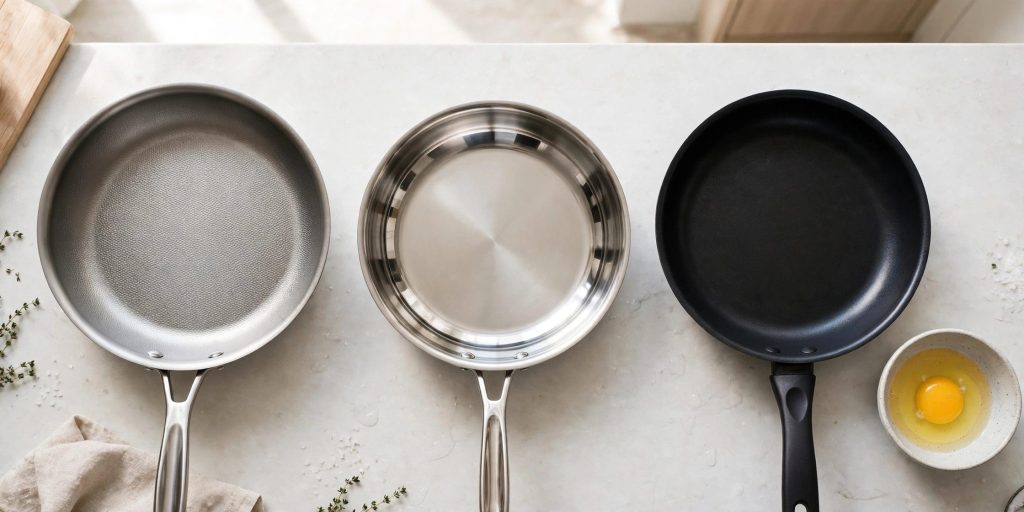
Here is the comparison most shoppers are actually making. Two of this guide’s constructions — bonded (Hestan) and alloy (Heritage Steel) — are stainless steel pans with a titanium upgrade to the surface, and they cook like it: same preheat ritual, same fond, same sear. The titanium earns its keep in scratch, stain and corrosion resistance, not in release. The textured pure-titanium interior (Our Place) is the only construction that changes the cooking behaviour, trading a coating’s effortlessness for a permanent surface that releases well with technique. And plain stainless or carbon steel remains the rational default for many kitchens: a fraction of the cost, documented for decades, and coating-free by nature. Our nonstick frying pan guide covers the coated end of the shelf honestly, and the same coating questions follow you to the oven — our air fryer guide tracks the glass and coating-free basket options. This titanium guide opens our non-toxic kitchen series, which sorts the whole kitchen material by material; read it alongside those two before you spend.
One narrower difference matters to a specific group of cooks: nickel. Pure titanium is nickel-free and chemically inert — the same biocompatibility that makes it an implant material — while stainless steels contain nickel that can leach in small amounts, particularly during long cooking of acidic foods (Kamerud et al., 2013). The Council of Europe’s EDQM (2024) assesses titanium as practically inert; no study directly compares the health risk of cooking in the two metals, so treat this as a composition fact for nickel-sensitive cooks looking for nickel-free cookware — not as a health claim.
One last buying rule for this category: distrust the discount, trust the documentation. A pan whose listing states its construction, thickness and oven ceiling can be judged; a pan sold at a permanent 60% off under a countdown timer is asking not to be. Black Friday will flood this search term with exactly the second kind.
Frequently Asked Questions
What are the disadvantages of titanium cookware?
Cost, technique and confusion. Coating-free titanium pans need a proper preheat or food sticks, pure titanium conducts heat poorly and needs a steel base for induction, and the word covers five constructions — so the biggest disadvantage is buying a coated pan while believing you bought a permanent metal surface.
Is titanium cookware really worth it?
It depends which construction you mean. Bonded, alloy and textured-interior pans cost more than stainless but cannot wear out a coating, so the value case is a pan bought once. Titanium-particle coated pans cost little and wear out like any nonstick — worth it only as a consumable, never as an investment.
Is titanium cookware actually nonstick?
No titanium pan is nonstick the way a fresh coating is. The textured titanium interior comes closest — in Prudent Reviews’ five-pan test it released an egg with no fat at all — but it still rewards preheating and a little fat. Bonded and alloy pans behave like stainless steel, because that is what their surfaces are.
Does titanium cookware work on induction?
Only through its base, never through the titanium. Titanium is weakly magnetic and will not heat on an induction hob by itself, so every induction-compatible titanium pan — including all five picks above — relies on a ferromagnetic steel layer underneath. If a listing cannot say what its base is made of, treat the induction claim as unproven.
Is PFOA-free the same as PFAS-free?
No. PFOA left US manufacturing in 2015, but most “PFOA-free” pans are still coated in PTFE — itself a PFAS. The Ecology Center (2020) found 79% of tested cooking pans were PTFE-coated, several behind trade names, and Consumer Reports (2022) measured 4 ppb PFOA in one “PFOA-free” pan.
Are nonstick pans being banned?
In some places, yes. Minnesota banned cookware with intentionally added PFAS from January 1, 2025, and Colorado and Maine followed on January 1, 2026, with more states scheduled for 2027–2028. California chose disclosure instead (AB 1200), France exempted cookware from its 2025 ban, and an EU decision is expected in 2027.
Is a scratched nonstick pan safe to use?
Guides advise retiring a pan once the coating peels or flakes. Flinders University and University of Newcastle researchers (2022) counted roughly 9,100 particles from a single scratch in a PTFE coating; but Cole et al. (2024) found no demonstrated PFAS chemical migration into a food simulant. Wear, not chemistry, is the documented problem.
How long do nonstick pans last compared to titanium cookware?
Published lifespans put PTFE nonstick at roughly 3–5 years and ceramic nonstick at 1–3 years, with slickness often fading sooner (Titanella, October 2026; Modern Kitchen Cookware, April 2026). Coating-free titanium constructions have no wear layer to expire: their working life is the pan’s own, backed here by lifetime warranties.
Last updated: November 6, 2026