There are two completely different purchases hiding inside the search for the best deep fryer, and most guides pretend there is only one. The first is an everyday countertop machine for fries, wings, onion rings and fish — used weekly, judged on cleanup and temperature recovery. The second is a once-or-twice-a-year capacity machine bought to fry a whole turkey, judged on size, stability and safety. A fryer that wins the first contest is physically incapable of the second, and a turkey fryer used for Tuesday’s fries is a garage-sized answer to a countertop question. This guide keeps the two contests separate: three everyday fryers ranked for home kitchens in Canada and the USA, then two turkey machines — one electric and indoor, one oil-less and outdoor — with the safety framing this category honestly requires. If the bird is the main event, plan it alongside our best roasting pan for turkey guide, because the households frying a turkey this year are usually roasting one next year.
The timing is not an accident. US Thanksgiving falls on 26 November 2026 — the single biggest frying week of the year — and turkey-fryer roundups across the major outlets were refreshed in the days before this guide was published, which tells you where buyer attention is. The everyday half of this page is deliberately evergreen: fries and wings do not have a season, and the same machines carry Christmas, New Year and game-day frying. One pairing is worth making before the choosing section: frying lives or dies on internal temperature, not on the dial, so keep our best wireless meat thermometer for turkey guide open alongside this one — it is the tool that tells you the turkey is actually done, and it earns its place on wings and fish the rest of the year.
Disclosure: CookSmartPicks is reader-supported. When you buy through links on this page, we may earn an Amazon commission at no extra cost to you. Prices and availability change often — check the current price on Amazon before you decide.
How we chose these fryers
CookSmartPicks is a research-based guide. We do not run a test lab, and we never claim hands-on testing we have not done. For this list we compared manufacturer specifications — oil capacity in litres, wattage, basket configuration, temperature range and stated bird capacity — against the tested fryer and turkey-fryer roundups published by outlets including Bob Vila, whose turkey-fryer guide was updated in November 2026, and against long-term owner reports, where the failure modes of this category (slow temperature recovery, filtration systems that clog, thermostats that drift) actually show up. Three criteria decided the everyday ranking: how fast the oil returns to temperature after cold food goes in, because that recovery is the difference between crisp and greasy; how the cleanup works in practice, because a fryer that is miserable to clean becomes a cupboard ornament; and capacity stated honestly, in litres of oil and realistic food loads rather than marketing servings. The turkey picks were judged on stated bird capacity, stability, and whether the design removes the classic outdoor propane-and-open-flame risks — which brings us to the safety note this category cannot skip.
The safety framing, plainly. Deep frying is the most fire-prone cooking method a home kitchen hosts, and turkey frying is its riskiest form. The US National Fire Protection Association (NFPA) has long warned against outdoor gas-fueled turkey fryers in particular, and its widely cited figures attribute an average of dozens of injuries and millions of dollars in property damage each year to deep-fryer fires, with Thanksgiving the peak day for home cooking fires in the US. The failure pattern is consistent: too much oil, a partially frozen bird, an unstable burner, and no thermometer. Every pick below was chosen partly to break that pattern — electric heat instead of open flame, indoor-capable designs, thermostatic control — and the questions section at the end carries the working rules: thaw fully, measure oil with the bird in water first, never fry in a garage, and never leave a fryer unattended. Read them before the turkey, not after.
The lineup at a glance
| Product | Best for | Why it stands out |
|---|---|---|
| T-fal 3.5L Deep Fryer with Oil Filtration | Easy cleanup | Filters and stores its own oil after frying — the cleanup problem, engineered away |
| Hamilton Beach 4.5L Professional Deep Fryer, 3-Basket | Batch frying | One large plus two small baskets: a full meal’s components fry at once |
| Chefman 4.5L Deep Fryer | Value | Family capacity with a timer and viewing window at the friendly end of the range |
| Masterbuilt 10L XL Electric Fryer | Indoor turkey fryer | Fries a whole turkey indoors on electric heat — and boils and steams the rest of the year |
| Char-Broil Big Easy Oil-Less Turkey Fryer | Oil-less alternative | Infrared propane cooking with no oil at all — nothing to spill, buy or dispose of |
1. T-fal 3.5L Deep Fryer with Oil Filtration — Best for easy cleanup
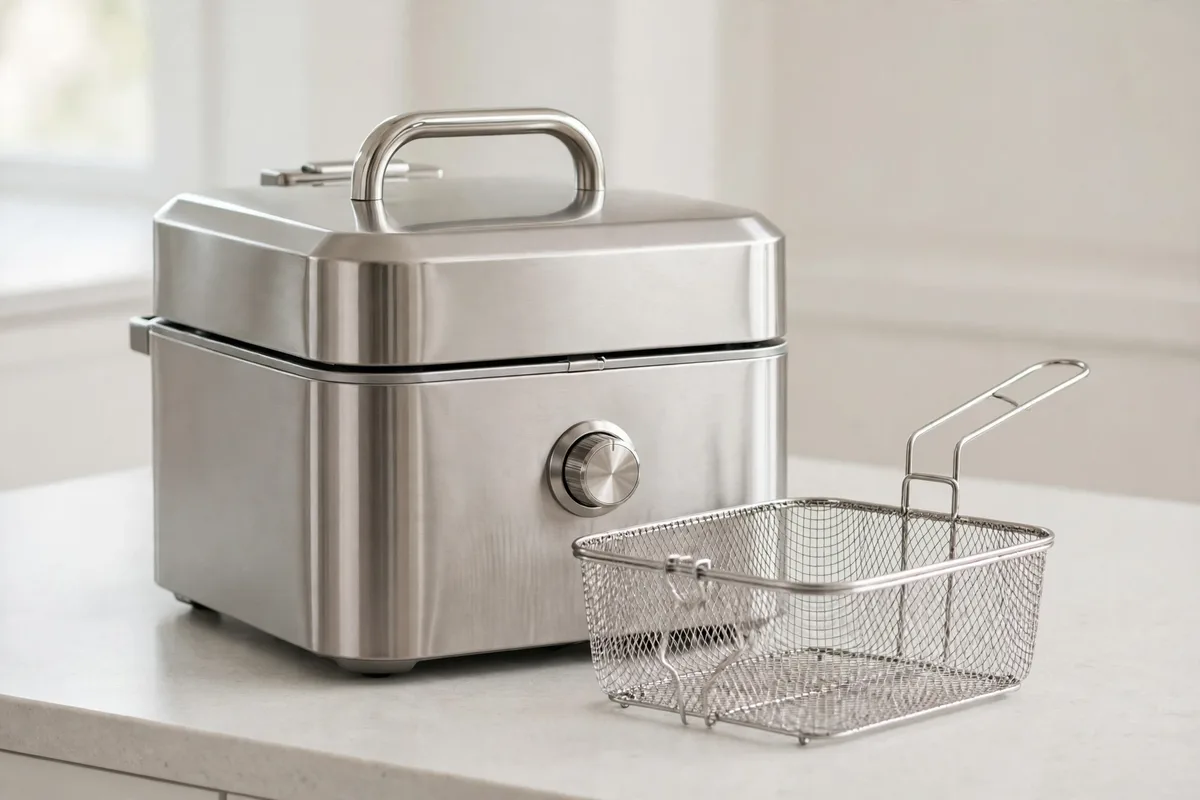
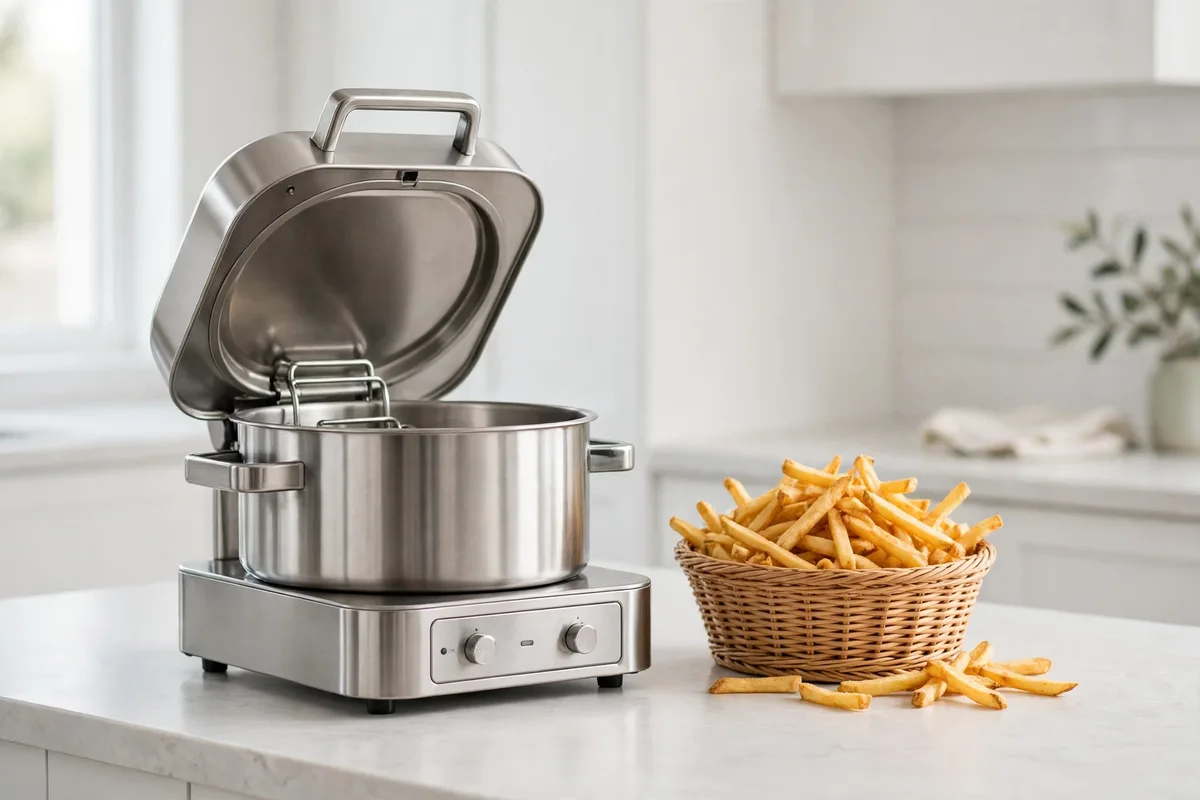
Ask long-term fryer owners why their machine gathers dust and the answer is rarely the frying — it is the oil. Draining, straining, funnelling and storing used oil is the chore that kills the habit, and the T-fal is built specifically to delete it. When the oil cools, a lever drains it through an integrated filter into a sealed storage box in the base, ready to pour straight back in next time; the oil lasts more fries, the counter stays clean, and the parts that do need washing are largely dishwasher-safe. The 3.5-litre capacity is the everyday sweet spot — a family load of fries or wings in one or two batches — and the adjustable thermostat, viewing window and breakaway safety cord are the expected fittings, properly done.
The frying itself is competent rather than spectacular, and that is the honest summary of every mid-size electric fryer: wattage in this class recovers temperature adequately for fries, wings and battered fish, provided you respect batch sizes and let the oil come back to temperature between loads — the discipline matters more than the brand. Where the T-fal earns its first-place everyday ranking is the arithmetic of use: a fryer you clean in minutes gets used weekly, and a fryer used weekly is worth owning. Two limits to note. The filtration is designed for T-fal’s own oil box system, so keep the container; and 3.5 litres will not fry a turkey or feed a party in one batch — that is what picks two and four are for. In Canada the T-fal name carries the same product as the Tefal branding used elsewhere, which helps when comparing listings across the two storefronts.
Yay · Pros
- Automatic oil filtration and sealed storage — the category’s best cleanup answer
- 3.5L capacity is the right everyday size for families
- Filtered oil lasts longer, which quietly lowers the running cost
Hmm · Cons
- Filtration depends on its own storage box — a part to keep track of
- Temperature recovery is adequate, not class-leading — respect batch sizes
- Too small for turkey or party-scale batch frying
Best for: weekly fryers who know the cleanup, not the cooking, is what usually ends the habit. Skip if: you regularly fry for crowds, or you want one machine that can also take a whole turkey.
2. Hamilton Beach 4.5L Professional Deep Fryer, 3-Basket — Best for batch frying
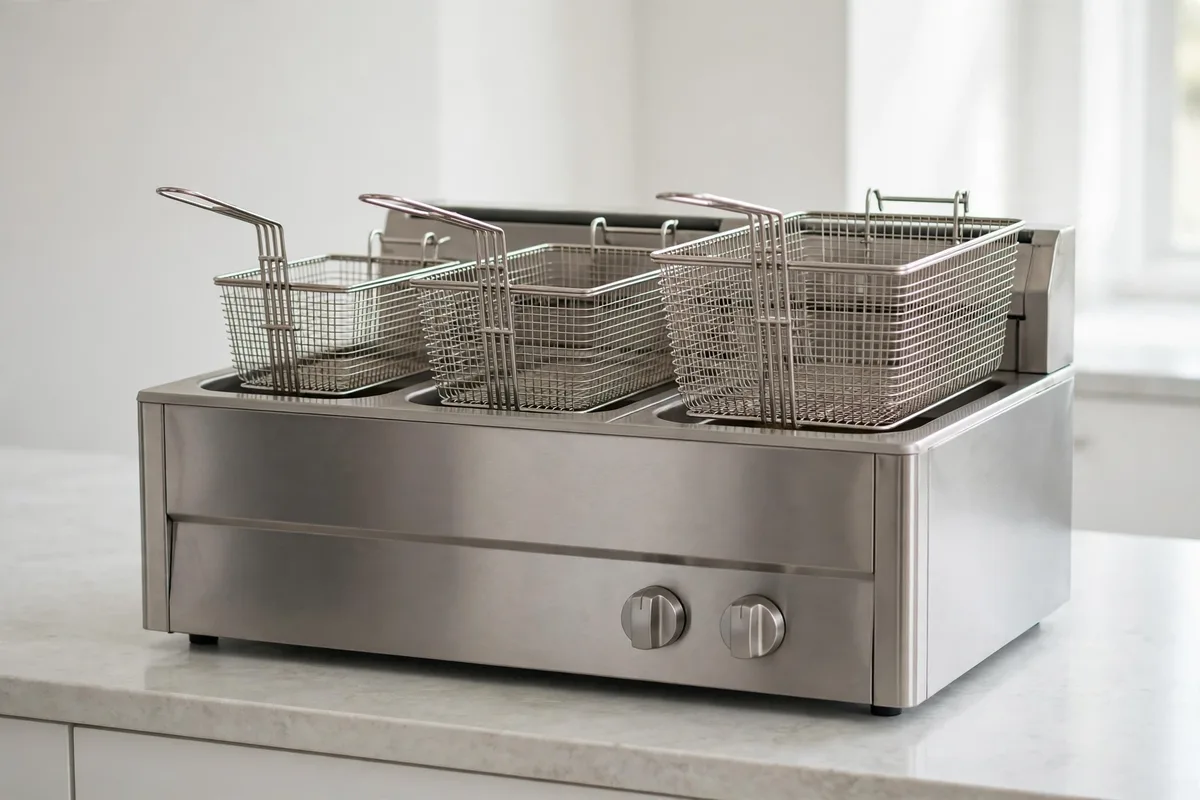
The Hamilton Beach answers the other everyday problem: volume and variety at the same time. Its 4.5-litre tank takes either one large basket — a serious single load of fries or a whole batch of chicken — or two smaller baskets side by side, so fish fries in one while fries finish in the other, at the same temperature but on separate timings, lifted and drained independently. That three-basket flexibility is the design’s whole argument, and for households that fry a full meal rather than a side dish, it is a strong one. The immersed heating element is the second argument: the element sits in the oil rather than under the tank, which is how professional fryers are built, and it shows in faster heat-up and better recovery when cold food goes in.
The fittings around that core are workmanlike in the good sense: adjustable temperature with a ready light, a viewing window, a breakaway cord, and a lid that contains splatter while the baskets drain on the rim. What it does not do is filter its oil — draining and straining are manual here, the standard chore the T-fal above was designed to avoid — so the honest comparison between picks one and two is cleanup versus capacity. Choose the Hamilton Beach if your frying is event-shaped: fish Fridays, wing nights, family batches. Choose the T-fal if it is Tuesday-shaped. Counter space is the other real cost; a 4.5-litre three-basket machine is a substantial appliance, and it earns that space only if the batch frying actually happens in your kitchen.
Yay · Pros
- One large or two small baskets — a whole meal fries at once
- Immersed element heats fast and recovers like a professional fryer
- 4.5L capacity handles family batches in fewer loads
Hmm · Cons
- No oil filtration — draining and straining are manual
- A large footprint for a countertop appliance
- Both baskets share one temperature — different-temp foods still queue
Best for: households that fry full meals — fish and fries together, wing nights, family batches. Skip if: cleanup is your known weak point, or your counter space is tight enough that size decides for you.
3. Chefman 4.5L Deep Fryer — Best value
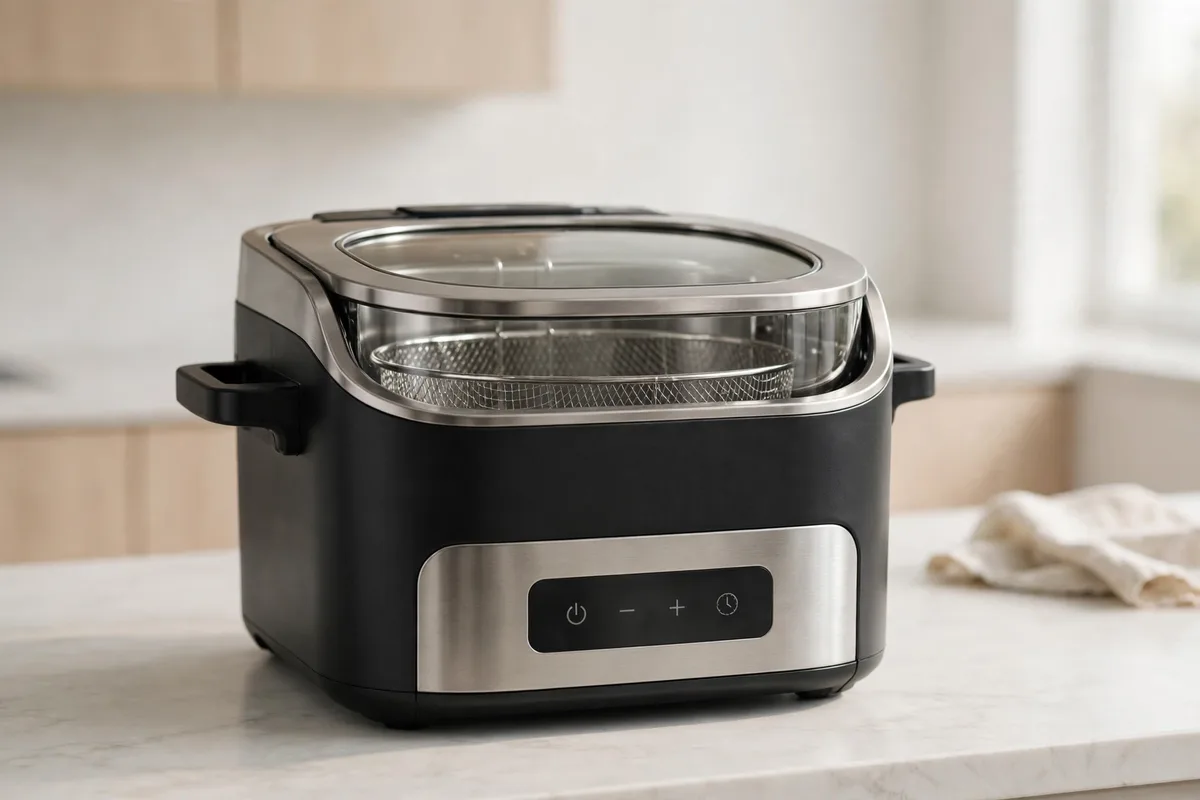
The Chefman takes the Hamilton Beach’s capacity argument and strips it to the essentials at a friendlier tier: the same family-scale 4.5-litre class, a large basket, a viewing window so you are not lifting the lid into a cloud of steam to check colour, and a built-in timer — a small feature that matters more in frying than in most cooking, because the difference between golden and gone-too-far is about ninety seconds and the cook is usually plating the previous batch when it happens. Temperature control is a straightforward dial, the basket hooks on the rim to drain, and the whole proposition is aimed at buyers who want real capacity without paying for filtration systems or multi-basket hardware.
Value picks earn their place by stating what was traded away, so: there is no oil filtration, the single basket means meal components fry in sequence rather than side by side, and temperature recovery in this tier asks for the same batch discipline as every mid-wattage fryer — smaller loads, patience between them, and a thermometer’s honesty over the dial’s optimism. None of that prevents excellent results; home frying succeeded for decades on less. What the Chefman gets right is the sizing decision most value buyers get wrong: it does not shrink the tank to hit its tier. A too-small fryer is the false economy of this category — endless batches, oil temperature sagging, food steaming in its own moisture. At 4.5 litres, this one fries a family load properly, and that is why it is the value pick rather than a smaller, cheaper machine.
Yay · Pros
- Full 4.5L family capacity at the value end of the range
- Built-in timer — genuinely useful when batches run back to back
- Viewing window checks colour without lifting the lid into the steam
Hmm · Cons
- Single basket — meal components fry in sequence
- No oil filtration; draining and straining are manual
- Recovery needs batch discipline, like every fryer in its wattage class
Best for: first-time fryer buyers and families who want proper capacity without the premium features. Skip if: you fry mixed meals often enough that the two-basket Hamilton Beach pays for itself in convenience.
4. Masterbuilt 10L XL Electric Fryer — Best indoor turkey fryer
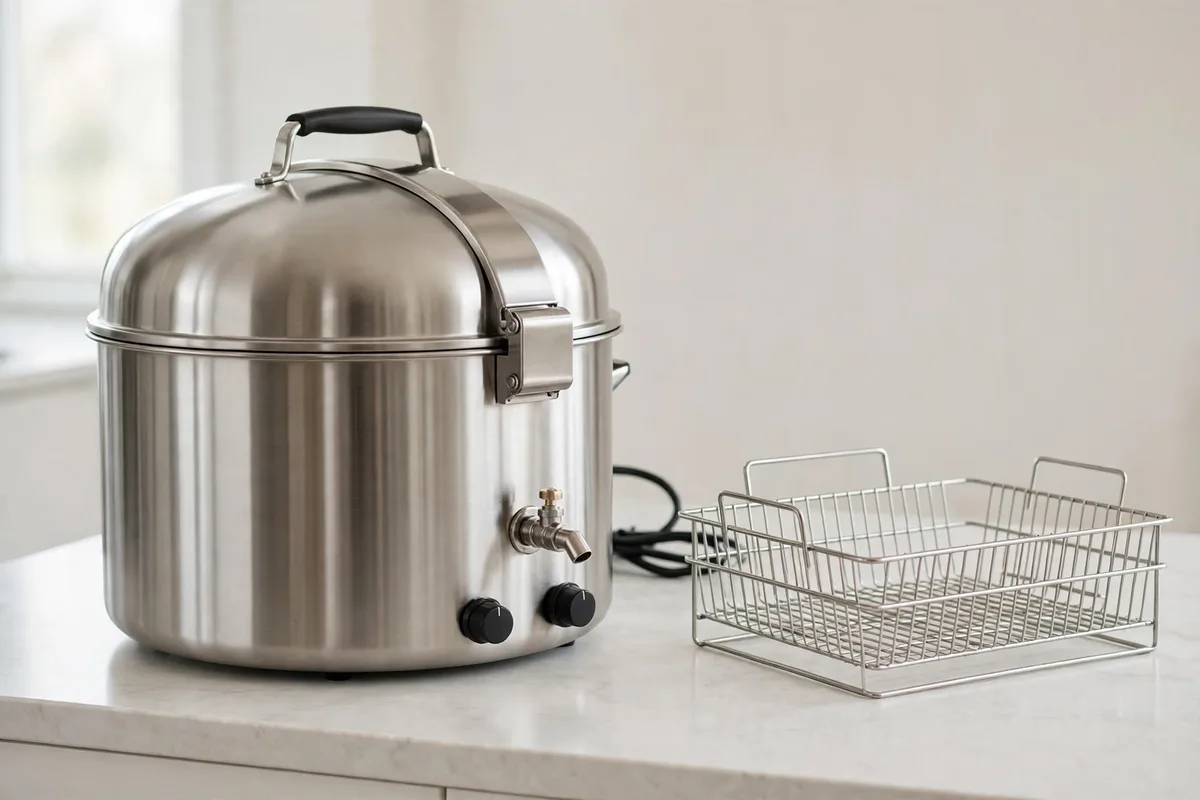
The Masterbuilt is the machine that changed what a turkey fryer is allowed to be. It is a 10-litre electric countertop unit — a very large one — rated by its maker for whole turkeys up to about 20 pounds, and it fries them indoors, on thermostatic electric heat, with no propane burner, no open flame, and no standing outside in November weather watching a pot. That combination addresses, in one design, nearly every element of the classic turkey-fryer accident pattern described in the safety note above. A built-in timer, a drain valve for the oil, and a basket with a lifting hook for the bird handle the working details, and the same tank boils and steams — seafood boils, corn, low-country boils — which is how a seasonal machine justifies its storage space the other eleven months.
Now the Canada note, which for this pick is decisive rather than decorative: in much of Canada, late November is already below freezing, and outdoor propane frying in the cold — with wind stealing heat from an open burner and the cook bundled and hurried — is the worst version of an already risky method. An indoor electric fryer removes the weather from the equation entirely, which is why this category matters more on the Canadian side of this guide’s audience than US roundups usually acknowledge. The honest costs are size and oil: 10 litres is a lot of counter and cupboard, the oil fill for a turkey is a significant purchase in itself, and the bird still demands the full discipline — completely thawed, oil level measured with the displacement method, lowered slowly, never left alone. Electric heat removes the flame. It does not remove the physics.
Yay · Pros
- Fries a whole turkey indoors — no propane, no open flame, no weather
- Maker-rated for birds up to about 20 pounds; timer and drain valve fitted
- Boils and steams too, so it works beyond turkey season
Hmm · Cons
- Very large — counter and storage space are real costs
- A turkey fill is a lot of oil to buy, store and later dispose of
- Full frying discipline still applies — thawed bird, measured oil, constant attendance
Best for: Thanksgiving and holiday hosts, and Canadian buyers for whom outdoor November frying is genuinely impractical. Skip if: counter space is scarce, or your turkey tradition is once a decade rather than once a year — rent the occasion, not the appliance.
5. Char-Broil Big Easy Oil-Less Turkey Fryer — Best oil-less alternative
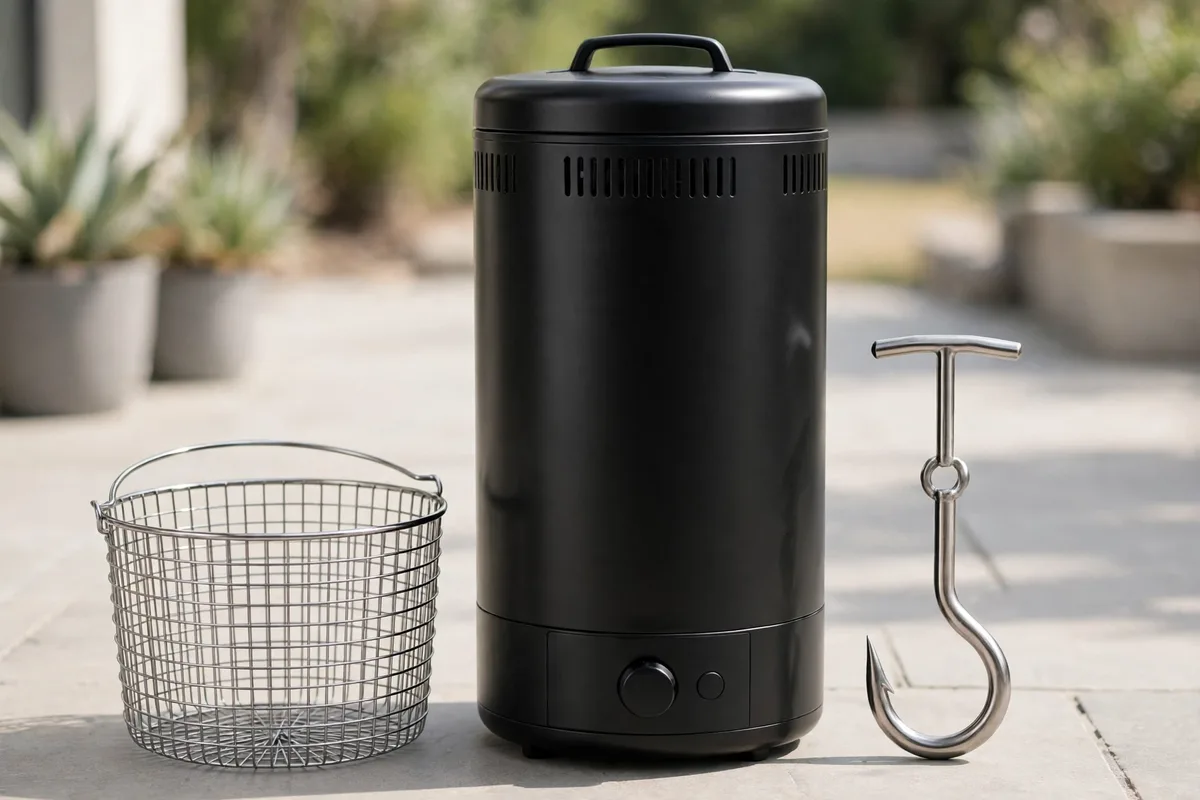
The Big Easy makes the most radical safety argument on this page: the most dangerous ingredient in turkey frying is the oil, so it uses none. It is a propane-fired infrared cooker — a cylindrical outdoor unit in which the bird sits in a wire basket inside a cooking chamber, and infrared heat roasts it with the browning and crisped skin people want from frying, without a pot of oil to spill, splash, overfill or dispose of afterwards. Char-Broil rates it for turkeys up to about 16 pounds, and the same chamber handles roasts and other large joints, which broadens it beyond a single holiday. No oil also means no oil bill — a recurring saving that owners of conventional turkey fryers feel every single year — and no used-oil disposal problem the morning after.
Precision about words matters here: oil-less “frying” is really high-heat infrared roasting, and the result, while genuinely close in skin and juiciness by most owner accounts, is not identical to a bird submerged in oil — purists will taste the difference, and this guide will not pretend otherwise. It is also still an outdoor propane appliance: it belongs outside, on a level surface, away from structures, attended — the NFPA’s warnings about outdoor gas turkey cookers were written about the oil-filled kind, but the level-surface, never-in-a-garage, never-unattended rules apply to this one too. What it removes is the oil-specific disaster set, and for many households that is exactly the right trade: the ritual and the result, minus the ingredient that causes the fires.
Yay · Pros
- No oil at all — nothing to spill, buy, filter or dispose of
- Infrared heat gives crisped skin and juicy meat, fryer-style
- Chamber also cooks roasts and large joints beyond turkey day
Hmm · Cons
- It is infrared roasting, not true frying — close, not identical
- Maker-rated to about 16 pounds — smaller ceiling than the Masterbuilt
- Still outdoor propane: level ground, outside, attended, always
Best for: hosts who want the fried-turkey ritual without the oil — its cost, mess and fire risk. Skip if: you want the authentic oil-fried result, or your bird runs larger than about 16 pounds.
Capacity, recovery and oil: what actually matters
Capacity is two numbers, not one. The litre rating is the oil tank; the number that decides your evening is the food load per batch, and the two are linked by a rule with no exceptions: overfilling the basket drops the oil temperature, and food in sagging oil steams and soaks up grease instead of crisping. If your frying life is fries and wings for a family, 3.5 to 4.5 litres with honest batch discipline covers it — and if you have been eyeing the machines in our best air fryers in Canada and the USA guide for the same jobs, the honest split is this: air fryers win on convenience and everyday health maths, deep fryers win on texture for battered food and anything that must be submerged to cook properly. Many kitchens end up with both, used for different foods. Recovery — how fast the oil returns to temperature — is the spec that never appears on the box; immersed elements and higher wattage recover faster, and the practical test in owner reports is whether batch three fries as crisply as batch one.
Oil is a system, not a supply. Choose a neutral, high-smoke-point oil — peanut is the traditional turkey choice, canola the everyday value choice — and plan its whole life before you buy it: how you will filter it (the T-fal does this itself; the others ask for a strainer and a funnel), where it will live between uses (cool, dark, sealed), how many uses you will take from it (until it darkens, foams or smells off — then it is done, whatever the count says), and how it leaves the house (never down a drain; sealed container, municipal disposal or a solidifier). The same planning mindset covers the rest of the fried-food table: our best indoor grills in Canada and the USA guide is the natural next read for the households building out a high-heat cooking corner. Buy the fryer whose oil system matches the effort you will honestly sustain — that, more than any dial or basket, predicts whether it is still in use next November.
Deep fryer questions, answered
Can you fry a whole turkey in a regular countertop deep fryer?
No — and this is the most important answer on the page. Everyday fryers in the 3.5 to 4.5 litre class cannot physically hold a turkey, and attempting to force capacity in this category is how accidents happen. Whole birds belong only in machines rated for them: the Masterbuilt electric fryer above (maker-rated to about 20 pounds) or the oil-less Char-Broil (about 16 pounds). Measure the oil level with the bird first using water displacement, use a fully thawed bird, lower it slowly, and never leave any fryer unattended.
How many times can you reuse frying oil?
There is no fixed number — the oil tells you. Filtered after each use and stored cool, dark and sealed, everyday oil typically serves several sessions; breaded and battered foods shorten its life faster than fries. Retire it when it darkens significantly, foams at temperature, smokes early, or smells stale or fishy. Filtration systems like the T-fal’s extend usable life by removing the crumbs that burn and flavour the oil, which is part of that machine’s running-cost case.
Is an indoor electric turkey fryer actually safer than a propane one?
It removes the largest single risk factor — the open flame under a pot of oil — along with the weather exposure that makes outdoor frying worse in cold climates. That is a real and significant improvement, and it is why the NFPA’s strongest warnings target outdoor gas-fueled fryers specifically. It does not make turkey frying risk-free: a large volume of hot oil indoors still demands a thawed bird, correct oil level, a stable surface, children and pets elsewhere, and a cook who stays in the room. Safer is a direction, not a destination.
What temperature should frying oil be?
Most everyday frying happens between 350 and 375 degrees Fahrenheit (about 175 to 190 Celsius): fries toward the middle of that range, battered fish and chicken toward the top. Turkey frying follows the fryer maker’s stated temperature for the bird’s weight. Trust a thermometer over the dial — built-in thermostats vary — and let the oil fully recover to temperature between batches. Food that goes into oil below temperature absorbs grease instead of sealing, which is the mechanical cause of the heavy, soggy result people blame on frying itself.
The short version
For everyday frying, buy the T-fal 3.5L with oil filtration if cleanup decides whether a fryer gets used — in most kitchens it does — the Hamilton Beach 4.5L three-basket if you fry full meals in batches, and the Chefman 4.5L if you want the capacity without the premium features. For the turkey, the Masterbuilt 10L XL electric is the indoor, flame-free answer and the natural pick wherever November is already freezing, while the Char-Broil Big Easy removes the oil — and its cost, mess and fire risk — from the ritual entirely. Whichever side of the split you are buying for, keep the two contests separate, respect the safety rules in the questions above, and the fryer you choose will still be earning its counter space long after the holiday that prompted it.
Last updated: November 16, 2026. We refresh this guide each season and whenever a pick is replaced by a better one.