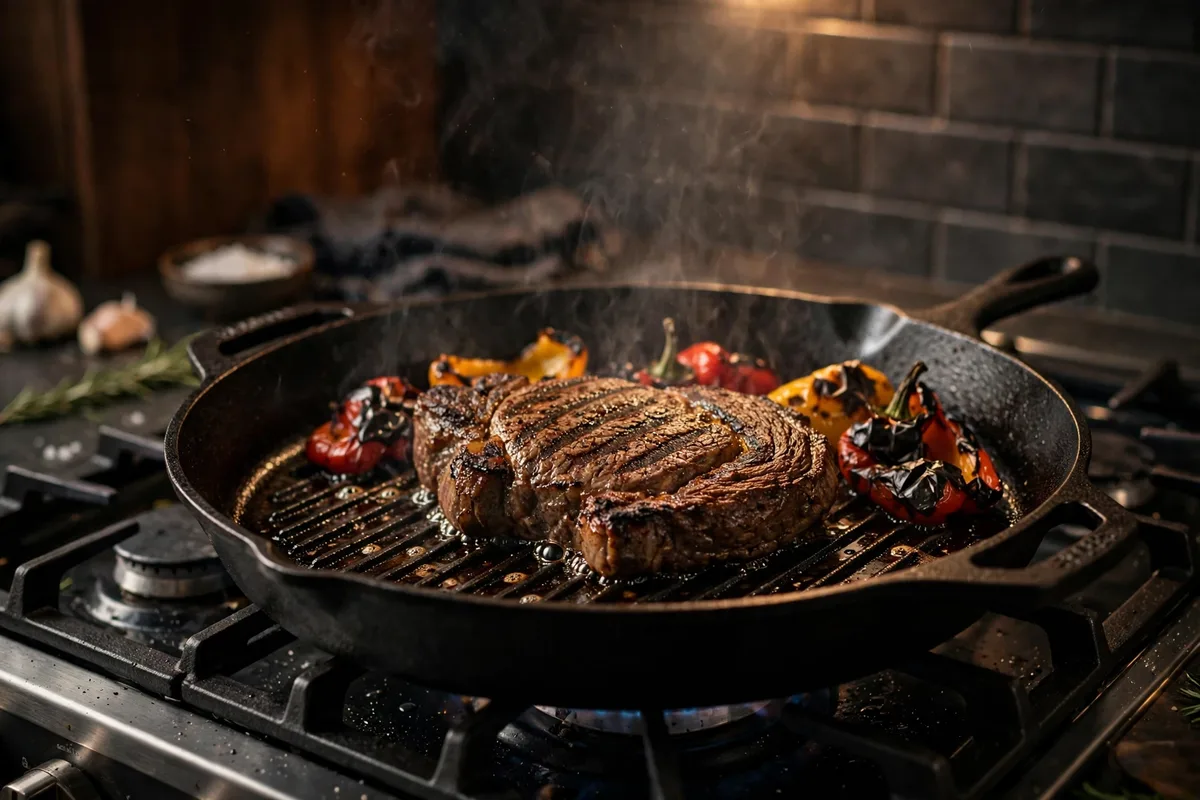
The best grill pan for most kitchens is the Lodge Cast Iron Grill Pan: its tall ridges drain fat and print real grill marks, and the cast iron tolerates any heat a home stove can produce. A grill pan promises July in January: striped steaks, charred peppers and a balcony-free barbecue for apartment life. What it actually delivers depends entirely on ridge height, pan material and how hot you are willing to run it — and this guide will tell you plainly where the promise ends, because a grill pan is a specialist, not a skillet with lines. Bought for the right jobs, it is a delight; bought as a general pan, it is a cupboard tenant.
The five picks below divide by material and mission: raw cast iron for maximum heat and minimum money, two enamelled French pans for easier care and better looks, a nonstick option honestly labelled for gentle work, and a double-burner reversible giant for feeding a crowd. Each was checked for ridge geometry, weight, pour spouts and Canadian availability. If your real need is all-purpose searing, our best stainless steel skillets in Canada and the USA guide is the better buy; for taking the grilling outside properly, the best patio heaters in Canada and the USA guide covers the yard, and the best flat-top griddles in Canada and the USA guide handles the flat-top alternative.
Disclosure: CookSmartPicks is reader-supported. When you buy through links on this page, we may earn an Amazon commission at no extra cost to you. Prices and availability change often — check the current price on Amazon before you decide.
How we chose these stovetop grill pans
Ridge geometry was the first screen, because it decides everything else: we compared ridge height and spacing from maker specifications and owner photography — tall, widely-spaced ridges drain fat and mark boldly, while low, tight ridges behave like a textured skillet and please nobody. Pan material came second, judged by the heat the job actually needs: raw and enamelled cast iron tolerate the hard preheat that makes marks; nonstick does not, and its pick is labelled for the gentler work it can honestly do.
We also checked the unglamorous specifications: weight with a full load (a cast iron grill pan plus four chicken breasts is a two-hand lift), pour spouts for draining fat, helper handles, and induction compatibility for Canadian condos. Every pick is available through normal Canadian retail. Two aluminium ‘grill pans’ with painted-on ridge lines were cut — a ridge you can feel with a fingernail is decoration, not geometry.
The lineup at a glance
| Product | Best for | Why it stands out |
|---|---|---|
| Lodge Cast Iron Grill Pan (10.25-Inch) | Best overall | The cast-iron standard: tall ridges, real heat tolerance, priced like a grocery run |
| Le Creuset Signature Cast Iron Skillet Grill | Best enamelled | Cast-iron sear with enamel convenience and a stovetop-worthy finish |
| Staub Cast Iron Grill Pan | Best design pick | Enamelled iron with a browning-friendly matte interior and a matching press |
| Calphalon Nonstick Grill Pan | Best nonstick (gentle use) | The gentle grill pan: ridges and drainage at medium heat, with zero iron chores |
| Lodge Double Burner Reversible Grill/Griddle | Best for crowds | Twenty inches of reversible iron — grill on one side, griddle on the other |
1. Lodge Cast Iron Grill Pan (10.25-Inch) — Best overall
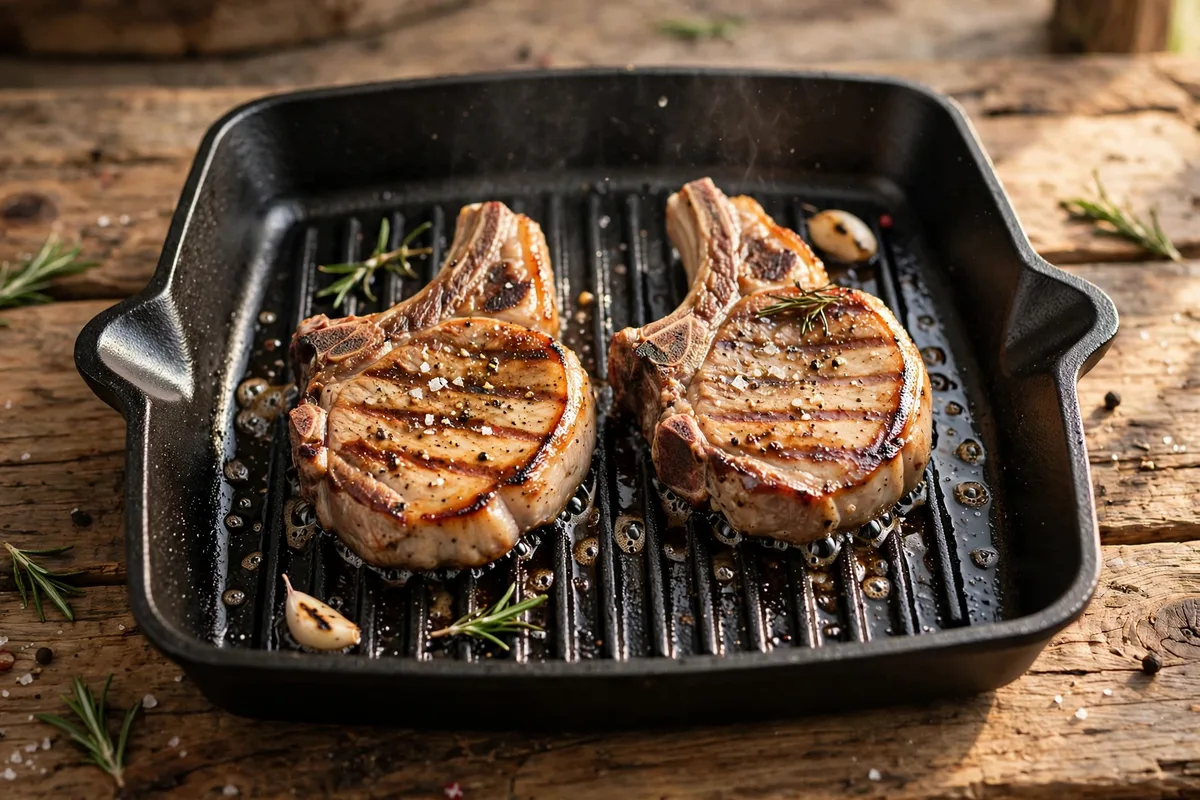
The Lodge grill pan is the category’s reference point for a reason: tall, widely-spaced ridges that actually drain fat and print bold marks, a 10.25-inch square of pre-seasoned cast iron that tolerates any preheat your stove can produce, and pour spouts on two sides for draining the rendered fat the ridges collected. It is made in Tennessee, works on every heat source including induction and open flame, and costs less than a single restaurant steak dinner for two.
Performance is exactly what the physics promises: a hard five-minute preheat, then steaks and chops that mark deeply and release once the crust sets. The pan’s mass holds temperature when cold food lands — the difference between marks and grey stripes. Lodge’s pre-seasoning is a starting layer, not a finish; it deepens with use, and the pan asks only for the standard cast-iron courtesies: dry it on the burner, oil it lightly, never leave it soaking.
Ownership economics close the case. There is no coating to fail, no enamel to chip, and the pan will be marking steaks for grandchildren. Canadian availability is universal and the price, even north of the border, stays in impulse territory. If the guide’s other picks are refinements for specific households, this one is the answer for the median kitchen — buy it first, and upgrade only if its one real demand, the drying ritual, genuinely annoys you.
Lodge’s pan has one more role owners discover in winter: it is a superb flatbread and naan surface, the ridges forgotten under dough that puffs and chars in spots. A single-task reputation undersells it; in daily service it is simply the heavy square pan that lives on the back burner.
Yay · Pros
- Tall ridges mark boldly and drain fat
- Any-heat tolerance; induction and flame safe
- Unbeatable price for a lifetime pan
Hmm · Cons
- Heavy; a two-hand lift when loaded
- Raw iron needs drying discipline
- Ridges need the hot-water deglaze trick to clean easily
Best for: Almost everyone — the default grill pan recommendation Skip if: You will not dry a pan on the burner after washing — enamel is your material
2. Le Creuset Signature Cast Iron Skillet Grill — Best enamelled
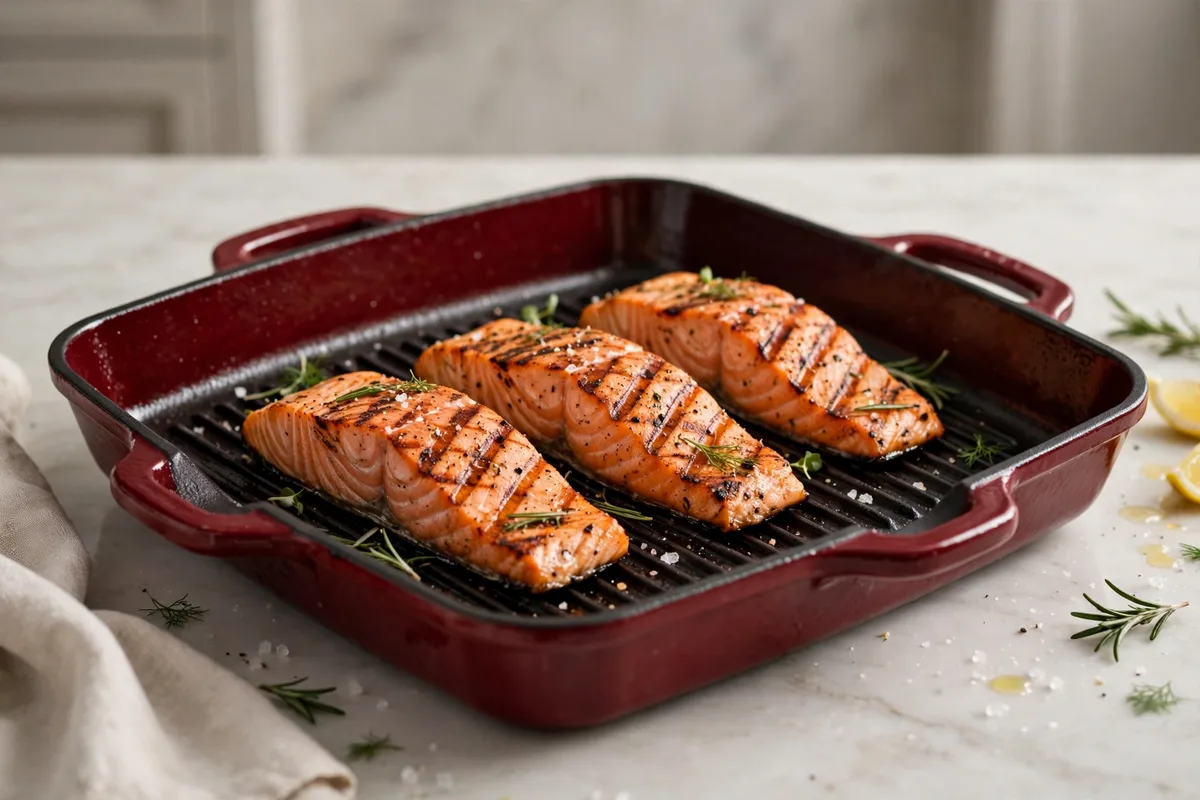
Le Creuset’s Signature skillet grill takes the Lodge formula and removes its one chore: the black satin enamel interior needs no seasoning, tolerates soaking, and releases residue more easily than raw iron, while the cast-iron body still delivers the hard-preheat sear that makes marks. The 10.25-inch square format, high ridges and dual pour spouts mirror the classic layout, and the enamel exterior comes in the brand’s colour range for kitchens where the pan lives on the stove as furniture.
The black enamel is the working surface to know: unlike the sand-coloured interior of the Dutch ovens, it is formulated for higher-heat searing and develops a patina over time that improves release. It is not nonstick and should not be overheated empty for long stretches — enamel’s one real rule — but within sane use it shrugs off metal tools and dishwashers (hand washing is kinder to the finish). Le Creuset’s Canadian retail and warranty presence is long-established.
This is the grill pan for the household that tried raw cast iron, loved the results, and quietly stopped using it over the drying ritual. The price is French and unapologetic; the counter-argument is a pan that gets used weekly for twenty years instead of monthly for two. Cost per use settles the argument in the enamel’s favour for exactly the cooks this pick names.
The Le Creuset’s enamel records its history honestly — the black interior lightens in the traffic lanes and darkens at the edges over the years — and owners read it the way chefs read a seasoned pan: as a map of meals, not damage. It never needs, and never gets, refinishing.
Yay · Pros
- Black satin enamel — no seasoning, easy care
- Cast-iron heat for real marks
- Colour range; established Canadian warranty
Hmm · Cons
- Premium price
- Enamel can chip if banged or overheated dry
- Heavy, like all iron
Best for: The cook who wants cast-iron results with wipe-clean care Skip if: Your budget says Lodge — the cooking physics are cousins
3. Staub Cast Iron Grill Pan — Best design pick
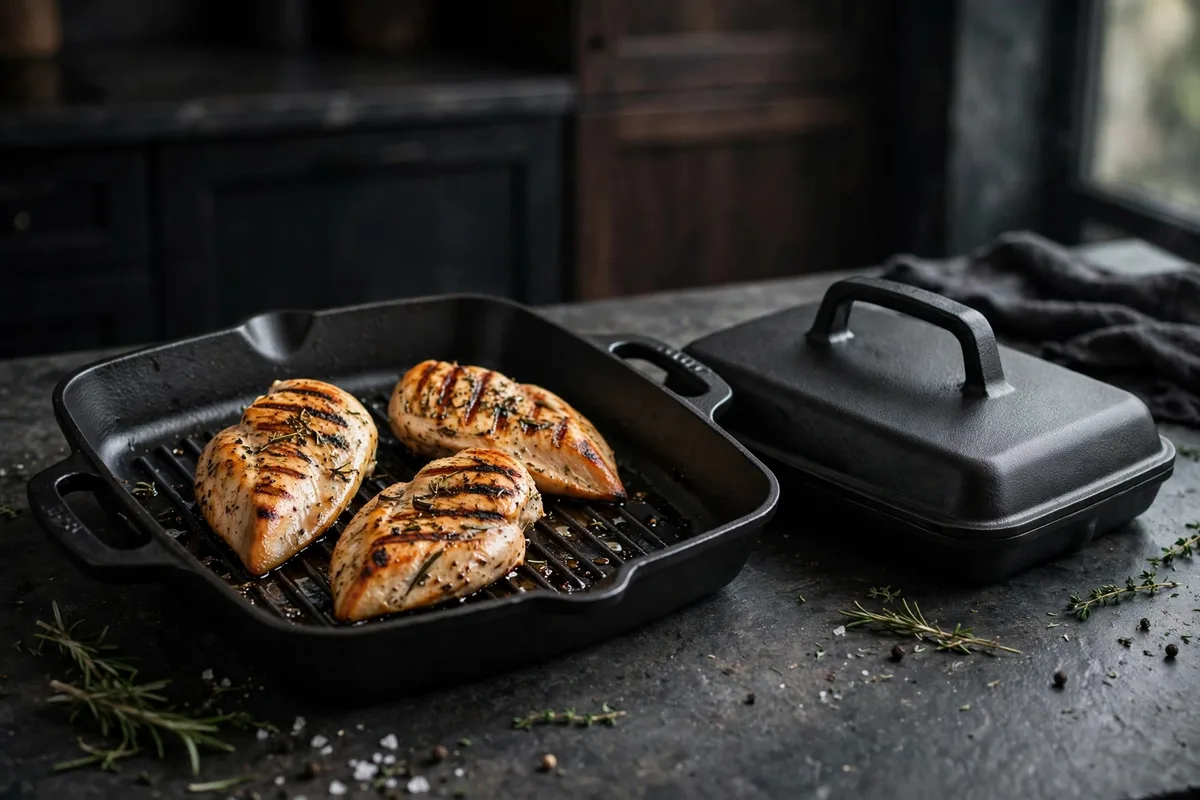
Staub’s grill pan is the aesthete’s cast iron: enamelled inside and out, with a matte black interior whose slightly textured surface browns eagerly and a form factor — the fold-away handle on the larger press-ready model, the sculptural lines on the square pan — that treats the stove as a display surface. The ridges are tall and purposeful, the twin spouts drain cleanly, and Staub’s enamel is formulated to brown rather than merely heat, which owners notice in the depth of the marks.
In use it behaves like the French heavyweight it is: slow, even heating, strong heat retention, and a surface that improves with a developing patina. Staub sells a matching grill press sized to the pan — the accessory this guide recommends most in the category — and the combination produces the closest thing to a bistro steak presentation achievable on a home burner. Zwilling’s Canadian channels carry the line with proper warranty support.
Choose Staub over its French rival on handle feel, interior texture preference, or looks; the cooking difference is small and the price band is the same. What you are buying is enamelled convenience plus design confidence — a pan that hosts dinner parties from the stove and never gets put away, because putting it away would hide it.
Staub’s press, bought months later by many owners, routinely gets described as the purchase that completed the pan: chicken breasts emerge evenly cooked with marks on both faces, and the sandwich output reaches cafe standard. Budget for it as phase two of the same decision.
Yay · Pros
- Matte enamel browns eagerly; no seasoning
- Matching grill press available
- Zwilling Canada distribution and support
Hmm · Cons
- Premium pricing, like its French rival
- Deep ridges hold residue — brush required
- Heavy with a full load
Best for: Design-led kitchens that cook seriously and entertain visibly Skip if: You want the lightest or cheapest route to grill marks
4. Calphalon Nonstick Grill Pan — Best nonstick (gentle use)
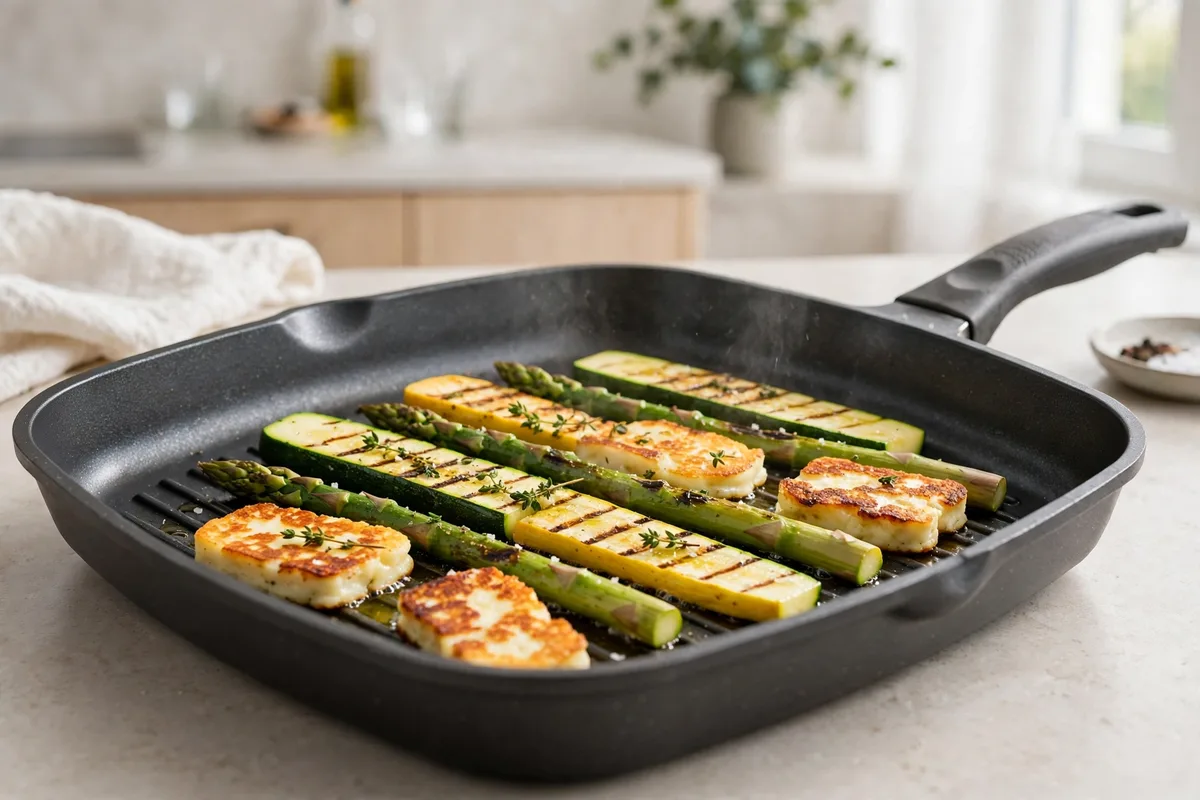
Honesty first: a nonstick grill pan cannot do the cast-iron trick, because its coating’s temperature ceiling (keep it at medium, per Calphalon’s guidance) sits below the hard-preheat zone where bold marks form. What it can do — and what this pick is for — is the gentle half of grill-pan cooking: asparagus, zucchini planks, fish fillets, halloumi, sandwiches and quesadillas, with ridges that drain and stripe lightly, on a pan that rinses clean in ten seconds and asks for no seasoning, drying or upper-body strength.
Calphalon’s hard-anodized body heats evenly for aluminium, the ridges are tall enough to matter for drainage, and the nonstick surface is metal-utensil tolerant within reason and rated for moderate oven use per the maker’s specifications. For the condo cook whose grill-pan ambitions are vegetables and panini rather than ribeyes, this is not a compromise — it is the correct tool, lighter and simpler than iron in every dimension.
The ownership term is the coating’s finite life: expect years, not decades, and retire the pan when the surface dulls and food starts to grip. Priced as a mid-life appliance rather than an heirloom, that maths is fair. Buy it with eyes open about the heat ceiling and it will be exactly as good as this section promises — no more, and importantly, no less.
The Calphalon’s quiet virtue is storage: it is the only grill pan here that hangs on a hook without a thought for the hook’s feelings, and in small kitchens that lightness decides whether the pan is used weekly or stored into oblivion. Tools that are easy to reach are tools that get used.
Yay · Pros
- Featherweight; ten-second cleanup
- Perfect for vegetables, fish, sandwiches
- Hard-anodized body heats evenly
Hmm · Cons
- Not a hard-sear tool — medium heat only
- Coating has a finite life
- Marks are lighter than cast iron’s
Best for: Vegetables, fish and sandwiches — gentle grilling without the iron ritual Skip if: You want steakhouse marks — that requires cast iron heat
5. Lodge Double Burner Reversible Grill/Griddle — Best for crowds
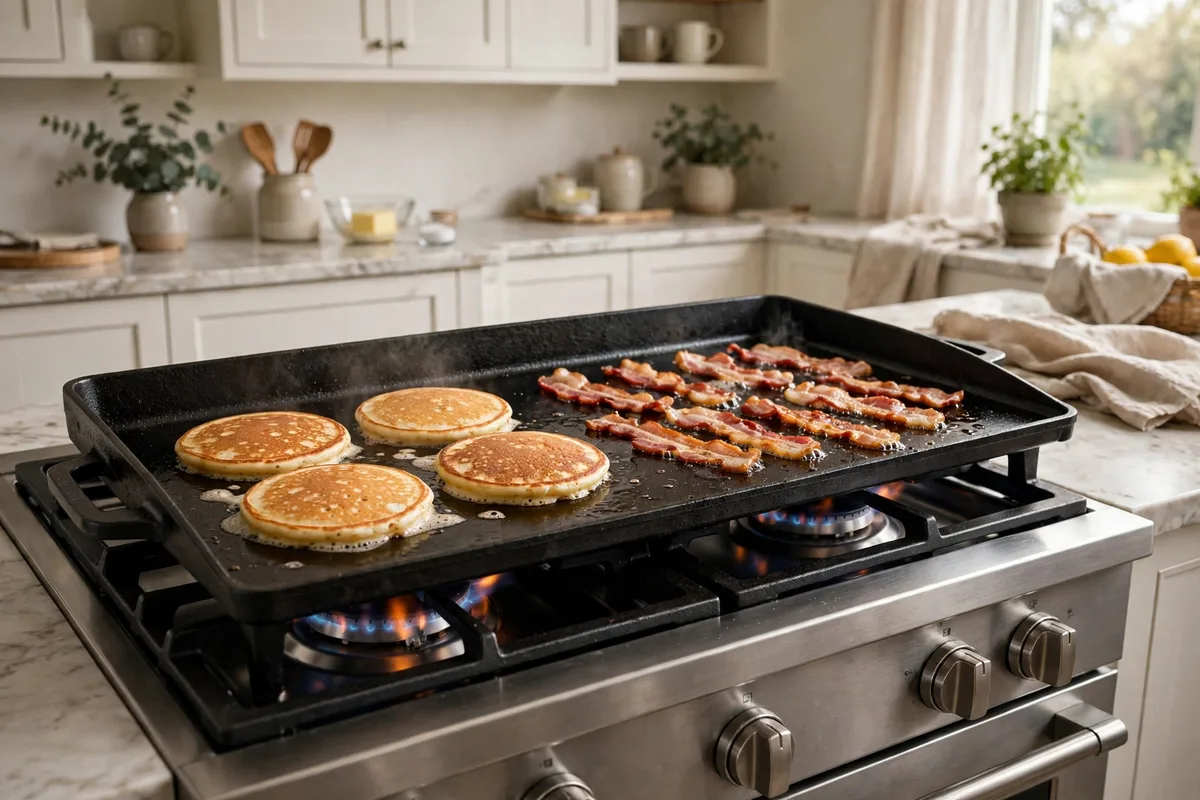
The reversible double-burner format is the grill pan scaled to a crowd: twenty inches of cast iron spanning two burners, grill ridges on one face and a flat griddle on the reverse — pancakes and bacon on Saturday morning, a flank steak and a row of peppers on Saturday night. Lodge’s version is pre-seasoned, made in Tennessee, and priced with the brand’s usual disregard for what the market would bear. The cooking area dwarfs any single pan in this guide; six burgers or four large steaks fit with elbow room.
The format’s physics need stating: two burners rarely match, so the iron’s mass does the diplomacy — a long, patient preheat (ten minutes at medium) evens the surface, and rotating the food once compensates for any remaining gradient. On glass-top stoves, check your manufacturer’s guidance on spanning burners; on gas and induction-bridge hobs it is in its element. The flat side quietly becomes the household’s most-used surface — grilled cheese for four, at once, is a domestic superpower.
Storage is the honest cost: this is a twenty-inch plank of iron that wants a home in the oven or a deep drawer, and its weight makes it a deliberate tool rather than a spontaneous one. For the household that cooks for six or preps for the week, that deliberateness is the point — it turns a production session into a single surface. Nothing else at this price feeds a crowd from a stovetop.
The double-burner’s flat side has a winter following of its own: it is a credible crepe and tortilla surface at scale, and more than one owner reports the griddle side outworking the grill side three to one across a year — the reversible format quietly insuring the purchase either way.
Yay · Pros
- Huge two-burner surface; grill + griddle in one
- Feeds six without batches
- Lodge pricing; lifetime material
Hmm · Cons
- Needs two burners of similar size
- Storage: it is a plank of iron
- Uneven if your burners mismatch badly
Best for: Big families, brunch crowds and meal-prep Sundays Skip if: Your burners are wildly mismatched or storage is tight
What ridges really do: the honest physics of the grill pan
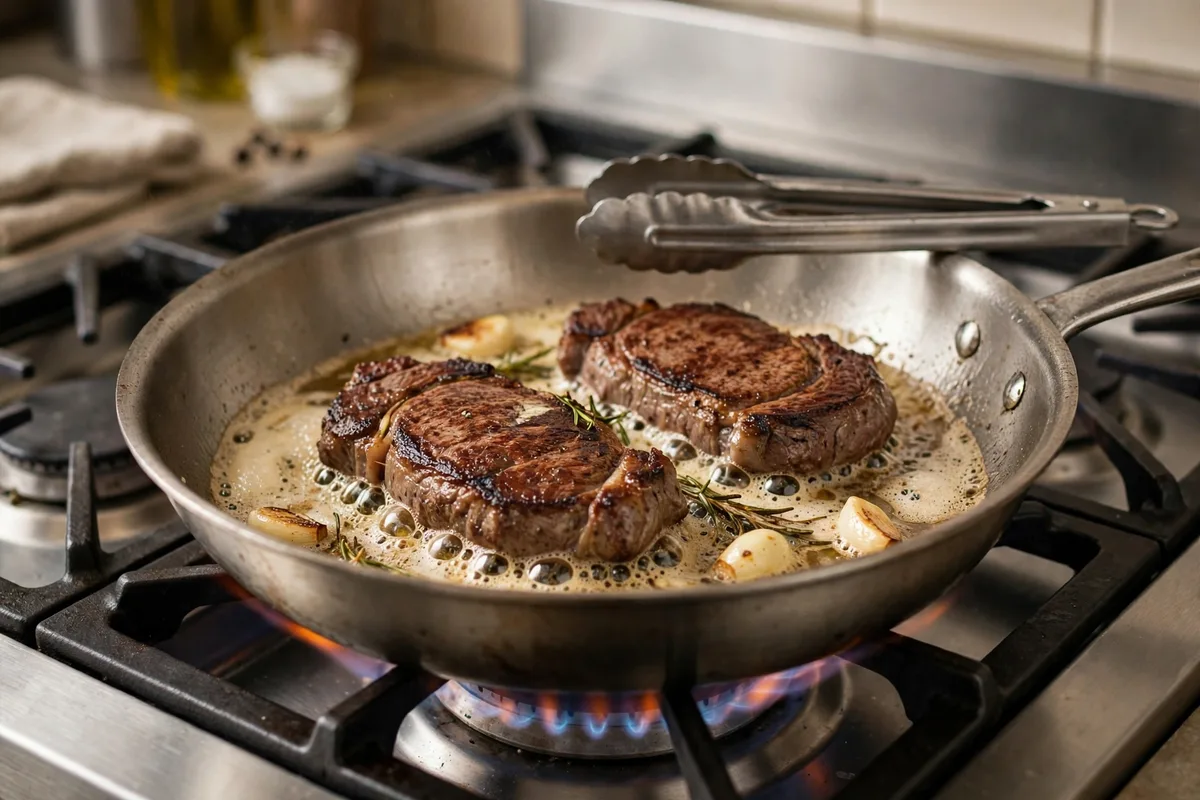
A grill pan browns only stripes, not the whole surface: its ridges cut the food’s contact with hot metal roughly in half, so a flat skillet always wins when total crust is the goal. A grill pan’s ridges do three things, only one of which is the photograph. They lift food off the pan floor, so rendered fat drains away from the cooking surface instead of pooling around the meat — the difference between frying in fat and cooking above it. They reduce contact to lines, which is why the marks form: the ridge tops reach searing temperature while the valleys steam gently, creating the striped contrast. And they cut total contact area roughly in half, which is why a grill pan sears less completely than a flat skillet — the deep truth of the category. A flat pan browns 100 percent of the surface; a grill pan browns stripes and leaves the rest pale and steamed.
That is not a dismissal — it is a targeting tool. For a thick steak or chicken breast where the interior doneness matters more than total crust, and where the presentation of marks carries the plate, the grill pan earns its keep. For thin cuts, smash burgers, or anything where maximum crust is the goal, the flat skillet wins outright and this guide says so in print. Buy the grill pan for what it is genuinely good at, and it will be used weekly; buy it as a skillet replacement and it will be donated within a year.
Smoke is the second honest topic. Ridged pans run hot and fats vaporize; a grill pan session without the range hood on high is a smoke-alarm rehearsal, especially with fatty cuts. Cast iron’s tolerance for a hard preheat makes it the confident choice for the high-heat work; nonstick’s temperature ceiling means its grill pan is a medium-heat tool for vegetables and fish, full stop. Match the material to the heat your cooking actually uses, not the heat the marketing photograph implies.
The grill press is the accessory that changes the maths: a heavy press flattens contact across the ridges, evens out the cooking of chicken breasts and sandwiches, and produces a second set of marks on the top side. Several makers sell matching presses; a foil-wrapped brick has served generations equally well. If your grill pan’s first month feels underwhelming, the press — and a longer, hotter preheat — is usually the fix, in that order.
Cleaning deserves the last word because it decides whether the pan survives in rotation. Ridges trap residue precisely where brushes fit worst; the technique that works is water into the hot pan (deglazing the ridges like a sauce), a stiff brush along the ridge direction, and immediate drying for raw iron. Enamel skips the rust vigilance; nonstick skips the scrubbing but caps the heat. None of this is hard — it is simply a pan with one extra ritual, and households that accept the ritual keep their grill pans for decades.
A final practical number: a cast iron grill pan needs roughly five minutes of preheat at medium-high to mark properly, and most disappointing grill-pan results trace to food landing at minute two. Set a timer for the pan the way you would for the oven — the discipline is unglamorous, and it is the difference between the photograph and the grey reality.
Grill pan questions, answered honestly
Does a grill pan really taste like outdoor grilling?
Stripes, yes — the ridge tops sear lines into the food exactly as a grill grate does. What you do not get is the grill’s smoke flavour, which comes from fat dripping onto open flame or coals, not from hot metal. A grill pan gives you the look and the fat drainage; for smoke flavour indoors, a pinch of smoked salt or a finishing brush of sauce comes closer than any pan.
Is cast iron better than nonstick for a grill pan?
For ridged pans, yes — cast iron’s mass holds the temperature that makes crisp marks when cold food lands, and it tolerates the hard preheat the job needs. Enamelled cast iron adds easier care. Nonstick grill pans are a different, gentler tool: fine for vegetables, fish and sandwiches at medium heat, but their coating’s temperature ceiling rules out the hard sear. Aluminium nonstick also cannot match iron’s ridge heat.
How do I clean between the ridges?
While the pan is still hot, pour in a cup of water — it will boil and lift the residue off the ridges (deglazing, exactly like making a sauce). Then scrub along the ridges with a stiff brush, dry on the burner, and oil raw cast iron lightly. Enamel can soak. The mistake is letting the pan cool with the residue on: cold, it sets like cement.
Do I need a grill press?
A press increases contact, cooks the top side, and flattens uneven cuts like chicken breasts so they cook evenly — it noticeably improves a grill pan’s results and adds top-side marks. A matching cast-iron press is ideal; a foil-wrapped brick or a heavy flat pan works nearly as well. It is the single most useful accessory in this category.
Can I use a grill pan on induction?
The pan, yes — cast iron and enamel grill pans are induction compatible and flat-bottomed. The caveat is output: small or weak induction zones may struggle to bring a heavy iron pan to hard-sear temperature, and the ridges need real heat to mark. On a strong induction hob it works beautifully; on a portable single burner, expect gentler results.
What if I mostly cook things that do not need grill marks?
Then buy a flat skillet instead — honestly. A grill pan is a specialist for marks, fat drainage and presentation on thick cuts. If your cooking is eggs, sauces, stir-fries and maximum-crust searing, our stainless and cast iron skillet guides will serve you better, and a grill pan can join later when the steak-and-photograph urge actually arrives.
The short version
Buy the Lodge cast iron grill pan unless you hate the drying ritual — then buy the Le Creuset or Staub enamel and never think about seasoning. Choose the Calphalon only for gentle work (vegetables, fish, sandwiches) and the Lodge double-burner plank when you cook for a crowd. And keep the flat skillet for maximum crust: a grill pan is for marks and drainage, and this guide would rather tell you that than sell you stripes.
Last updated: November 18, 2026. We refresh this guide each season and whenever a pick is replaced by a better one.