The best stainless steel skillet for most cooks is the All-Clad D3 12-inch: its tri-ply construction heats evenly to the rim, it is oven and broiler safe to 600°F, and its cooking floor measures about 9.5 inches across inside the 12-inch rim. Every other pan material on this site asks for a compromise you manage forever: cast iron wants seasoning, carbon steel wants more seasoning, and nonstick wants replacing. Stainless steel is the one skillet material that asks for a skill instead — ten minutes of preheat technique — and then simply never wears out. This guide is for the cook who is done babying coatings and wants the pan that sears a steak, builds a pan sauce from the fond, and goes in the dishwasher afterwards without a guilty thought.
The five picks below span the honest range: the American-made tri-ply benchmark, a 5-ply Italian upstart, the Belgian engineering flagship, and two tri-ply value pans that cook far above their price. Each was checked for clad construction (not a disc glued to the bottom), cooking-surface diameter rather than rim diameter, and Canadian availability — because a skillet recommendation that ends at the border is half a recommendation. If you are cross-shopping materials, our best cast iron skillets in Canada and the USA and best carbon steel pans in Canada and the USA guides cover the other two forever-pan families, and the best cookware sets in Canada and the USA guide suits anyone who would rather buy the whole kitchen at once.
Disclosure: CookSmartPicks is reader-supported. When you buy through links on this page, we may earn an Amazon commission at no extra cost to you. Prices and availability change often — check the current price on Amazon before you decide.
How we chose these stainless steel skillets
Construction came first, and it eliminated most of the market: a pick had to be fully clad — aluminium or copper core running up the sidewalls — rather than a disc-base pan, because disc bases scorch at the disc’s edge and leave the walls cold. We then compared cooking-surface diameter (the flat floor, where food actually sits) instead of the rim number on the box, handle comfort under a full pan’s weight, and oven and broiler limits from each maker’s own specifications.
Two more filters were Canada-shaped. Every pick is sold through ordinary Canadian retail or the maker’s Canadian storefront, with warranty handling that does not start with international shipping. And we weighted the pan’s behaviour with fond — the browned layer that becomes pan sauce — as heavily as raw searing, because deglazing is the job stainless does that no other material does as well, and a skillet that sears but cannot sauce is only half the tool.
The lineup at a glance
| Product | Best for | Why it stands out |
|---|---|---|
| All-Clad D3 Stainless 12-Inch Fry Pan | Best overall | The tri-ply benchmark: even heat, perfect fond, made in Pennsylvania |
| Made In Stainless Clad Frying Pan (12-Inch) | Best 5-ply alternative | Five layers, Italian-made, with a handle that stays cooler and a rolled rim |
| Demeyere Industry 5 Skillet (11-Inch) | Best engineered | Belgian 5-ply with Silvinox finish and welded handles — no rivets to scrub |
| Tramontina Tri-Ply Clad 12-Inch Fry Pan | Best value | Genuine tri-ply at a fraction of the benchmark’s price — the cook’s secret |
| Cuisinart MultiClad Pro 12-Inch Skillet | Best mid-price polish | Tri-ply with a drip-free rim and tapered edges, from a brand with Canadian service |
1. All-Clad D3 Stainless 12-Inch Fry Pan — Best overall
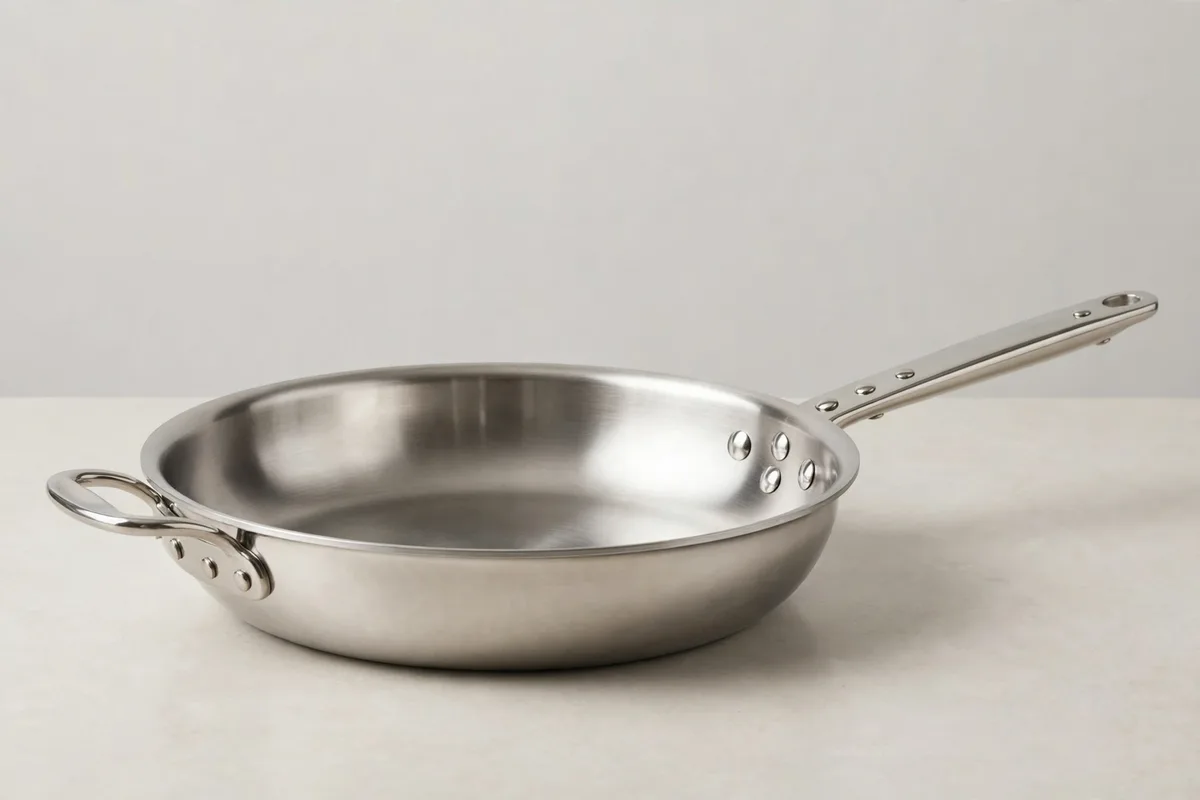
The D3 is the pan the category is measured against, and after decades that is still earned rather than inherited. Its tri-ply construction — 18/10 stainless around an aluminium core, bonded to a magnetic stainless exterior — heats evenly across the floor and up the walls, so a steak’s edge cooks like its centre and a sauce reduces uniformly instead of spotting. The cooking floor measures roughly 9.5 inches across inside the 12-inch rim, the honest number for judging how many chicken thighs fit without crowding.
What owners praise, year after year, is the fond: stainless grabs proteins just enough to build the deep brown layer that becomes a pan sauce with wine and butter, then releases cleanly once the crust forms. The pan is oven and broiler safe to 600°F per All-Clad, induction compatible, and dishwasher tolerant in the way only uncoated steel can be — though hand washing keeps the polished exterior prettier. It is made in Canonsburg, Pennsylvania, and carries a limited lifetime warranty.
Ownership is the D3’s closing argument: there is nothing to wear out. The surface that sticks in month one is the same surface in year twenty, rainbow heat-tints and protein ghosts polish away with a vinegar wipe or a scouring cleanser, and the riveted handle will outlast the stove under it. Buy it once, learn the preheat, and the skillet question is settled for a generation — which is exactly what the price is asking you to believe, and for once the belief is justified.
Ten years into ownership, D3 pans develop the honest patina of work — fine scratches, a softened polish — and owners consistently describe preferring them that way: the pan becomes kitchen equipment in the professional sense, maintained rather than displayed, and entirely unbothered by the decade.
Yay · Pros
- Fully clad tri-ply — even heat to the rim
- Superb fond and deglazing behaviour
- Oven/broiler safe to 600°F; induction ready
Hmm · Cons
- Premium price, especially in Canada
- Riveted handle traps residue around rivets
- Heavier than disc-base pans
Best for: The buy-it-for-life cook who makes pan sauces and wants the benchmark pan Skip if: You want food to release like nonstick from day one — stainless has a learning curve
2. Made In Stainless Clad Frying Pan (12-Inch) — Best 5-ply alternative
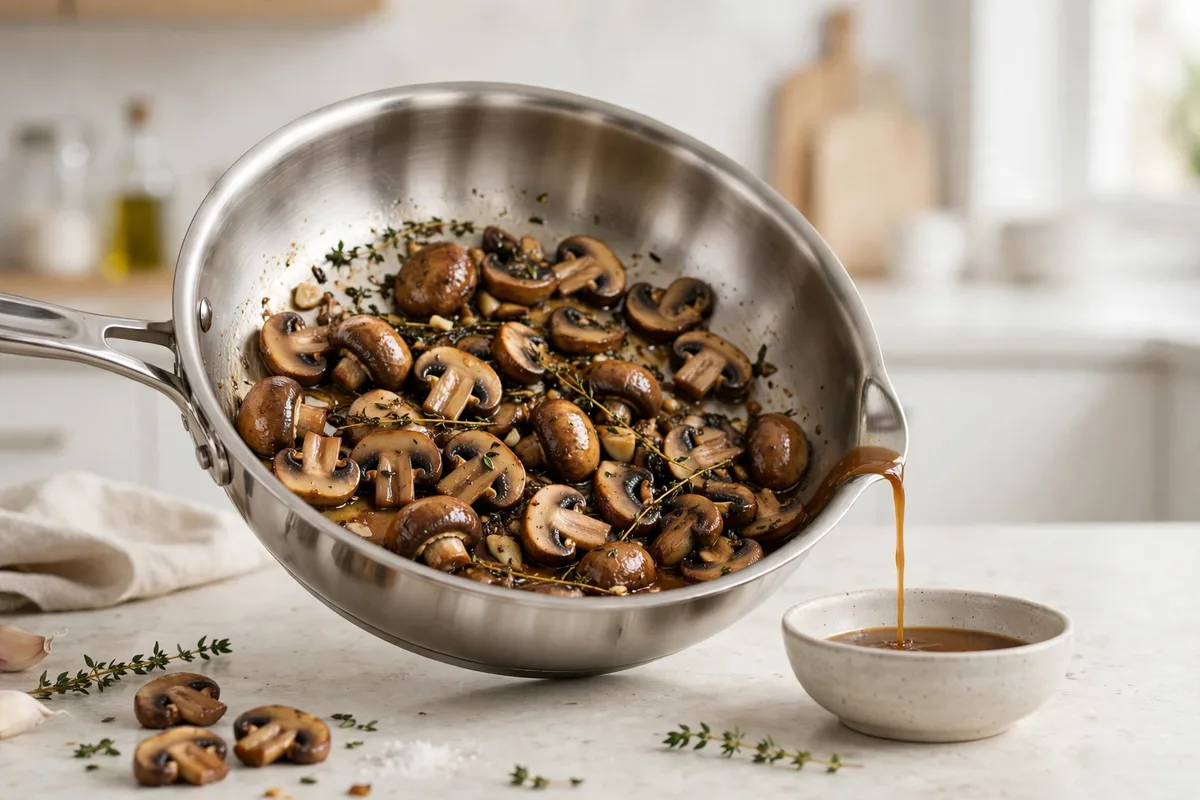
Made In’s Stainless Clad line is the direct challenge to the benchmark: five alternating layers of stainless and aluminium alloys, made in Italy, with heat response a shade quicker than tri-ply and a total thickness that resists warping on high-output burners. The 12-inch pan’s cooking floor is comparably generous, the walls flare for easy spatula work, and the rolled rim pours a sauce without the dribble down the pan’s side that plagues straight rims.
The handle deserves its own sentence: Made In’s hollow-core stay-cool design genuinely runs cooler on the stovetop than most rivals, and its shape fills the hand in a way that makes a full pan feel balanced rather than nose-heavy. The pan is rated to 800°F in the oven per the maker — the highest ceiling in this guide — and works on induction. Canadian buyers order through Made In’s Canadian storefront, which removes the cross-border warranty fog that used to haunt the brand here.
Where the D3 is the establishment, this is the connoisseur’s pick: a little more money than the value pans, a little less than some All-Clad street prices in Canada, and arguably the most refined details in the class. Owner reports consistently praise the evenness and the finish quality, and the pan’s searing manners match the benchmark’s — fond, release, sauce. If your hand prefers its handle in a showroom grip test, that preference is a legitimate reason to choose it.
Made In’s direct model has one ownership consequence worth knowing: the pan arrives by courier with generous trial terms in both countries, so the handle question — the most personal variable in the guide — can be settled in your own hand, on your own stove, before the purchase is final.
Yay · Pros
- 5-ply construction, made in Italy
- Stay-cool hollow handle; rolled pouring rim
- 800°F oven rating — highest here
Hmm · Cons
- Direct-to-consumer model — no local shelf to test
- Costs more than the value tri-ply picks
- Newer brand; shorter track record
Best for: The detail-driven cook who wants 5-ply refinement and a cooler handle Skip if: You prefer buying cookware in-store with a local return counter
3. Demeyere Industry 5 Skillet (11-Inch) — Best engineered
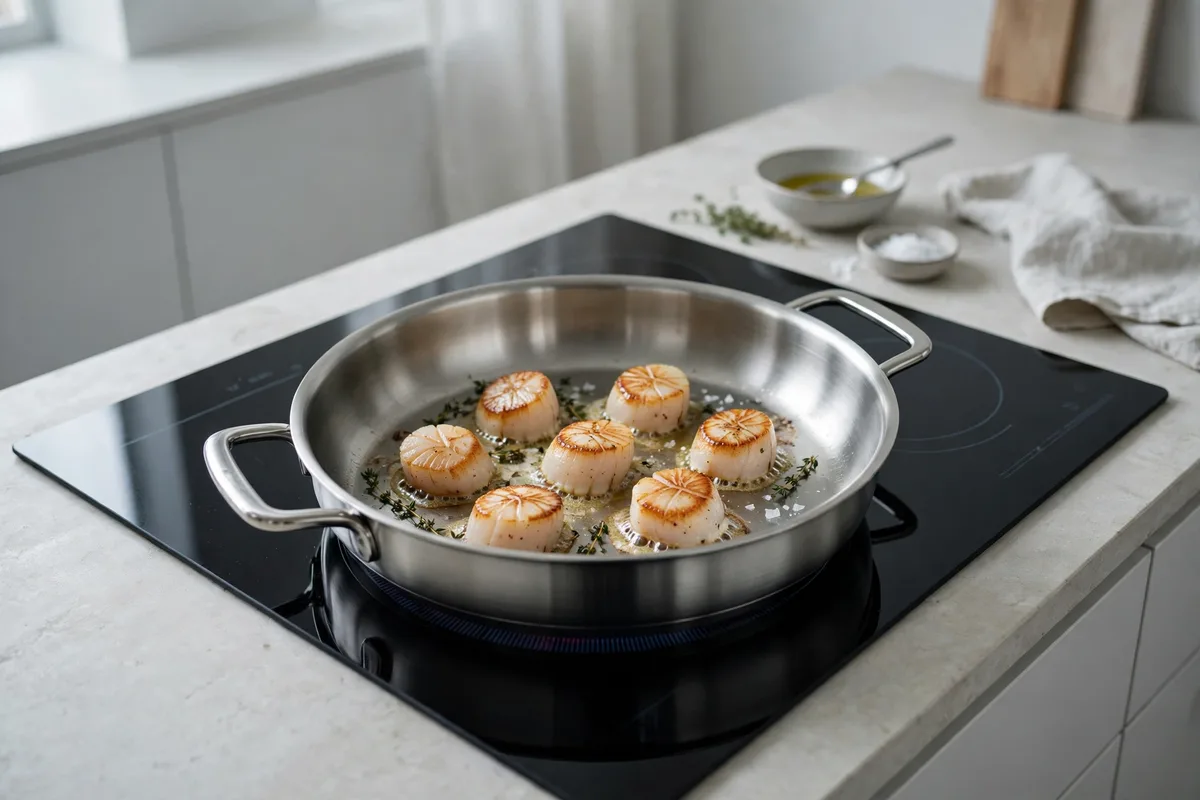
Demeyere is the engineer’s answer to clad cookware: the Industry 5 pairs a 5-ply body with the details nobody else bothers with. The handles are welded, not riveted, so the interior is a smooth, uninterrupted surface — no rivet heads to trap egg or sauce, and nothing to scrub around. The Silvinox surface treatment, a Demeyere signature, keeps the steel bright, resists the rainbow staining stainless is prone to, and makes cleanup measurably easier than untreated steel.
Performance matches the paperwork: the 5-ply build (with a thicker aluminium core than most) heats evenly and holds temperature when cold food lands, the flared rim pours cleanly, and the pan is induction-optimized — Demeyere’s TriplInduc base technology claims notably better induction efficiency, a claim independent reviewers have found plausible in faster boil times. The 11-inch size is the sweet spot for most households; a 9.5-inch sibling exists for smaller burners and smaller families.
The honest costs are price and presence: this is the most expensive pan in the guide, and Demeyere’s Canadian distribution runs through Zwilling’s channels, so street prices fluctuate. But for the cook who reads spec sheets for pleasure and intends to hand the pan down, the welded, treated, overbuilt Demeyere is the end of the search — the skillet equivalent of buying the industrial version.
Demeyere’s welded interior has a quiet second benefit: nothing loosens. Riveted handles on any brand can develop a faint play after a decade of thermal cycling; the weld simply has no mechanism for it, which is part of what the flagship premium is actually purchasing.
Yay · Pros
- Welded handles — smooth, rivet-free interior
- Silvinox finish resists stains, eases cleanup
- Thick 5-ply core; induction-optimized base
Hmm · Cons
- Highest price in this guide
- Heaviest feel of the five
- Canadian pricing varies by retailer
Best for: The engineering-minded cook who hates rivets and wants the flagship build Skip if: Budget matters more than the last 10 percent of refinement
4. Tramontina Tri-Ply Clad 12-Inch Fry Pan — Best value
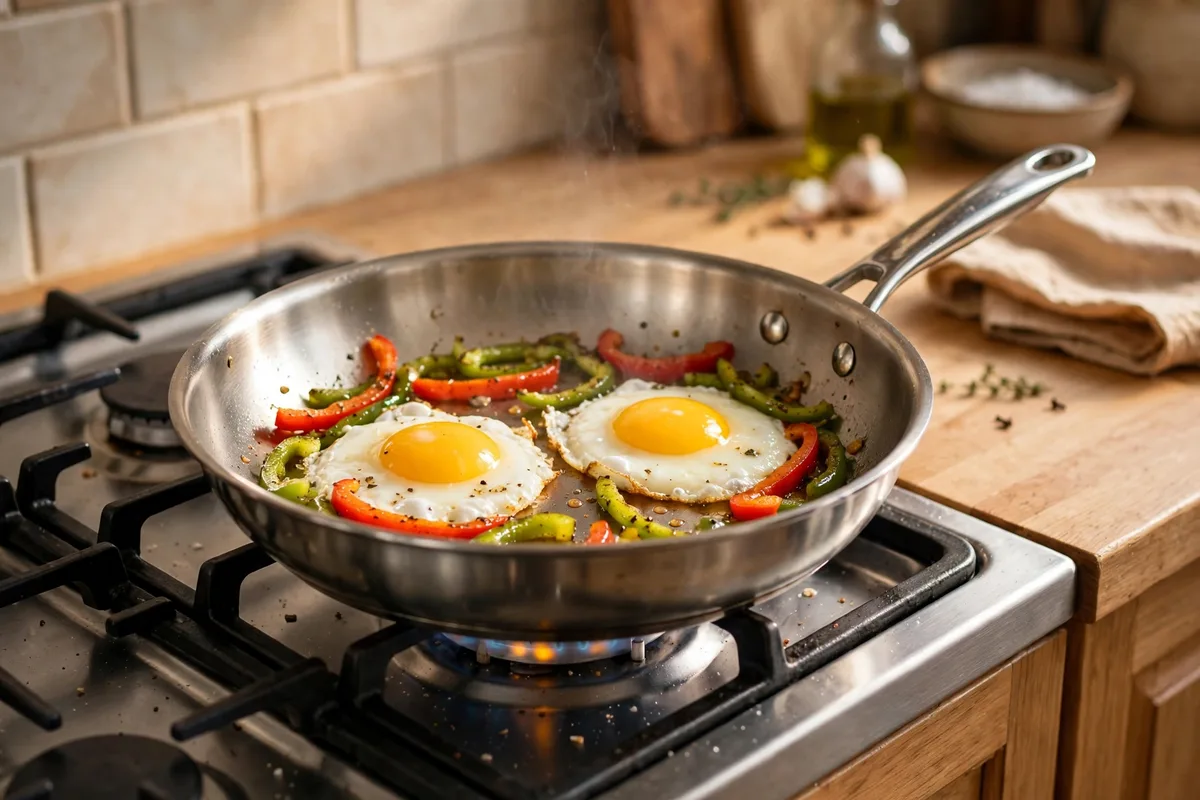
The Tramontina Tri-Ply Clad line is the worst-kept secret in cookware: genuine fully-clad construction — 18/10 stainless, aluminium core, magnetic exterior — at a price that routinely undercuts the benchmark by half or more, which is why test kitchens and value-focused reviewers have recommended it for years. The 12-inch fry pan sears, builds fond and deglazes with the same manners as pans costing three times as much, because the physics of clad steel does not check the logo.
Differences live in the finishing details: the handle is a simpler shape that some hands find less sculpted, the polish is a notch less mirror-like, and the pan is made in Brazil and China depending on the production run, per the brand’s own listings. It is oven safe to 500°F, induction compatible, and sold widely in Canada through mainstream retail — which also means sales are frequent and the street price is often lower than the list suggests.
For a first stainless skillet, or a second pan for the cottage, this is where the smart money starts: the performance gap to the flagship pans is real but small, while the price gap is enormous. Owner reports run to years of daily service without warping or delamination. Spend the savings on a better knife, and dinner will not know the difference.
Tramontina owners’ most common report is disbelief, sustained: the pan keeps performing like the expensive one it sits beside in many kitchens. Its second most common report is buying the second size — the surest sign a value pick has crossed into a household standard.
Yay · Pros
- True tri-ply clad at a value price
- Sears and deglazes like pans triple the price
- Widely available in Canada; frequent sales
Hmm · Cons
- Handle and finish a notch below the flagships
- Oven rating (500°F) lower than the leaders
- Origin varies by production run
Best for: The value hunter who wants real clad performance without the flagship tax Skip if: You want the heirloom finish and lifetime-brand experience
5. Cuisinart MultiClad Pro 12-Inch Skillet — Best mid-price polish
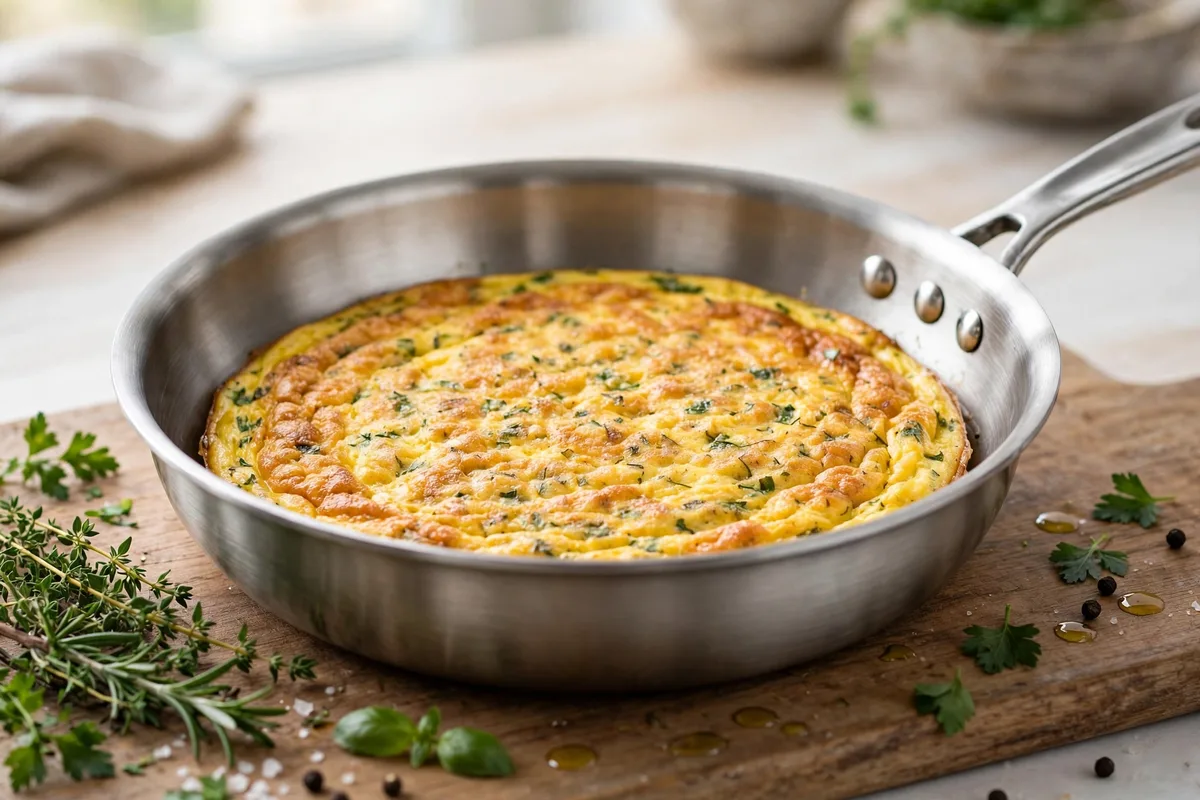
MultiClad Pro is Cuisinart’s long-running clad line, and the 12-inch skillet shows the brand’s kitchenware polish: tri-ply construction with an aluminium core, a tapered drip-free rim that genuinely pours without sheeting down the outside, and a brushed exterior that hides the scratches a polished finish advertises. The cooking surface is 18/10 stainless, the pan is induction compatible, and Cuisinart rates it oven safe to 500°F with broiler use included in the line’s documentation.
On the stove it behaves like proper clad: even heating, confident fond, clean release once the crust sets. The handle’s cool-grip design stays manageable on gas, and the helper handle earns its place when the pan is loaded with a frittata heading for the oven. Cuisinart’s Canadian presence matters here — warranty service and replacement parts run through established domestic channels rather than a cross-border email thread.
Positioned between the Tramontina’s minimalism and the flagships’ refinement, the MultiClad Pro is the pick for the buyer who wants the name-brand safety net and the finishing touches — the rim, the brush, the service network — without paying the Pennsylvania or Belgian premium. It has been in production for years with a consistent owner record, which in cookware is its own specification.
The MultiClad Pro’s brushed exterior ages the most gracefully in this guide: where polished pans record every year as scratches on a mirror, the brush pattern absorbs them into its texture, so a five-year-old Cuisinart reads as seasoned rather than worn.
Yay · Pros
- Tri-ply with a genuinely drip-free rim
- Brushed finish hides wear gracefully
- Established Canadian service network
Hmm · Cons
- Oven ceiling (500°F) below the leaders
- Slightly thinner feel than flagship pans
- Riveted handle, like most of the class
Best for: The brand-comfort buyer who wants clad manners plus a service safety net Skip if: You broil at maximum heat often and want a 600°F+ rating
The preheat is the product: how stainless actually works
Stainless steel releases food cleanly when the dry pan is preheated until water droplets bead and dance — the Leidenfrost point — and the oil goes in only after that preheat. Every stainless complaint — the sticking eggs, the welded-on chicken — traces to one skipped step. Stainless is microscopically porous, and cold steel grabs protein; heated steel expands, smooths, and, past the right temperature, creates the vapour cushion cooks call the Leidenfrost effect. The water-bead test is the calibration: flick water into the dry pan — droplets that skitter and dance as beads mean the pan is ready for oil; water that sizzles flat means wait. Oil goes in after the preheat, food seconds later, and the same chicken that glued itself to a cold pan releases on its own once the crust forms. Two minutes of patience is the entire learning curve, and it is why owners describe stainless as ‘nonstick that you operate yourself.’
Eggs deserve the honest footnote: stainless can fry an egg cleanly at a lower, butter-mediated temperature, but it will never be the effortless slide of a fresh coating, and scrambled eggs in stainless are a soaking commitment. Most stainless households keep one small nonstick or carbon steel pan for eggs and use the skillet for the 90 percent of cooking — searing, sautéing, saucing — where it is strictly better than the alternatives. That division of labour is not a failure of the material; it is the correct fleet design for a kitchen.
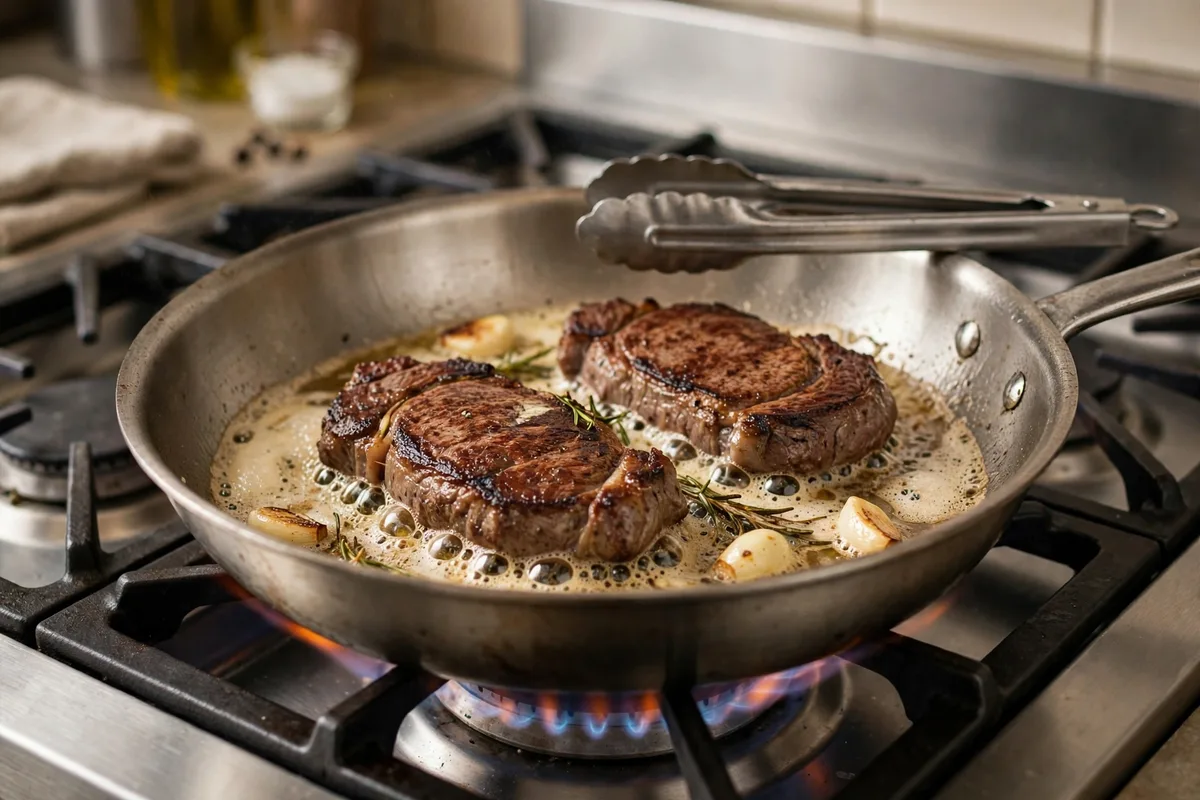
Fond is the other half of the argument. The browned residue after searing is concentrated flavour that a nonstick pan literally cannot produce (its surface prevents the bond) and that becomes a restaurant pan sauce with a splash of wine, stock or even water, scraped up as it simmers. Stainless is the only common material that builds fond, tolerates the deglazing liquid, and then goes under a broiler or into a dishwasher. Once that sauce habit forms, cooks rarely go back — the skillet stops being a frying pan and becomes the kitchen’s flavour engine.
Care is refreshingly unceremonious: dishwashers are allowed (hand washing keeps it prettier), baked-on residue yields to a simmer of water and baking soda, rainbow heat tints are harmless oxidation that vinegar erases, and a scouring cleanser restores the factory matte when you care. There is no seasoning to maintain, no coating to protect from metal tools, and no thermal-shock anxiety beyond the ordinary. The pan’s second decade is indistinguishable from its first, which cannot be said of anything else on the stove.
Sizing honesty closes the guide: a ‘12-inch’ skillet offers about 9.5 inches of flat floor, and crowding that floor with four cold chicken breasts drops the temperature into steaming territory — grey meat, no fond. Cook in two batches or size up; the material rewards space. That, plus the preheat, is the whole technique. Everything else about stainless — the sear, the sauce, the permanence — is the reward for those two habits.
One measurement separates the clad classes in daily use: recovery time. When a cold steak lands, a thick-clad pan’s floor temperature dips and recovers within seconds, while a thin disc-base pan stays depressed long enough to steam the meat’s underside — the grey band under the crust that home cooks blame on the stove. It is the single most tasted difference between the tiers in this guide, and it is why the flagship pans feel ‘faster’ despite identical burner settings.
Stainless steel skillet questions, answered
Why does food stick to my stainless steel skillet?
Because the pan was too cold or the food was moved too early. Preheat the dry pan until water droplets bead and dance, add oil, then food — and leave it alone. Protein bonds temporarily, then releases itself once the crust forms and moisture stops gluing it down. Lifting early tears the crust and reads as sticking; patience is the nonstick coating stainless uses.
Can stainless steel skillets go in the dishwasher?
Yes — uncoated clad stainless is one of the few premium cookware materials that genuinely tolerates dishwashers, and manufacturers including All-Clad say so. The caveats are cosmetic: detergents can dull the polished exterior over years, and aluminium-core edges prefer gentler handling. Many owners hand-wash to keep the finish; nobody has to.
Is tri-ply worth it over a disc-bottom pan?
For a skillet, yes. A disc base heats the floor only, leaving the sidewalls cold — sauces reduce unevenly and food at the edges steams. Full cladding carries the core up the walls, so the whole pan works. Disc bases are fine for stockpots; skillets, whose walls do real cooking, are where cladding earns its price.
What size stainless skillet should I buy first?
The 12-inch (about 9.5 inches of flat cooking floor) is the household standard: room for three to four chicken breasts or two large steaks without crowding. Smaller households that cook one or two portions often prefer a 10-inch for its lighter handling. Buy the size your burner can heat evenly — an oversized pan on a small burner sears in the middle only.
How do I remove rainbow stains and stuck-on residue?
Rainbow tints are harmless heat oxidation: a wipe of white vinegar removes them instantly. For stuck residue, simmer water with a spoon of baking soda in the pan for a few minutes, then wash normally; a paste of a scouring cleanser like Bar Keepers Friend restores the finish on stubborn spots. Nothing on a stainless pan is permanent except scratches you will stop noticing.
Can I use metal utensils and high heat?
Yes to both, within sense: metal tools scratch cosmetically but cannot damage a coating that does not exist, and clad stainless tolerates the highest stovetop heat — though sustained empty preheating on maximum can warp any pan and discolour steel. The oven and broiler ceilings in each pick’s section are the maker’s ratings; respect those rather than the stovetop’s enthusiasm.
The short version
Buy the All-Clad D3 12-inch if the budget allows one pan for decades; take the Made In for 5-ply refinement or the Demeyere for rivet-free engineering. On a budget, the Tramontina Tri-Ply Clad delivers most of the performance for a fraction of the price, and the Cuisinart MultiClad Pro adds brand polish and Canadian service. Whichever arrives, learn the water-bead preheat — with stainless, technique is the coating.
Last updated: November 18, 2026. We refresh this guide each season and whenever a pick is replaced by a better one.