For roughly half the year in most of Canada — and a good stretch of it in the northern USA — the outdoor clothesline is a decoration. Lines freeze, daylight shrinks, and a load hung outside in January comes back stiffer than it left. That leaves the tumble dryer, one of the hungriest appliances in the house: hard on electricity bills and harder on the clothes themselves, because heat and tumbling fade colours, shrink cotton and quietly shorten the life of delicates. The best clothes drying rack is the low-technology answer households rediscover every winter — a frame, some rails, moving air, and a full load dried for free. The five racks in this guide cover the shapes that actually work in apartments and laundry rooms: the big gullwing, the stainless A-frame, the budget accordion, the two-tier organiser and a wide-span frame built for bedding.
Choosing between them is less about drying — they all dry — than about the three frictions that make owners abandon a rack: not enough rail space for a real load, rust or peeling rods that mark clean clothes, and a folded shape that still hogs the closet it was meant to disappear into. Every pick below is judged on those frictions first, using manufacturer specifications for capacity, drying length, folded size and materials, weighed against long-term owner reports from buyers in Canada and the USA. One partner purchase deserves a mention up front: indoor drying adds real moisture to a home’s air, and households that dry load after load through a closed-window winter often pair their rack with one of the picks in our guide to the best dehumidifiers for Canada and the USA — explained in the deep-dive below.
Disclosure: CookSmartPicks is reader-supported. When you buy through links on this page, we may earn an Amazon commission at no extra cost to you. Prices and availability change often — check the current price on Amazon before you decide.
How we chose these drying racks
CookSmartPicks is a research-based guide. We do not run a test lab, and we never claim hands-on testing we have not done. For this list we compared manufacturer specifications — rated capacity, total drying length or rod count, folded dimensions, frame and rod materials — with current expert roundups and with owner reports from verified buyers who have lived with these racks through months of real loads, especially the complaints that only appear late: sagging wings, chipped coatings and stiff joints. Brand-stated capacities are labelled as brand claims wherever they appear; owner-proven behaviour over seasons of laundry is described as such, and the two are never blurred.
The lineup at a glance
| Product | Best for | Drying space | Why it stands out |
|---|---|---|---|
| Honey-Can-Do Heavy-Duty Gullwing Drying Rack | Best overall | ~46 linear ft (brand figure) | The category’s workhorse, with a mesh sweater shelf and a ~50 lb brand-rated capacity |
| Cresnel Stainless Steel Foldable Drying Rack | Best rust-proof build | ~21 rods | Stainless frame and rods — no coating to chip, no rust to mark clothes |
| Amazon Basics Foldable Drying Rack | Best budget classic | Accordion rails, one standard load | The flat-folding staple for apartments and dorms, rated to ~32 lb per the listing |
| Songmics 2-Tier Foldable Drying Rack | Best tiered design | 2 tiers plus adjustable wings | Double the rails in a single-tier footprint, with sock clips for smalls |
| JAUREE 79-Inch Retractable Drying Rack | Best for sheets & bedding | 79-inch max span (brand figure) | Three retractable rods that let sheets and comforters hang in one clean drop |
1. Honey-Can-Do Heavy-Duty Gullwing Drying Rack — Best overall
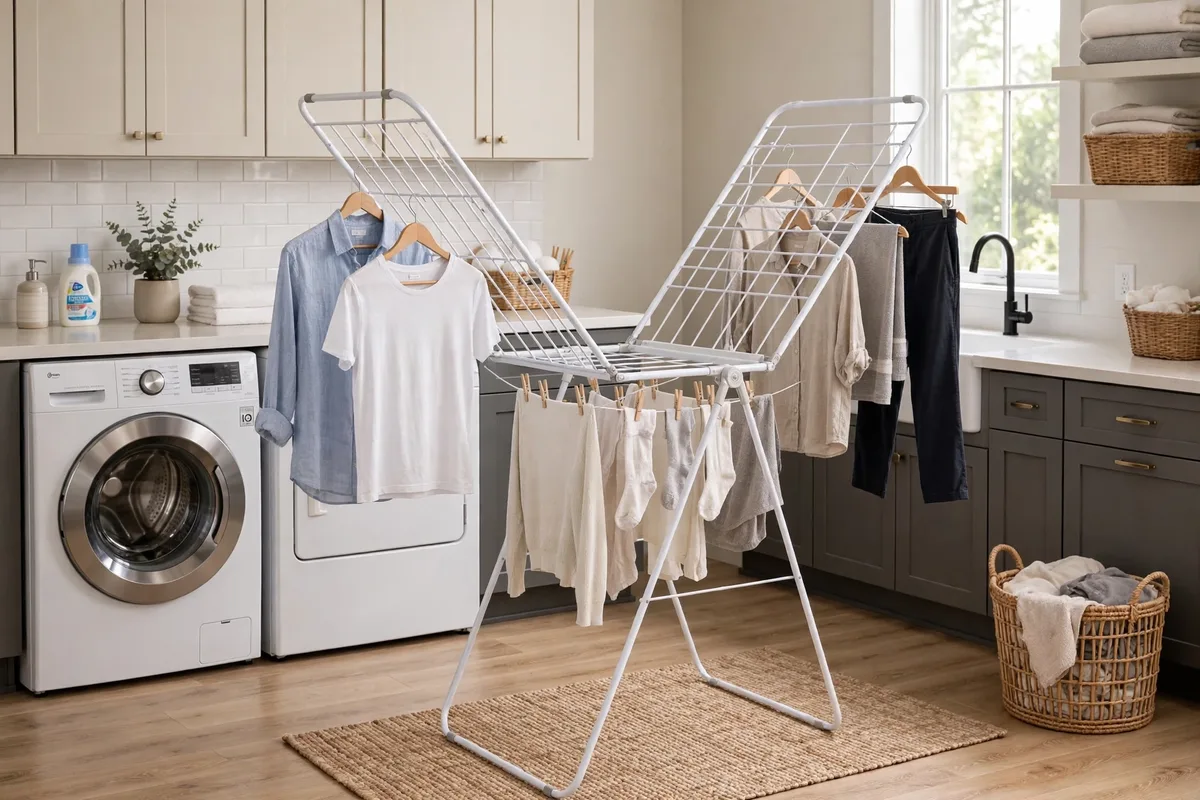
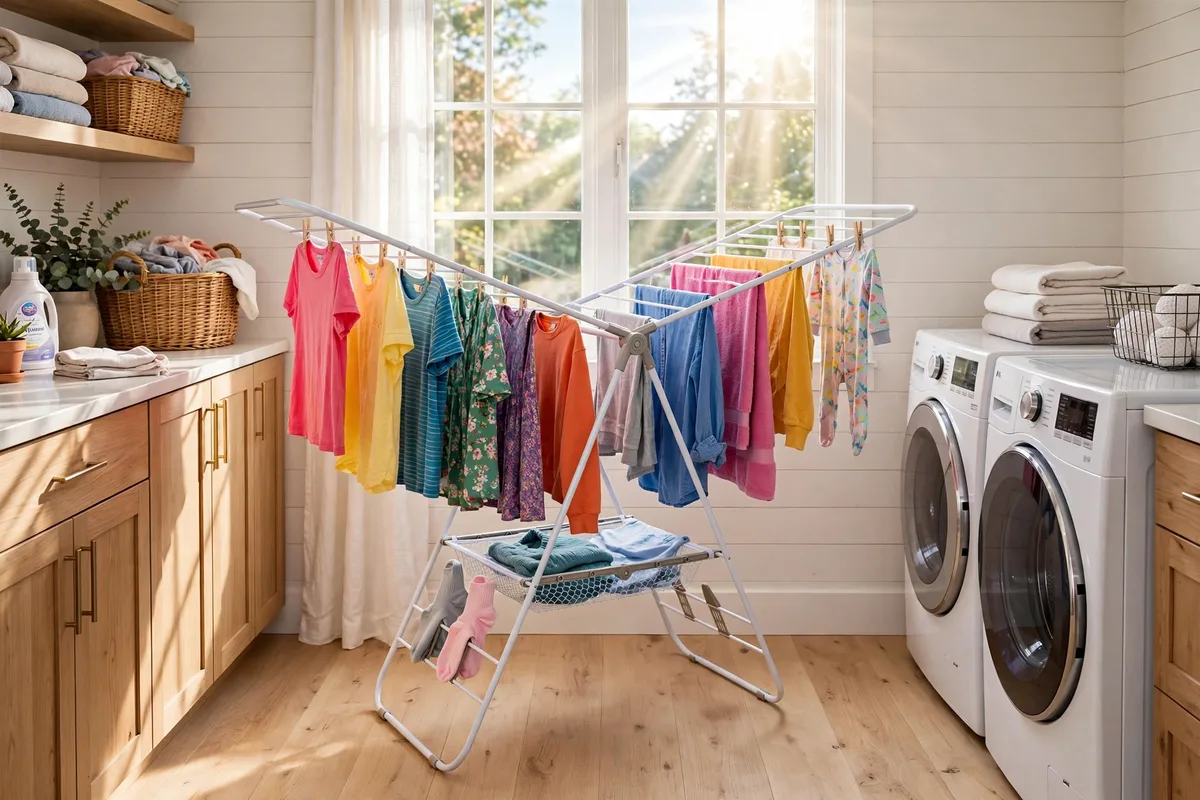
The Honey-Can-Do Heavy-Duty Gullwing is the rack the rest of this category is measured against — the pick Business Insider reviewers have repeatedly endorsed as the workhorse of indoor drying, and the shape most households picture when a rack has to swallow a full load. Two wings angle up from a flat centre section like a gull’s, which is where the roughly 46 linear feet of drying space (a brand figure) comes from: shirts and trousers ride the raised wings where air circulates best, the flat middle takes small items, and a mesh shelf across the centre cradles sweaters flat so knitwear dries without the shoulder horns hangers leave. Honey-Can-Do rates the frame at about 50 lb of capacity — again a brand figure — and the build is a class sturdier than light accordion racks.
The long-term owner note is equally consistent, and it is about the wings. After years of heavy loads, owners report the raised wings beginning to sag or sit at a slightly tired angle — the rack keeps working, but the crisp geometry softens. Treat it as a wear point rather than a defect: loaded within its rating and folded rather than dragged, the frame lasts. Folding is genuinely flat, so it slides behind a door, and sets up in seconds with nothing to assemble. For households replacing dryer loads several times a week, this is the default recommendation — the most drying space in a sane footprint.
Yay · Pros
- Roughly 46 linear feet of drying space plus a mesh sweater shelf (brand figures)
- About 50 lb brand-rated capacity — a full family load, denim included
- Folds flat, no assembly, sets up in seconds
Hmm · Cons
- Wings can sag after years of heavy loads, per long-term owners
- Large footprint when open — measure the laundry-room corner first
- Steel frame is coated, not stainless — wipe rods dry in very damp rooms
Best for: households drying full loads several times a week who want the proven default. Skip if: your only drying spot is a narrow bathroom — the Amazon Basics folds smaller and lives happier in tight quarters.
2. Cresnel Stainless Steel Foldable Drying Rack — Best rust-proof build
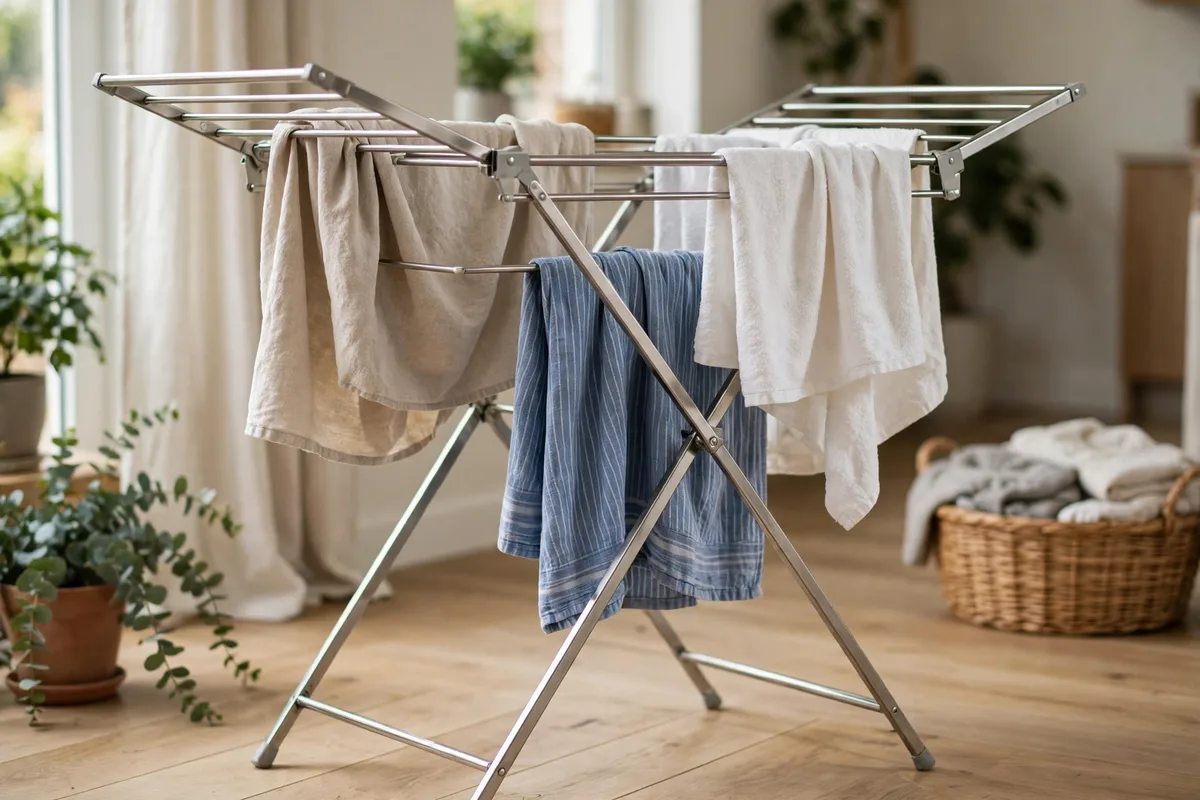
The Cresnel answers the complaint that eventually kills most coated racks: rust. Its frame and rods are stainless steel, so there is no epoxy or powder coating to chip and no bare steel underneath waiting to bloom orange and mark a white shirt. In a humid bathroom or a laundry room that never quite dries out, that material choice is the whole product. The design is a classic A-frame with around 21 rods across its tiers, and the top section doubles as a hanger rail for shirts on hangers — the fastest way to dry a work shirt without creases setting in.
The honest caveat, repeated across roundups and owner reports, lives at the joints: the connectors are plastic, and they are the part to treat kindly. Open and close the frame by its legs rather than wrenching the wings, and the rack should outlast several coated rivals; force them cold and stiff in a January basement and they are what will eventually complain. It folds to roughly 3 inches thick (a brand figure), flat enough for the gap beside a washing machine, The stainless build also wipes clean. For damp rooms and coastal air, this is the durable pick.
Yay · Pros
- Stainless frame and rods — no coating to chip, no rust to mark clothes
- Folds to about 3 inches, per the brand — beside-the-washer storage
- Around 21 rods plus a hanger-friendly top rail
Hmm · Cons
- Plastic joints are the weak point — open and close it gently
- Less total drying space than the big gullwing
- Stainless costs more than coated steel of the same size
Best for: bathrooms, damp laundry rooms and anyone burned by a rusted rack before. Skip if: you regularly dry very large loads — the Honey-Can-Do simply holds more.
3. Amazon Basics Foldable Drying Rack — Best budget classic
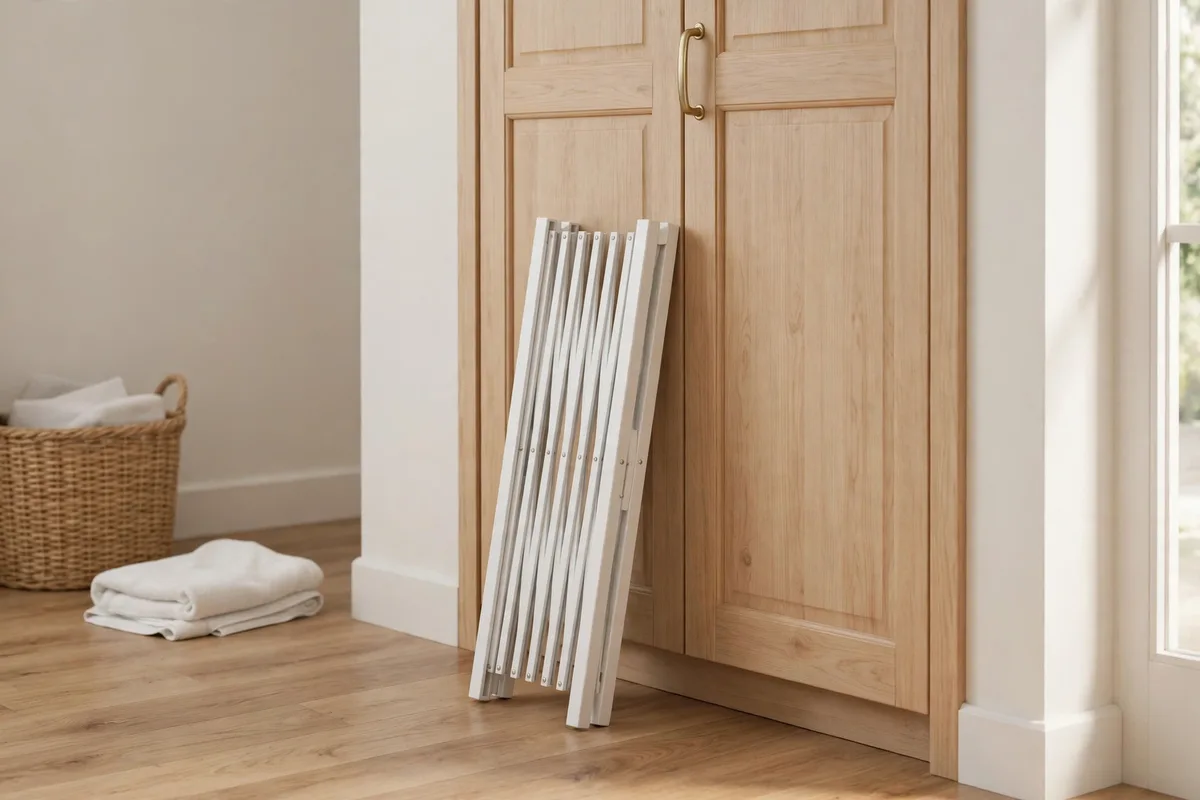
The Amazon Basics Foldable Drying Rack is the accordion staple — the first rack most apartment dwellers and dorm residents ever buy, and still the sensible default at its end of the market. The design has not needed to change in decades: epoxy-coated steel rods in a scissoring frame that opens into a row of parallel rails, with a flatter top section for small items. The listing rates it at up to roughly 32 lb, enough for a standard load of mixed laundry if the heaviest pieces are spread across several rods rather than stacked on one. It weighs little and carries one-handed.
Its long-term complaint class is the coating. Owners who keep the rack in a steamy bathroom report the epoxy eventually chipping at the rod ends and fold points, after which the exposed steel can rust — the exact failure the stainless Cresnel above is built to avoid. Kept in a drier room and wiped down occasionally, examples serve for years. It folds completely flat for a closet or the slot between washer and wall, and needs no assembly. As a first rack, a spare for delicates, or a dorm workhorse, it remains the budget classic for a reason.
Yay · Pros
- The proven accordion design — light, simple, nothing to assemble
- Folds completely flat for a closet or beside the washer
- Holds up to about 32 lb per the listing — a standard mixed load
Hmm · Cons
- Epoxy coating can chip over years, then rust at the chips
- Not the rack for heavy denim-and-towel loads every day
- Rails only — no sweater shelf or hanger rail
Best for: first racks, dorms, small apartments and delicates duty on a budget. Skip if: it will live in a steamy bathroom full-time — stainless ages better there.
4. Songmics 2-Tier Foldable Drying Rack — Best tiered design
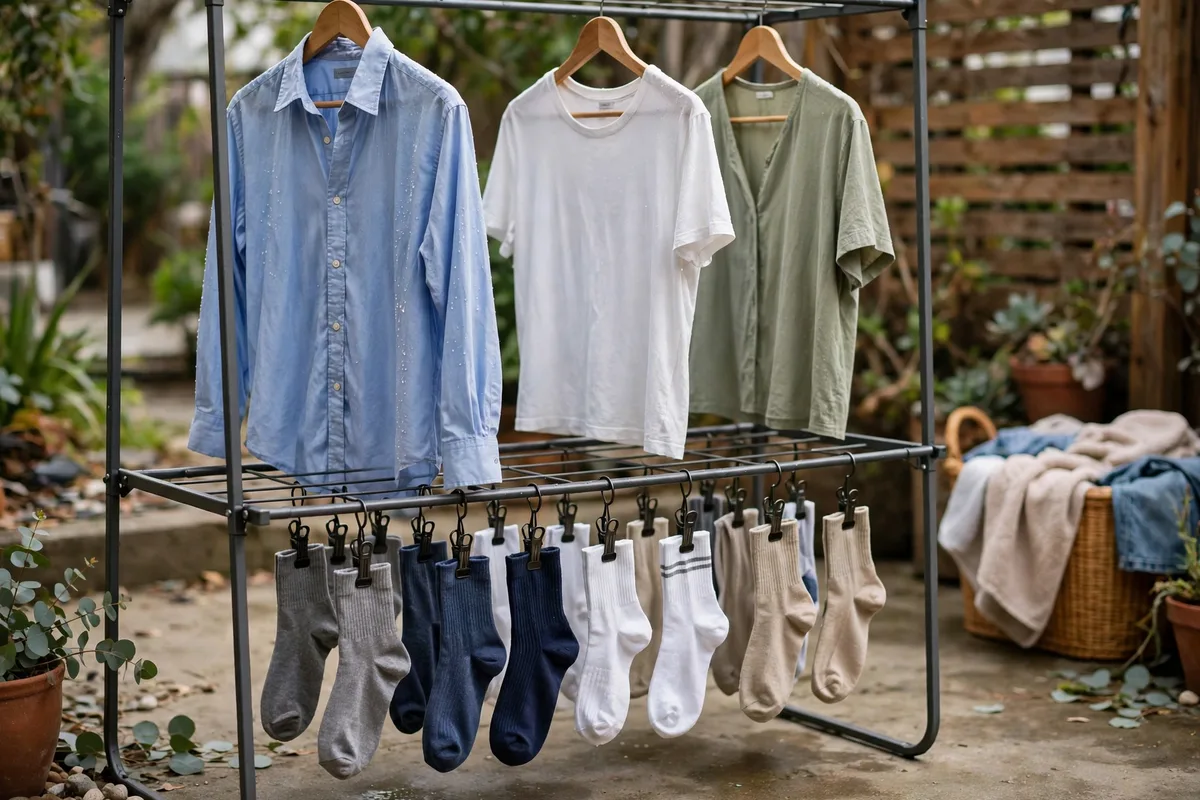
The Songmics 2-Tier Foldable Drying Rack is the small-space organiser’s answer: instead of spreading out, it stacks. Two tiers of rails double the hanging length in roughly the footprint of a single-tier rack, the wings at the top adjust for height so longer items can hang from the upper level without pooling on the lower, and a set of sock clips along the frame swallows the small laundry — socks, underwear, washcloths — that otherwise eats rail space out of all proportion to its size. The frame is steel, and the layout suits the way small households actually wash: frequent modest loads, heavy on smalls, in a room where floor space is scarce.
Owner reports split on the build experience, and honesty requires saying so. Assembly gets mixed reviews — most owners manage it without drama, but a minority describe fiddly parts — and the folding joints are reported as stiff by some owners. That variance is the trade for the clever layout. Once up, the tiered shape earns its keep: a full small load dries in a corner, shirts ride the top wings, and the frame folds away when the room has to be a room again. Buy it for the floor plan rather than for heirloom build quality, and it is the smartest use of a square metre in this guide.
Yay · Pros
- Two tiers — double the rails in a single-tier footprint
- Sock clips and height-adjustable wings handle smalls and long items
- Folds away when the room has to be a room again
Hmm · Cons
- Assembly and joint stiffness get mixed owner reports
- Coated steel frame — the same long-term chip caveat as other coated racks
- Tiered layout suits small loads better than bulky bedding
Best for: small apartments and frequent small loads heavy on socks and smalls. Skip if: you want zero assembly and a set-up-in-seconds frame — the accordion and gullwing open faster.
5. JAUREE 79-Inch Retractable Drying Rack — Best for sheets & bedding
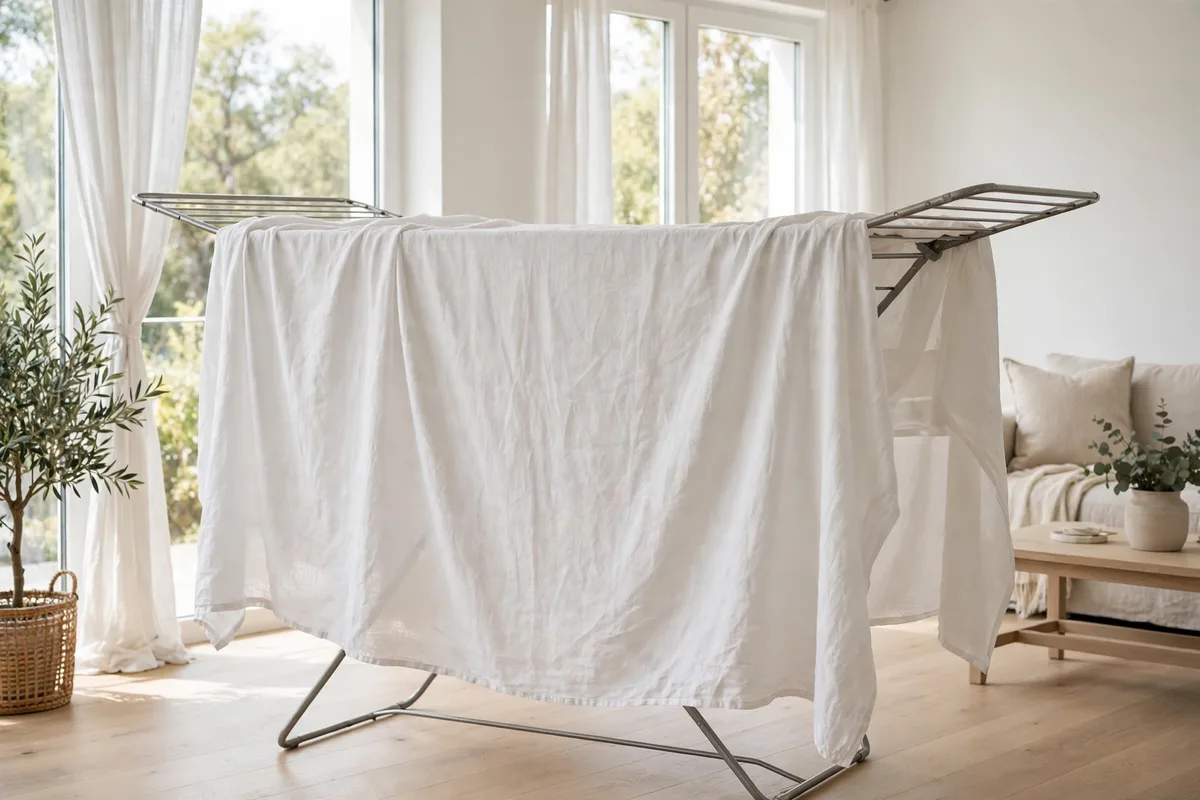
The JAUREE 79-Inch Retractable Drying Rack exists for the loads every other rack here apologises to: duvet covers, comforters, flat sheets and bath-sheet sets that drape over a standard rack, touch the floor, and dry in folds that stay damp. Three retractable rods extend the span out to a brand-stated 79 inches, so a large sheet hangs in one clean drop with air on both sides, and the stainless frame resists the rust that bedding duty — long, slow, very wet — eventually finds in coated racks. JAUREE rates the frame to roughly 130 lb; treat that as a brand claim rather than a tested figure, but the build is plainly aimed at weight: a wide stance and long rods.
The cost of the span is the floor it stands on. Opened to full width, this rack needs the room its 79 inches imply — a laundry room, a spare room, a wide hallway — and small apartment bathrooms need not apply. Retracted, it behaves more modestly, and the frame stores flatter than its open size suggests, but households should measure the intended drying spot before ordering rather than after. Used at its strength, though, nothing else in this guide dries bedding as well: sheets come off dry edge to edge instead of folded-damp in the middle.
Yay · Pros
- 79-inch max span — sheets and comforters hang in one clean drop
- Stainless frame, suited to slow, wet bedding loads
- Brand-rated to about 130 lb (brand claim), with a wide, stable stance
Hmm · Cons
- Needs the floor width its span implies — measure first
- Overkill for ordinary mixed loads
- Retracting rods are one more mechanism to treat reasonably
Best for: bedding, duvet covers and sheet-heavy households with a laundry or spare room. Skip if: floor space is tight — every other pick here folds smaller and lives easier.
How indoor drying actually works: airflow, humidity and materials
Airflow beats heat. Drying is evaporation, and evaporation cares about moving air far more than warmth. A rack beside a radiator in still air dries slowly and unevenly, while the same load in a cooler room with a window cracked or a small fan running dries faster — the airflow keeps sweeping saturated air away from the fabric so more water can leave. Spacing is the second half of the physics: garments hung with a finger’s width between them dry in hours, while garments touching in bunches dry last exactly where they touch. Overloading a rack is therefore false economy — two half-loads dry faster than one stuffed load, and they come off smelling like laundry instead of cellar.
Humidity is the honest trade-off. The water has to go somewhere, and indoors it goes into your rooms: a full load releases roughly two to three litres of moisture as it dries. In a heated, ventilated home that is a trivial amount spread over a day. In a small flat with closed windows through a Canadian winter, load after load can push humidity high enough to condense on cold windows and walls — the damp pattern that, repeated for months, invites mould. The fixes scale with the problem: crack a window or run an exhaust fan while drying for ordinary loads, and close the laundry-room door and run one of the picks from our guide to the best dehumidifiers for Canada and the USA when drying is daily and the windows are frosting over.
Materials decide how a rack ages. Stainless steel cannot rust and has no coating to shed, which is why it anchors the damp-room picks here; its weakness is never the metal but the plastic joints most designs still use. Coated steel — epoxy or powder coat over ordinary steel — is cheaper and perfectly durable until the coating chips at a fold point, after which rust starts at the chip; keeping coated racks dry between loads stretches their life by years. Wood is the handsome outlier: warm to look at and sturdy, but it dislikes being left damp, can hold mustiness itself, and is usually the heaviest to move. Whatever you choose, clothes come off the rack nearly ready — a quick pass from one of the picks in our guide to the best garment steamers for Canada and the USA relaxes the few creases air-drying leaves.
Drying rack questions, answered
How much can I save by air-drying clothes instead of using a dryer?
A typical electric tumble dryer uses roughly 2 to 4 kWh per load, according to energy-agency figures — the exact draw depends on the machine’s age, load size and cycle. Air-drying that load uses no electricity, so the saving per load is that energy, priced at your local tariff. Households that air-dry several loads a week avoid a meaningful slice of their laundry energy over a year, and their clothes last longer, because tumble heat and friction are hard on fibres and elastic. We deliberately avoid a dollar figure: tariffs vary widely between provinces and states, and any precise promise would be invented.
Will drying clothes indoors cause mould?
Drying clothes indoors does not cause mould by itself, but it does release the water from a full load — roughly two to three litres — into your room air. If that moisture lingers on cold walls and windows day after day, condensation can feed mould over time. The fix is ventilation and air movement: open a window briefly, run a bathroom fan, or pair the rack with a dehumidifier in winter, and avoid drying in a small, sealed, unheated room. Occasional indoor drying in a normally heated, ventilated home is not a mould sentence; chronic damp with no airflow is the real risk.
How do I stop air-dried clothes smelling musty?
Musty air-dried clothes almost always mean the load dried too slowly. Thick items bunched together trap damp air, and bacteria do the rest. Space garments so air can pass between them, point a small fan at the rack or place it near — not on — a heat vent, and do not overload beyond the rack’s rails. Wring or spin the load well before hanging: an extra spin cycle is the cheapest drying upgrade there is. If a smell has already set in, rewash with the machine properly loaded rather than drowned in detergent, which itself can leave residue that smells.
What is the best drying rack material — stainless steel, coated steel or wood?
Stainless steel is the most durable choice: it cannot rust or shed a coating, which is why the stainless picks in this guide suit bathrooms and humid laundry rooms, though its plastic joints remain the weak point. Coated steel costs less and performs well for years, but once the epoxy or powder coating chips, the exposed steel can rust at that spot. Wood looks warm and folds beautifully, yet it dislikes being left damp, can develop its own mustiness, and is usually heavier. Match the material to the room: stainless for wet spaces, coated steel for value, wood for looks.
How much weight can a clothes drying rack hold?
Capacity varies more than the product names suggest. Light accordion racks are commonly listed around 30 to 35 pounds, mid-size gullwing designs around 50 pounds, and heavy-duty wide-span models carry brand claims well above 100 pounds — treat the highest figures as manufacturer claims rather than tested limits. Wet laundry is heavier than you expect: a full load of wet denim and towels can strain a light rack. The safer rule is to respect the listed capacity, spread heavy items across several rods instead of one, and step down a size class if your loads are mostly jeans, hoodies and bath towels.
The short version
Renters and first-time buyers should start with the Amazon Basics — inexpensive, flat-folding and proven. Households drying full loads several times a week should buy the Honey-Can-Do Gullwing, the most drying space in a sane footprint. Damp bathrooms and laundry rooms point to the stainless Cresnel; small flats with constant smalls point to the two-tier Songmics; and anyone whose weekly wash is mostly bedding should measure the room and take the JAUREE. Whichever rack you choose, hang with space between garments and keep air moving, and the dryer becomes the appliance you reach for only for towels and emergencies — and a quick finish with one of the picks in our guide to the best steam irons for Canada and the USA covers the rest.
Last updated: November 18, 2026. We refresh this guide each season and whenever a pick is replaced by a better one.