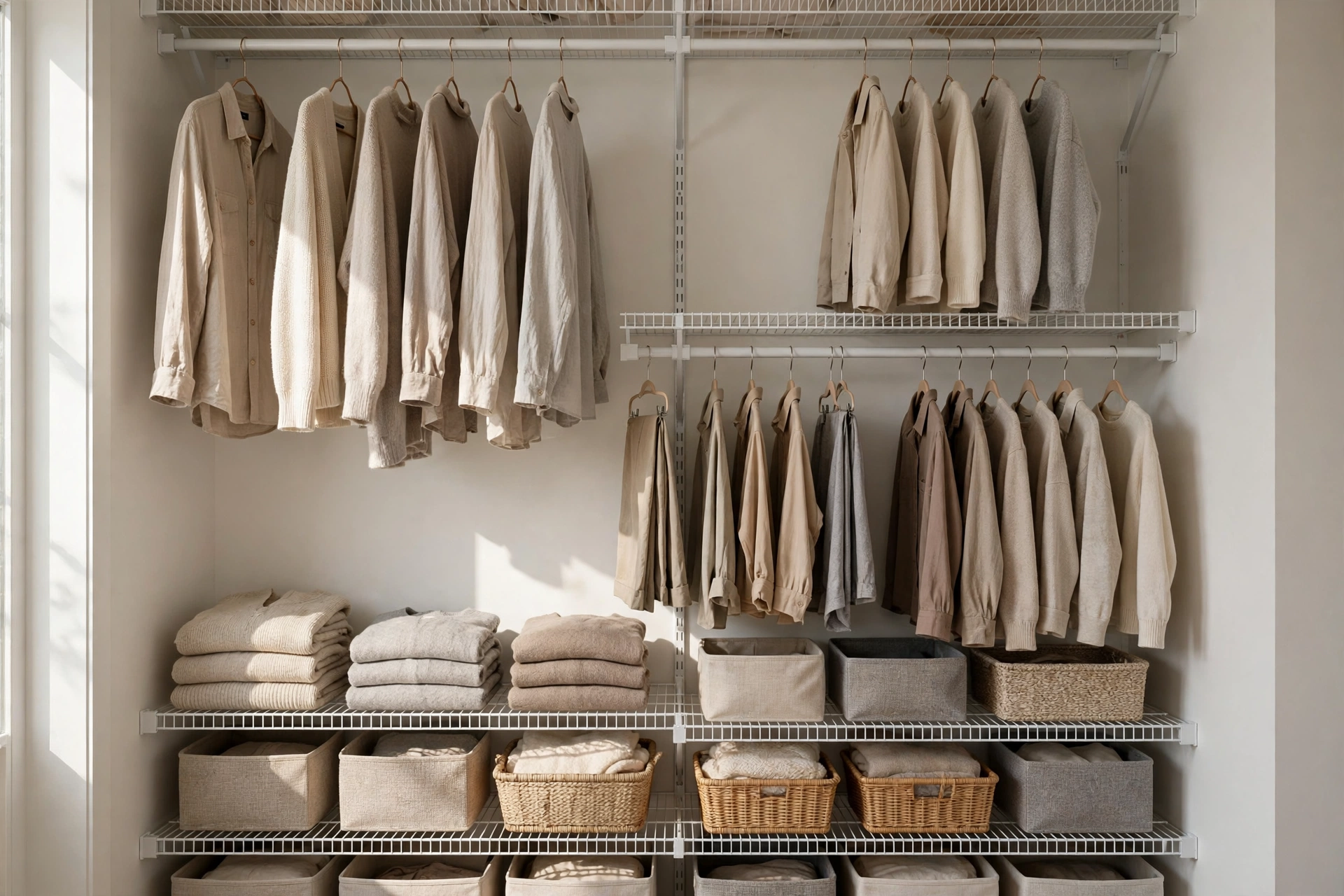
"Closet organizer" is two different purchases wearing one name. Homeowners are buying a permanent kit — uprights and rails that screw into the wall and stay put for a decade. Renters and dorm residents need the exact opposite: storage that hangs from the existing rod, stands on the floor, or multiplies the rail they already have, then leaves without a trace. Most roundups rank both kinds in a single list as if they compete. They don't, and this guide doesn't pretend they do: the kits come first, clearly labelled, and the no-drill picks follow for everyone whose lease counts holes.
The honest headline: for owners, the choice is between two category institutions — Rubbermaid's no-cut kit and ClosetMaid's adjustable track system — and for renters, a hanging organizer that three separate roundups agree on. And in Canada there is a third test every system here has to pass: the twice-a-year wardrobe rotation, when bulky winter coats and heavy knits swap places with summer clothes. A closet that can't absorb that swap is undersized no matter how tidy it looks in January.
How we chose these closet organizers
We built this list from the roundups that actually work this category — Primea Reviews' kit and renter guides (they hold much of this search results page), SnugSpace Gear's kit comparisons, Trovevale's freestanding and budget picks, and DormGearHQ's dorm rankings — then checked kit sizes and configurations against the manufacturers' own listings. Where the sources split the field the same way we do — kits versus no-drill — we followed that split. CookSmartPicks does not run its own closet lab; what we do is reconcile the published evidence and flag the trade-offs the roundups bury.
Three things separated the picks. Honest capacity — shelving and hanging measured in feet, not a marketing "up to" number with the good configuration sold separately. Install reality — whether fitting means cutting, whether it needs studs, and what your landlord sees at move-out. Load behaviour — wire shelves and rods sag, hanging organizers sway, and fabric shelves bow under denim; the picks below are the ones whose designs respect those limits.
The lineup at a glance
| Closet organizer | Best for | Why it made the cut |
|---|---|---|
| Rubbermaid Configurations Deluxe Custom Closet Kit, 4–8 Ft | Best overall kit | No cutting and roughly 22 ft of shelving with 12 ft of hanging in one kit — Primea's best overall kit |
| ClosetMaid ShelfTrack Closet Organizer Kit | Best standard reach-in kit | The adjustable track standard for reach-in closets — best overall for Primea and SnugSpace alike |
| YOUDENOVA Hanging Closet Organizer, 6-Shelf | Best for renters | The renter consensus pick — Primea, Trovevale and DormGearHQ all rank it at or near the top |
| Amazon Basics Slim Velvet Hangers, 50-Pack | Best for small closets | A slim velvet profile that buys back rail space — Primea's best overall for small closets |
| SONGMICS 6-Cube Storage Organizer | Best budget freestanding | Budget freestanding cubes for folded clothes, bins and dorm rooms — Trovevale's pick |
| VIPEK V5 Portable Closet Wardrobe | Best freestanding second closet | A heavy-duty steel-frame wardrobe that works as a genuine second closet — Trovevale's pick |
1. Rubbermaid Configurations Deluxe Custom Closet Kit, 4–8 Ft — Best overall kit
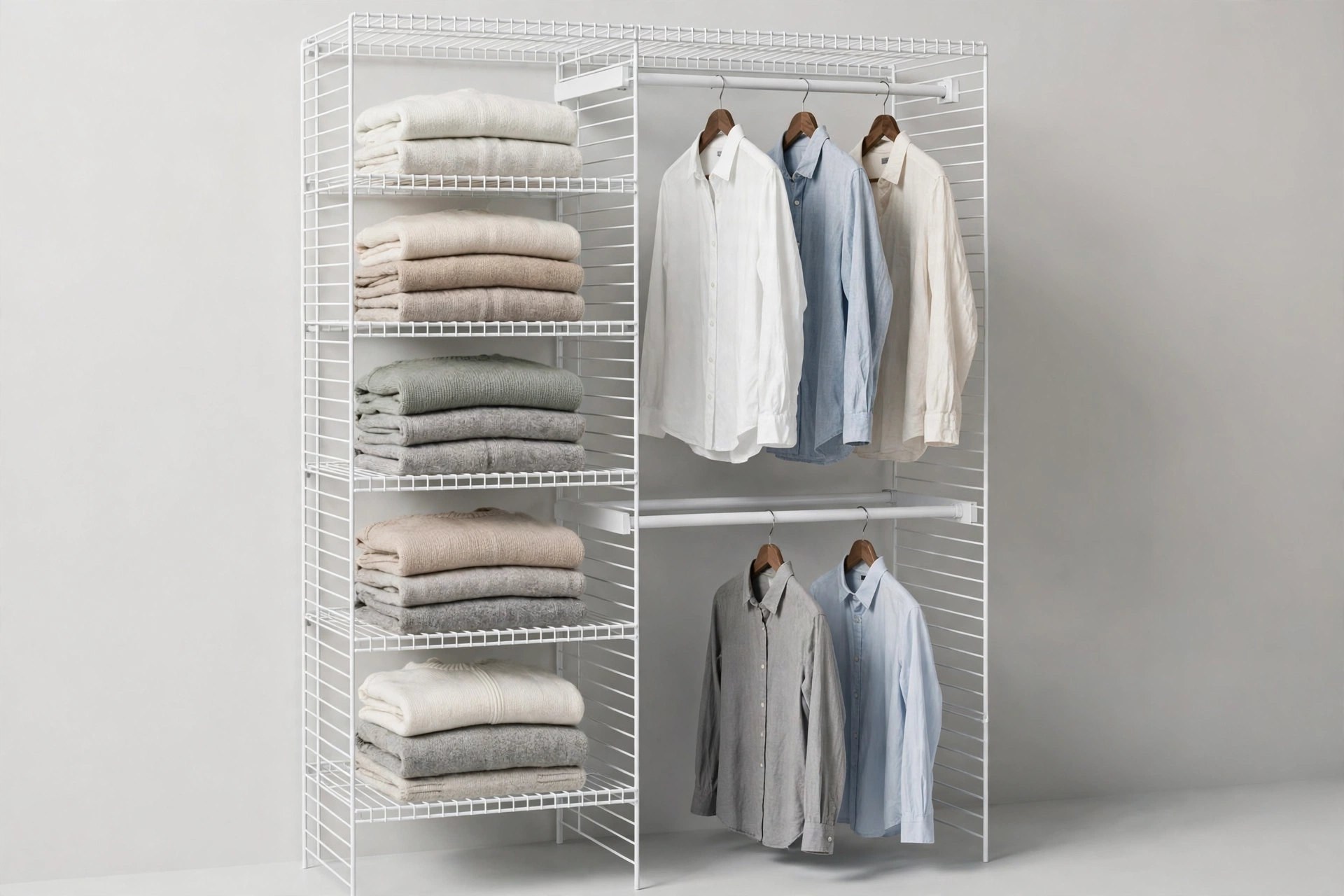
The Configurations Deluxe is Primea's best overall kit, and its advantage is a single practical fact: no cutting. Where most kits hand you shelves and rods that need trimming to size, the Rubbermaid's components telescope and expand to fit closets from 4 to 8 ft wide straight out of the box. Per Primea, one kit delivers roughly 22 ft of shelving and 12 ft of hanging space — enough to double-hang shirts and pants on one side and still leave long-hang room for dresses and coats. Shelves and rods reposition on the uprights without new holes, so the layout can change when the wardrobe does.
The trade-offs are install and finish. This is a permanent system: uprights screw into the wall, and fitting it is an afternoon's work, not a ten-minute job. The white wire shelving is functional rather than furniture-grade, and wire shelves can leave lines on folded knitwear — a shelf liner fixes that, but it is an extra. None of this matters if you own the walls; all of it matters if you don't.
Yay · Pros
- No cutting — expands to fit 4–8 ft closets out of the box
- Roughly 22 ft of shelving and 12 ft of hanging per kit, per Primea
- Reconfigurable — shelves and rods move without new holes
Hmm · Cons
- Permanent install — screws, anchors and an afternoon
- Wire shelves can mark folded knitwear without liners
- Utilitarian wire look, not built-in cabinetry
Best for: homeowners with a standard reach-in who want a one-weekend transformation. Skip if: you rent — this kit leaves holes; jump to the YOUDENOVA below.
2. ClosetMaid ShelfTrack Closet Organizer Kit — Best standard reach-in kit
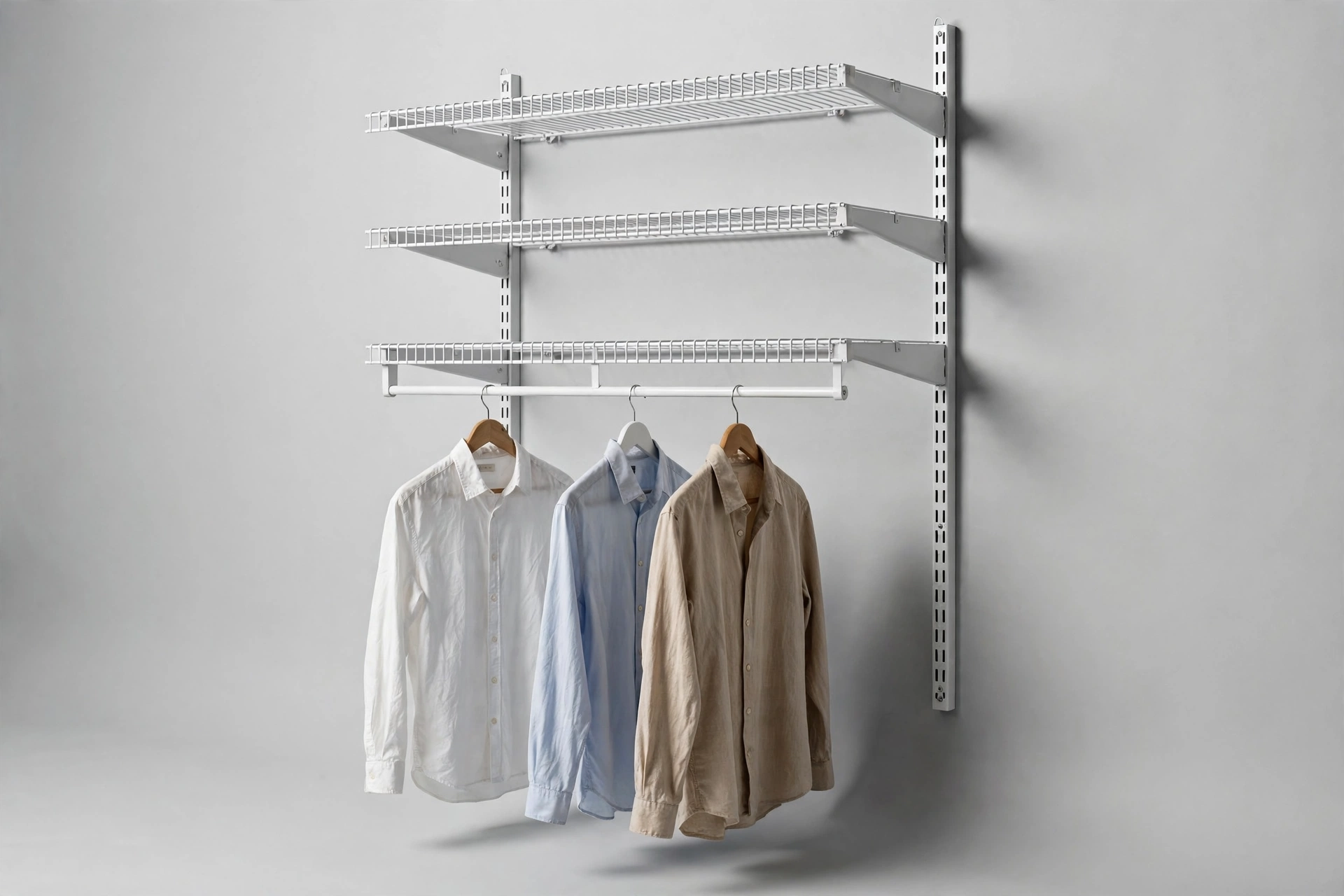
ClosetMaid is the other institution in this category, and Primea and SnugSpace both name its kits their best overall for standard reach-in closets. The ShelfTrack system works on a hang track: a horizontal rail screws in near the top of the wall, vertical standards hang from it, and brackets, wire shelves and rods click in wherever you place them — the SuperSlide shelving line is designed so hangers glide continuously along the rod instead of catching at every bracket. The real advantage is the ecosystem: drawers, extra shelves and accessories all clip into the same standards, and replacement parts sit on the shelf at hardware stores across Canada and the US.
Against the Rubbermaid, the compromises are fitting and completeness. Some ShelfTrack kits expect shelves or rods trimmed to width, so read the box before assuming a no-cut install, and the entry-level kits are sparse — one rod, a couple of shelves — with the useful configurations built from add-ons that raise the real total. The wire-shelf caveats from the Rubbermaid apply here too.
Yay · Pros
- Adjustable track system — reconfigure without new holes
- Deepest add-on ecosystem in the category
- Parts and replacements available everywhere in both countries
Hmm · Cons
- Some kits need shelves or rods trimmed to fit
- Entry kits are basic — add-ons raise the real cost
- Wire shelves can mark folded knitwear
Best for: standard reach-in closets and anyone who wants to grow the system piece by piece. Skip if: "trim to fit" ends the conversation — the Rubbermaid expands instead of cutting.
3. YOUDENOVA Hanging Closet Organizer, 6-Shelf — Best for renters
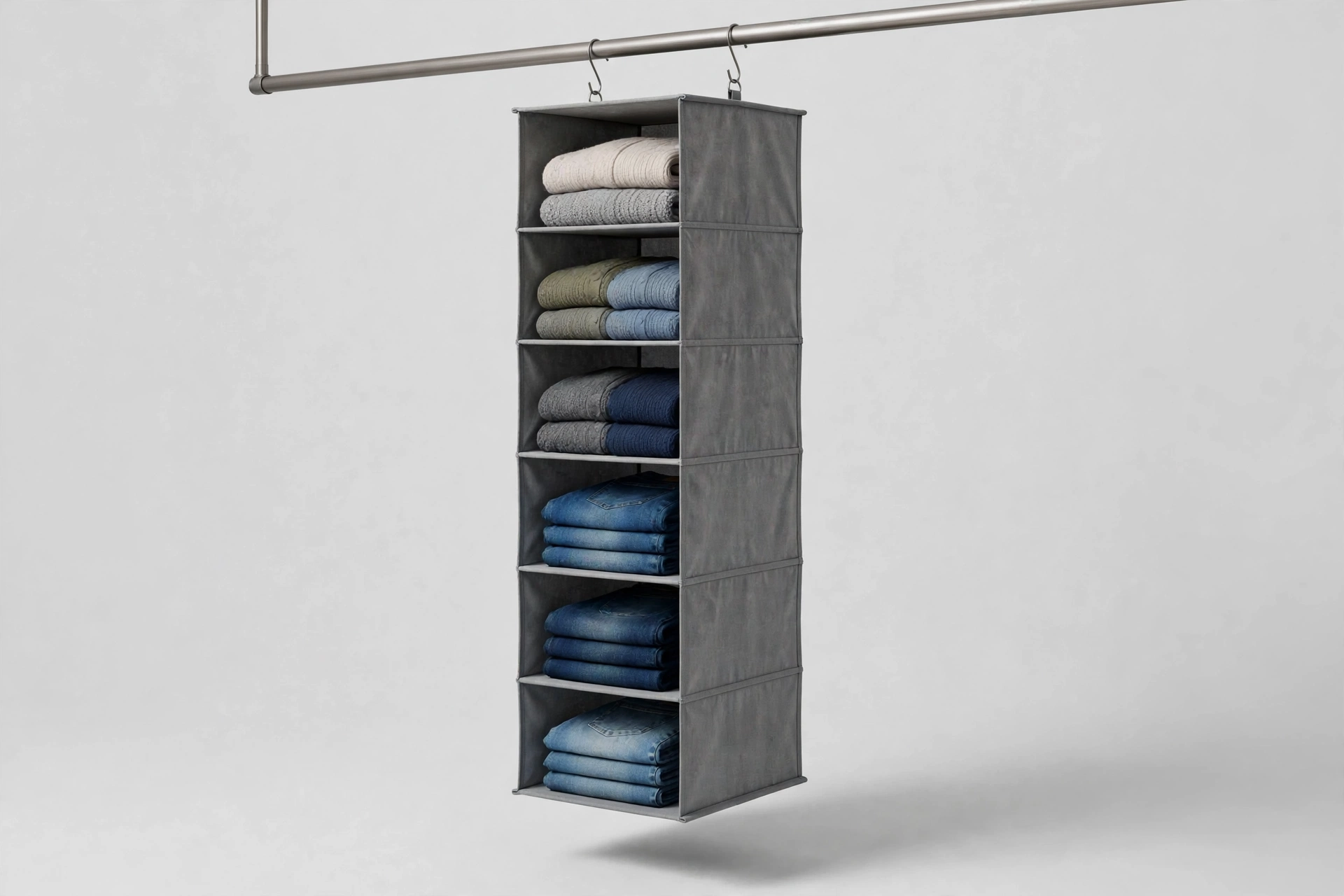
Start of the no-drill half of the guide, and the easiest recommendation in it: Primea, Trovevale and DormGearHQ all rank this hanging organizer at or near the top of their renter roundups — a consensus that almost never happens in this category. It hooks over the existing closet rod, gives you six open shelves for folded clothes, and installs in roughly the time it takes to unpack it. At move-out it folds flat into a suitcase. Holes made: zero.
The honest limits are physics. A hanging fabric shelf sways, and its shelves bow under real weight — folded sweaters and jeans are fine, a shelf of hardcover books is not. It also spends hanging rail to buy shelf space, occupying a section of rod, so in a very small closet it is a trade rather than a free win. Judged as what it is — reversible folded-clothes storage for people who can't drill — nothing else here does the job as simply.
Yay · Pros
- Zero holes, zero tools — hangs on the rod you already have
- The consensus pick across three separate renter roundups
- Folds flat and moves with you
Hmm · Cons
- Fabric shelves bow under heavy loads
- Trades a section of hanging rail for shelf space
- Sways — not suited to books or hard goods
Best for: renters, dorm rooms and anyone whose lease forbids screws. Skip if: your shortage is hanging space, not folded storage — this organizer trades one for the other.
4. Amazon Basics Slim Velvet Hangers, 50-Pack — Best for small closets
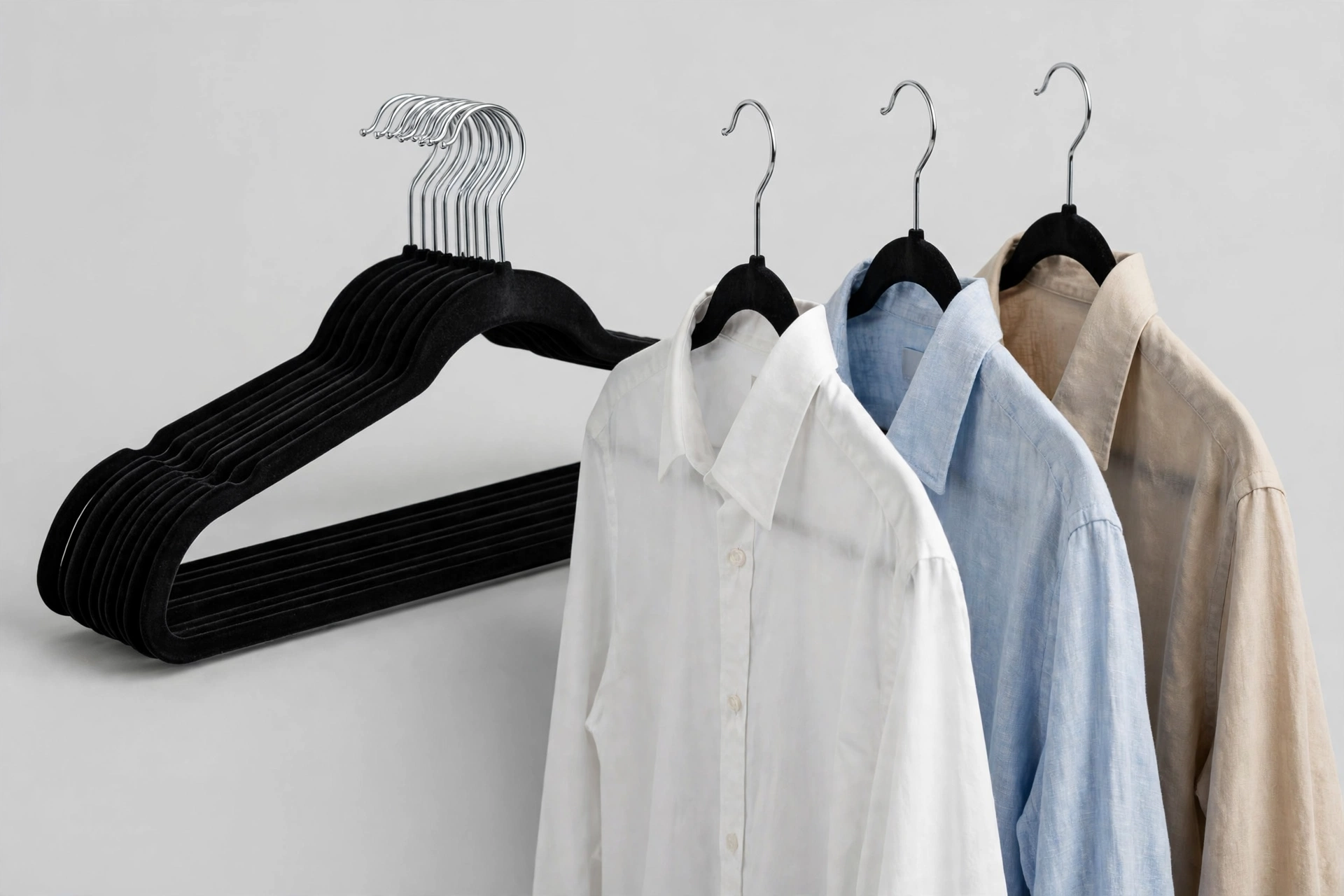
The cheapest capacity upgrade in this guide is not a shelf at all. Primea names this 50-pack its best overall for small closets, and the logic is plain geometry: a slim velvet hanger takes a fraction of the rail thickness of a chunky wooden or padded hanger, and multiplied across a full rail, that difference comes back as extra shirts of usable space. The velvet surface grips, so blouses, dresses and wide necklines stay on the hanger instead of sliding into a heap at the bottom of the closet.
Slim is a trade, not a miracle. These hangers flex under genuinely heavy garments — a Canadian winter parka or a tailored suit belongs on a sturdy wooden hanger, not on the space-saving pack — and the same velvet grip that holds clothes on also makes sliding them off a two-handed job. As a bulk swap for everyday shirts, trousers and dresses, though, it is the highest space-per-dollar move in this entire guide.
Yay · Pros
- Buys back real rail space across a whole closet
- Velvet grip keeps slippery fabrics on the hanger
- One 50-pack re-hangers a full wardrobe
Hmm · Cons
- Flexes under heavy coats and tailored suits
- Grip makes sliding clothes off slower
- Slim profile trades strength for space
Best for: small closets where the rail itself is the bottleneck. Skip if: your wardrobe is mostly heavy coats and tailoring — keep sturdy hangers for those and use these for the everyday rail.
5. SONGMICS 6-Cube Storage Organizer — Best budget freestanding
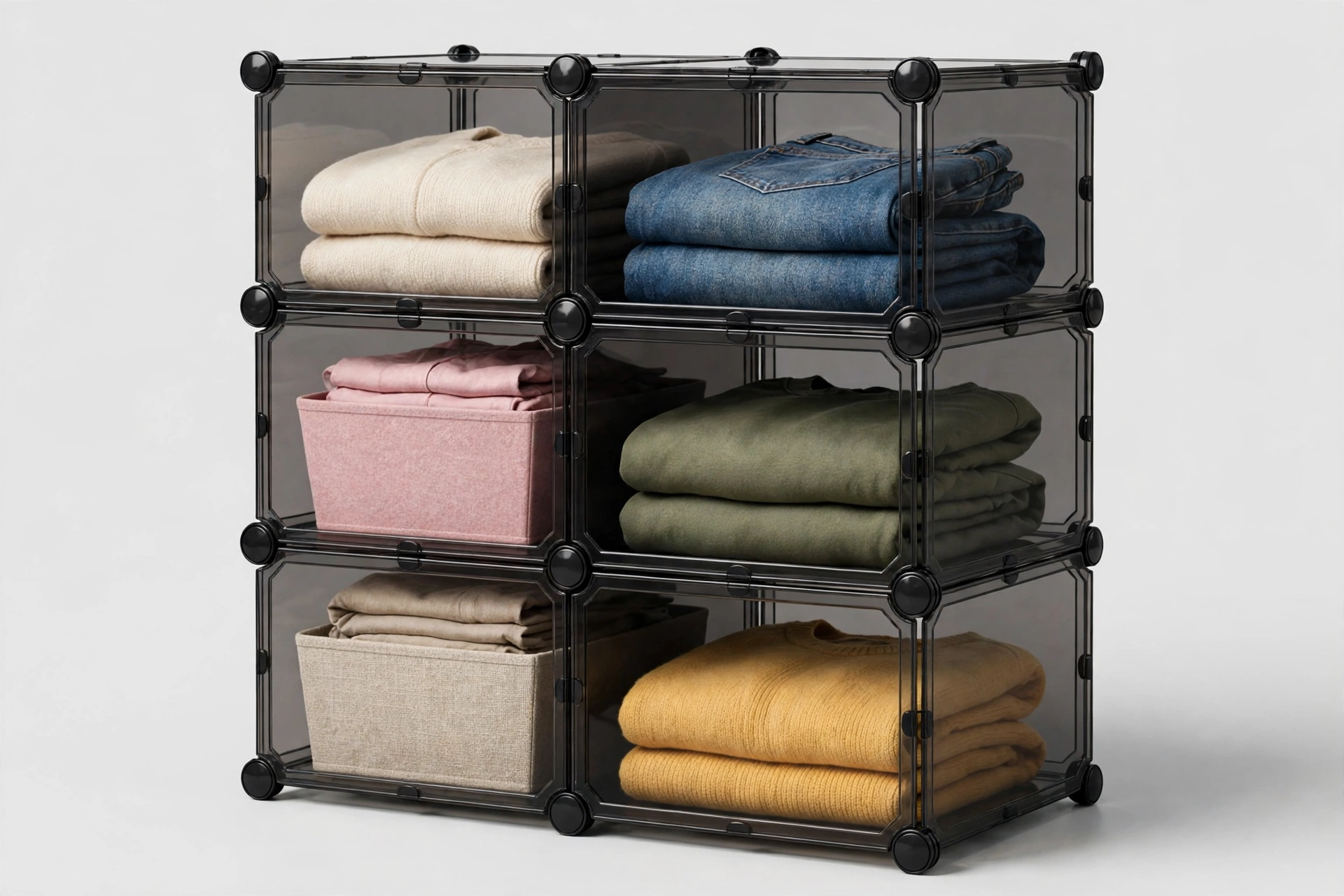
Trovevale's budget freestanding pick takes the opposite approach to the rod entirely: six interlocking cubes — most people build them two wide and three tall, but the panels restack to fit the corner you actually have — assembled from plastic panels and connectors with no wall contact and no tools beyond a firm push. Cubes suit exactly the things rails and shelves handle badly: folded stacks, storage bins, bags, and kids' clothes that never stay folded anyway.
Keep the expectations honest. Each cube has a modest load limit — clothes and linens, yes; a cube full of vinyl records, no. The open fronts collect dust, and the look is dorm-functional rather than bedroom furniture. What redeems it for its audience is portability: it breaks down flat at move-out and rebuilds at the next place, which is why cube organizers keep surfacing in renter and student roundups year after year.
Yay · Pros
- Freestanding — no wall, no rod, no holes
- Restackable shape fits odd corners and alcoves
- Breaks down flat for moving day
Hmm · Cons
- Per-cube load limits — clothing weight only
- Open fronts gather dust
- Utilitarian, dorm-room look
Best for: dorms, kids' rooms and folded-clothes overflow on a budget. Skip if: you need hanging space — cubes don't hang anything; look at the VIPEK below.
6. VIPEK V5 Portable Closet Wardrobe — Best freestanding second closet
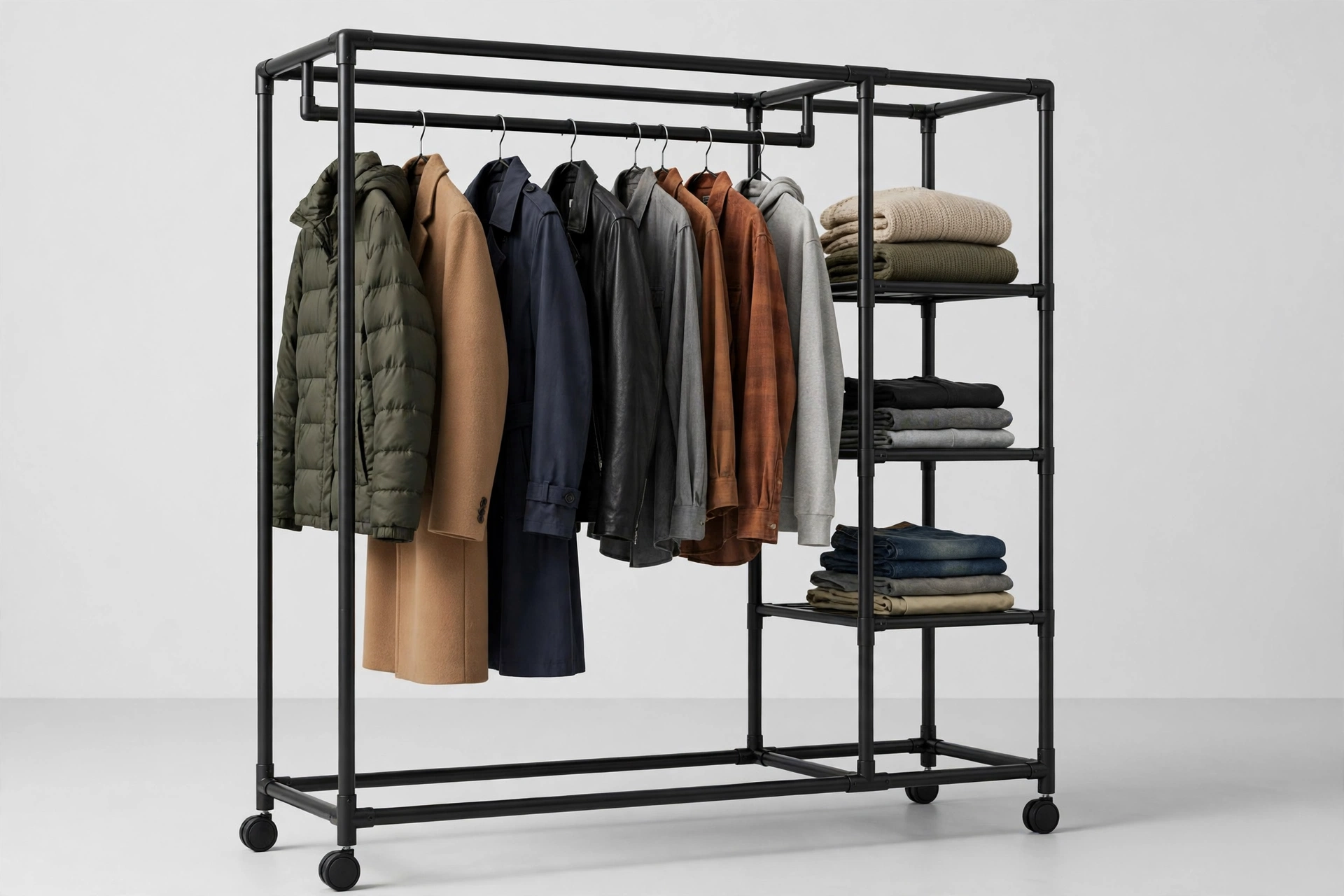
Trovevale's heavy-duty freestanding pick is the only no-drill option here that is honestly a second closet rather than an accessory to one. The V5 is built around thick steel tubes and sturdy connectors, with a full-width hanging rod and shelving tiers — a frame meant to be loaded like furniture, coats and all, rather than treated as a collapsible garment rack. It stands on the floor of a bedroom corner, spare room or basement, and no part of it needs the wall's permission.
Size is the whole caveat. This is a piece of furniture: measure the corner it will live in, expect the longest assembly in this guide, and set it against a wall even though it doesn't bolt to one — a fully loaded wardrobe is more stable for it. For households whose built-in closets simply cannot hold the wardrobe, including the Canadian winter-coat overflow that appears every October, it solves a problem no kit or cube can.
Yay · Pros
- A genuine second closet — full hanging rod plus shelving
- Heavy-duty steel frame built for coat weight
- Freestanding — no drilling, and it moves with you
Hmm · Cons
- Large footprint — measure the room, not just the closet
- The longest assembly in this guide
- Most stable placed against a wall when fully loaded
Best for: homes with too little built-in closet, full stop — and households drowning in winter coats. Skip if: your closet just needs organizing rather than replacing; the kits and cubes above are less furniture.
Closet organizers: what actually matters
Kits versus no-drill is the first and only real fork. If you own the walls, a kit returns more storage per dollar than any accessory — but measure the closet's width, depth and door swing first, and check whether the kit expands to fit (the Rubbermaid) or expects trimming (many ClosetMaid boxes). If you rent, skip the kit sections of every guide, this one included: hanging shelves, cubes and a freestanding wardrobe are your entire category, and they are genuinely good at it.
Think in hanging feet and shelf feet, not product photos. Double-hang rods double your shirts and trousers; long-hang space should be reserved for dresses and coats. The same zone logic we applied to kitchen shelves in our pantry organizers guide works here — group by how often you reach for it, not by category purity. And shoes are their own problem, with their own dimensions and their own mess; they get a dedicated guide to the best shoe racks rather than a shelf in this one.
In Canada, plan the twice-a-year rotation. Bulky winter coats, boots and heavy knits occupy half a closet for half the year. The systems above earn their keep in April and October: off-season clothes compress into vacuum storage bags and move to a top shelf, a cube or the spare wardrobe, and the rail goes back to the season you are actually wearing. Build the swap into the layout from day one — a closet with nowhere for the off-season to go will re-clutter itself twice a year, guaranteed.
Closet organizer questions, answered
What size closet kit do I need? Measure the wall width the kit will cover, not the whole closet. The Rubbermaid Configurations Deluxe covers 4 to 8 ft from one box; wider walls take a second kit or add-on shelves. If your measurement lands awkwardly between sizes, choose the expanding system over the trim-to-fit one — your future self, mid-install, will thank you.
Can renters really organize a closet without drilling? Yes — the constraint is real, but the category is built for it. Hanging organizers ride the rod you already have, cubes and freestanding wardrobes stand on the floor, and slim hangers multiply existing rail space. Everything in the no-drill half of this guide leaves with you and leaves no holes behind.
Wire shelves or solid shelves? Wire is lighter, less expensive and ventilated — and it can emboss lines into folded knitwear while small items tip between the rungs. Solid surfaces cost and weigh more. Most owners compromise: wire in the hanging zones, and bins or shelf liners wherever folded stacks live.
How do I keep an organized closet organized? The unglamorous answer: clothes come back to the rail clean and pressed often enough that you want to hang them up — a decent steam iron does more for closet order than one more shelf. Then run the seasonal rotation twice a year and let the off-season wardrobe leave the rail entirely instead of competing with what you wear now.
The short version
Own your walls? Buy the Rubbermaid Configurations Deluxe for a no-cut weekend install, or the ClosetMaid ShelfTrack if you will grow the system piece by piece. Renting? The YOUDENOVA hanging organizer is the consensus fix, the Amazon Basics velvet hangers buy back rail space for the least money in this guide, SONGMICS cubes swallow the folded overflow, and the VIPEK V5 is the answer when the closet itself is the problem. Whichever side of the fork you are on, measure first — nearly every return in this category starts with a tape measure that stayed in the drawer.
Last updated: November 16, 2026. We refresh this guide each season and whenever a pick is replaced by a better one.