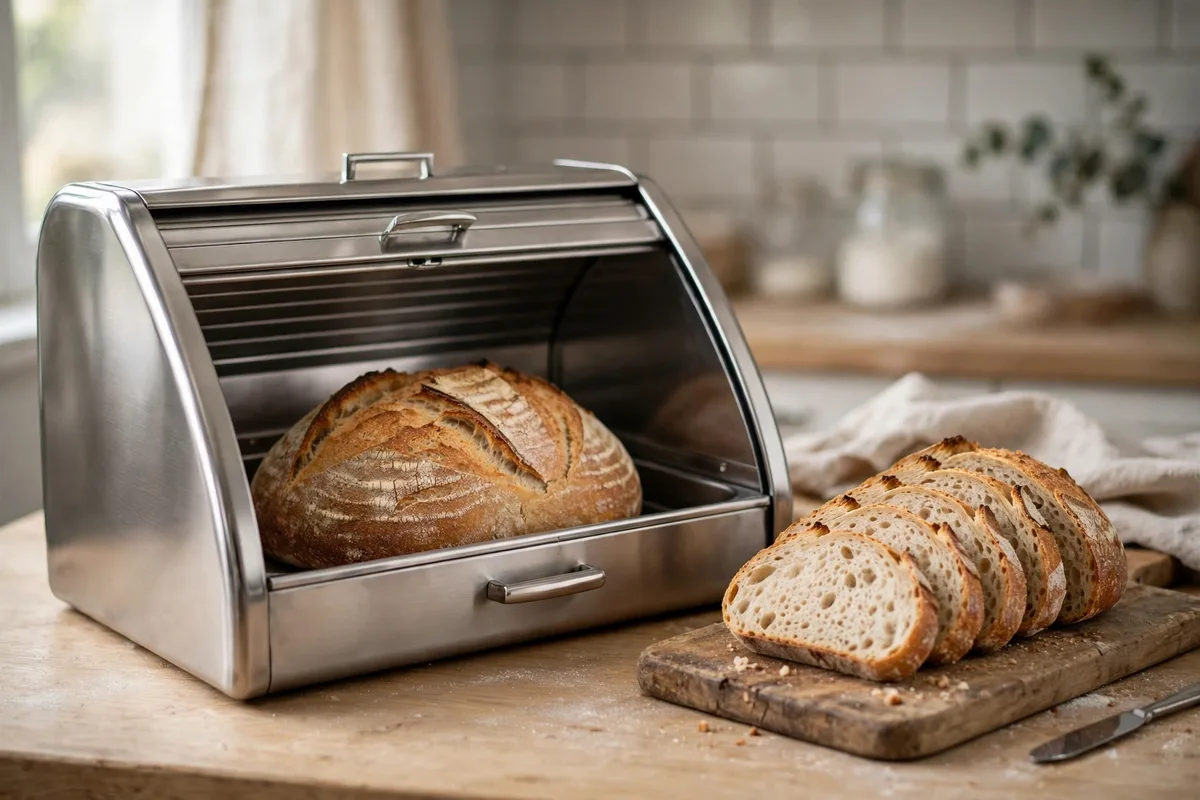
A bread box keeps bread fresh by holding humidity in a narrow band — vented, not sealed — and typically stretches a crusty loaf’s good days from about two to about four; the Brabantia Roll Top is the most proven box that does it. A bread box looks like the simplest purchase in the kitchen — a box — until you learn what it is actually for: holding a loaf’s humidity in the narrow band where the crumb stays soft, the crust stays crisp, and mould stays discouraged. Sealed plastic fails one way, open air fails the other, and the boxes in this guide are the engineered middle, differing in how they vent, how much counter they consume, and how honestly they fit a real 900-gram bakery loaf.
The five picks span the design families: Brabantia’s roll-top and fall-front steel classics, a stainless budget box, and two bamboo designs that breathe naturally and double as cutting surfaces. Each was checked for loaf fit, venting design and the crumb-cleaning reality, with Canadian availability confirmed. For the bread’s neighbours on the counter, our best produce saver containers in Canada and the USA guide handles the produce drawer’s version of the same freshness fight, and the best pantry organizers in Canada and the USA guide covers the pantry at large.
Disclosure: CookSmartPicks is reader-supported. When you buy through links on this page, we may earn an Amazon commission at no extra cost to you. Prices and availability change often — check the current price on Amazon before you decide.
How we chose these bread boxes
Bread storage is a humidity problem wearing a furniture costume, so the shortlist was judged on moisture management first: how each design vents (adjustable vents, fixed vents, bamboo’s natural exchange, or a plain seal), because that choice decides whether crusty loaves stay crusty and soft loaves stay soft. Capacity was measured against a standard 900 g bakery loaf rather than the litre figures in listings, and door mechanics — roll-top, fall-front, hinged — were weighed for the counter space they consume in use, not just at rest.
Materials and cleaning came next: a bread box lives in crumb territory, so interiors had to wipe clean without trapping debris in tracks, and Canadian availability was confirmed for every pick. Two decorative boxes with sealed, unvented interiors were cut — a sealed box is a mould incubator with good looks, and this guide will not recommend one for bread whatever its reviews say.
The lineup at a glance
| Product | Best for | Why it stands out |
|---|---|---|
| Brabantia Roll Top Bread Box (Stainless Steel) | Best overall | The classic: a door that vanishes upward, a top that stores, steel that wipes clean |
| Brabantia Fall Front Bread Box | Best for bakers (tall loaves) | The baker’s box: a door that opens to a shelf and room for a risen boule |
| Home Basics Stainless Steel Bread Box | Best budget steel | Steel-box fundamentals at a budget price — the category’s test drive |
| Suncoo Bamboo Bread Box (Clear Front) | Best bamboo (breathable) | The breathing box: bamboo’s natural exchange keeps sourdough crusts alive |
| Prep Naturals Bamboo Bread Box (Double Layer) | Best double-decker | Two boxes in one footprint: the family bread economy, separated and breathing |
1. Brabantia Roll Top Bread Box (Stainless Steel) — Best overall
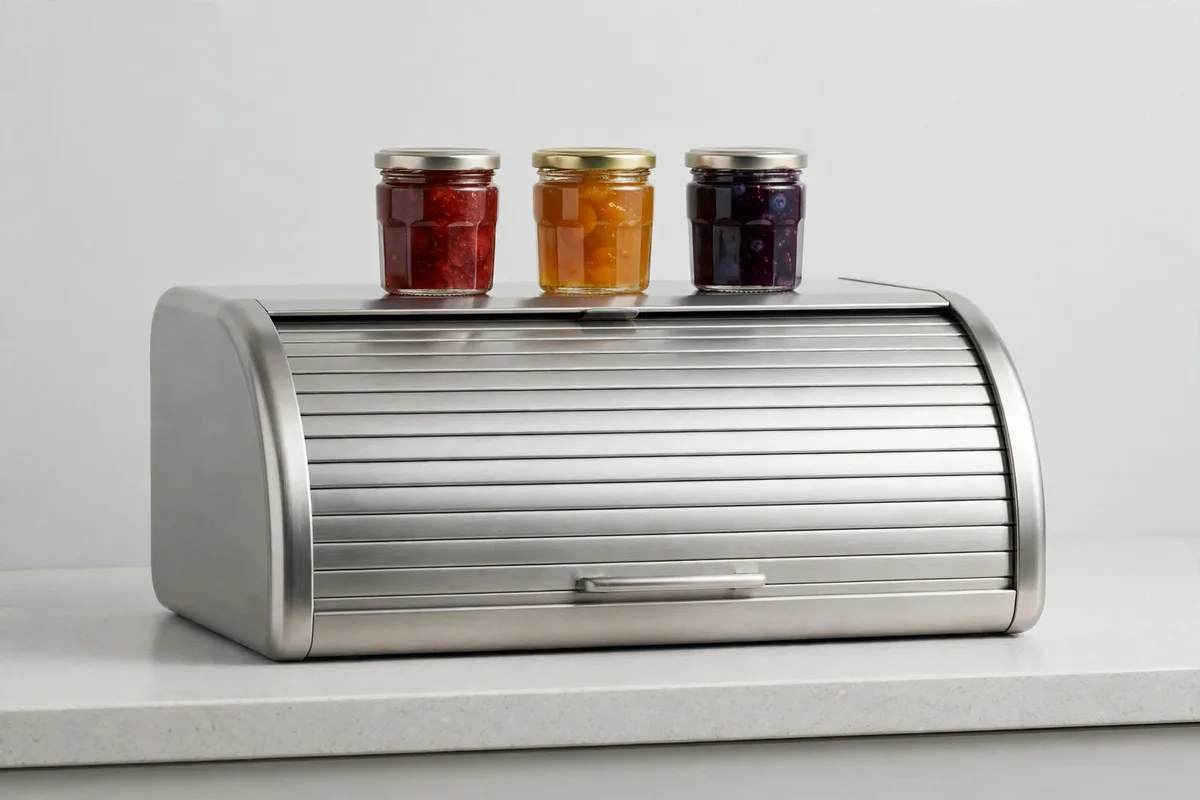
The Roll Top is the bread box perfected over decades of Dutch production: a stainless body whose door rolls up into the box’s own roof, consuming zero counter swing, with a flat top that works as a shelf for the jam jars. Inside, a standard bakery loaf and a half fits with air around it; the base’s slight corrugation lifts the loaf off any condensation, and Brabantia’s ventilation pattern — small, fixed, and tuned by long experience — keeps the humidity band where crusty bread wants it.
Owners’ verdicts across years of reports are unusually consistent: bread keeps noticeably better than in a bag, the roll mechanism never becomes the story, and the box wipes clean in seconds because the interior is smooth steel with nowhere for crumbs to hide. The flat top’s storage bonus matters in real kitchens — this is the rare counter appliance that returns space. Finishes run from fingerprint-prone shine to matte and coloured options that behave better in busy kitchens.
Brabantia’s Canadian distribution is long-established, with the warranty and replacement-part culture the brand runs everywhere. It is the premium end of steel boxes and justifies it the way the category allows: by being the box households keep for a decade and never think about, which is the entire job. If you buy one bread box in your life, the smart money starts here.
A decade in, the Roll Top’s owners report the same two facts: the mechanism still travels like day one, and the box has outlasted two toasters. The steel’s gauge is the reason — it shrugs off the daily knocks that dent thinner boxes into door-dragging misery within a few years.
Yay · Pros
- Roll-top door uses no counter swing
- Flat top doubles as a shelf
- Smooth steel interior wipes clean in seconds
Hmm · Cons
- Fixed venting — no adjustment for very humid kitchens
- Steel shows fingerprints; matte finishes cost more
- Premium price among steel boxes
Best for: Most households — the proven steel standard Skip if: Your kitchen is very humid and you want adjustable venting
2. Brabantia Fall Front Bread Box — Best for bakers (tall loaves)
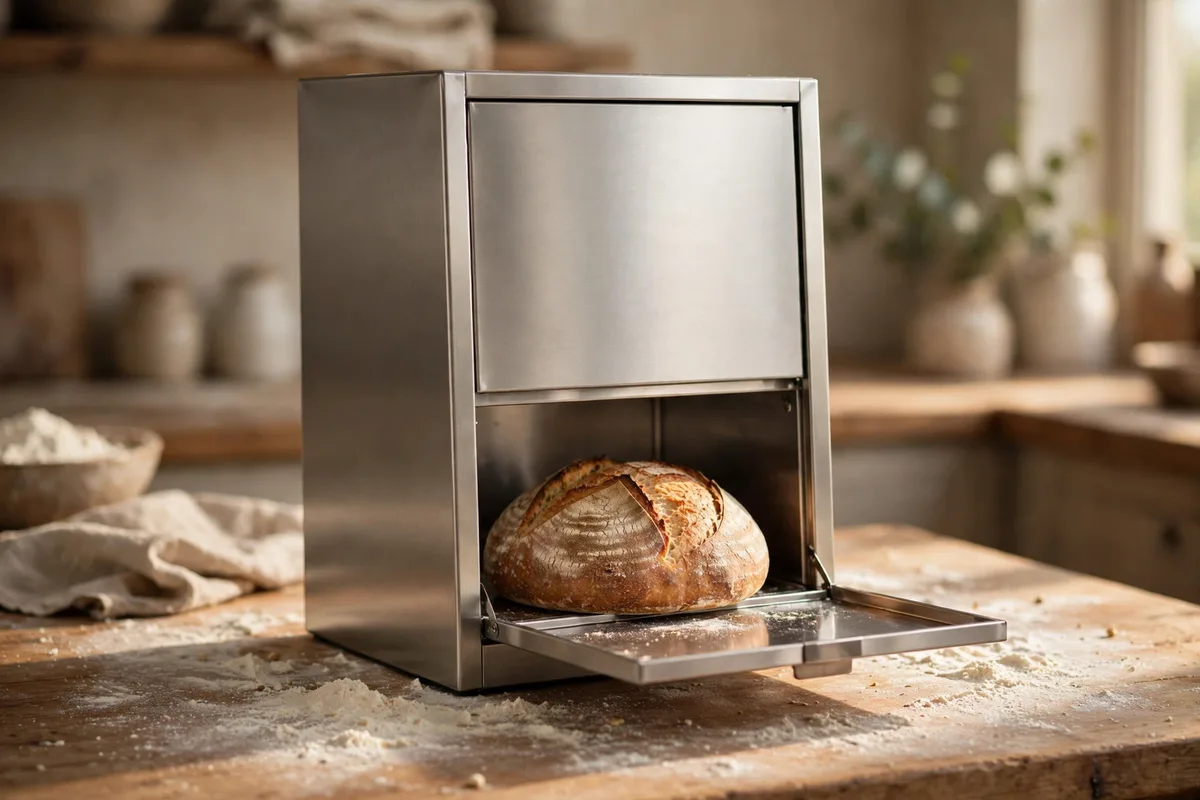
The Fall Front trades the roll-top’s vanishing act for capacity and access: the door drops forward to become a shelf-like opening, revealing a taller interior that swallows banneton-raised sourdough boules, a loaf plus a tray of cooling rolls, or the family’s entire bread economy at once. For households that bake — where the box must hold shapes no supermarket loaf anticipates — that vertical generosity is the whole argument, and the magnetic catch keeps the door sealed with a satisfying certainty.
The trade is printed on the box: open, the door occupies the counter in front of it, so this design suits kitchens with depth to spare or an island’s end. Inside, the same Brabantia virtues apply — smooth steel, tuned fixed venting, a corrugated base — and the fall-front’s wide mouth makes the weekly crumb wipe the easiest in this guide. The top remains flat and load-bearing for lighter storage.
Canadian availability matches the roll-top’s, and the price premium is modest. Choose between the two Brabantias by geometry, not quality: measure your loaves’ height and your counter’s depth, and the correct Dutch box selects itself. Bakers, in our reading of owner reports, choose this one and never look back.
The Fall Front’s tall chamber has a second career owners discover by accident: it proofs dough. A shaped loaf in a banneton, parked inside the closed box, gets the draft-free, humid rest that good rises want — the baker’s box quietly moonlighting as the baker’s proofing drawer.
Yay · Pros
- Tallest interior here — boules and bakes fit
- Wide mouth makes cleaning easiest
- Magnetic door seal; flat storage top
Hmm · Cons
- The open door eats counter depth
- Costs more than the roll-top in most finishes
- Tall profile will not fit under low cabinets
Best for: Bakers storing tall loaves and bakes in progress Skip if: Your counters are shallow — the open door needs depth
3. Home Basics Stainless Steel Bread Box — Best budget steel
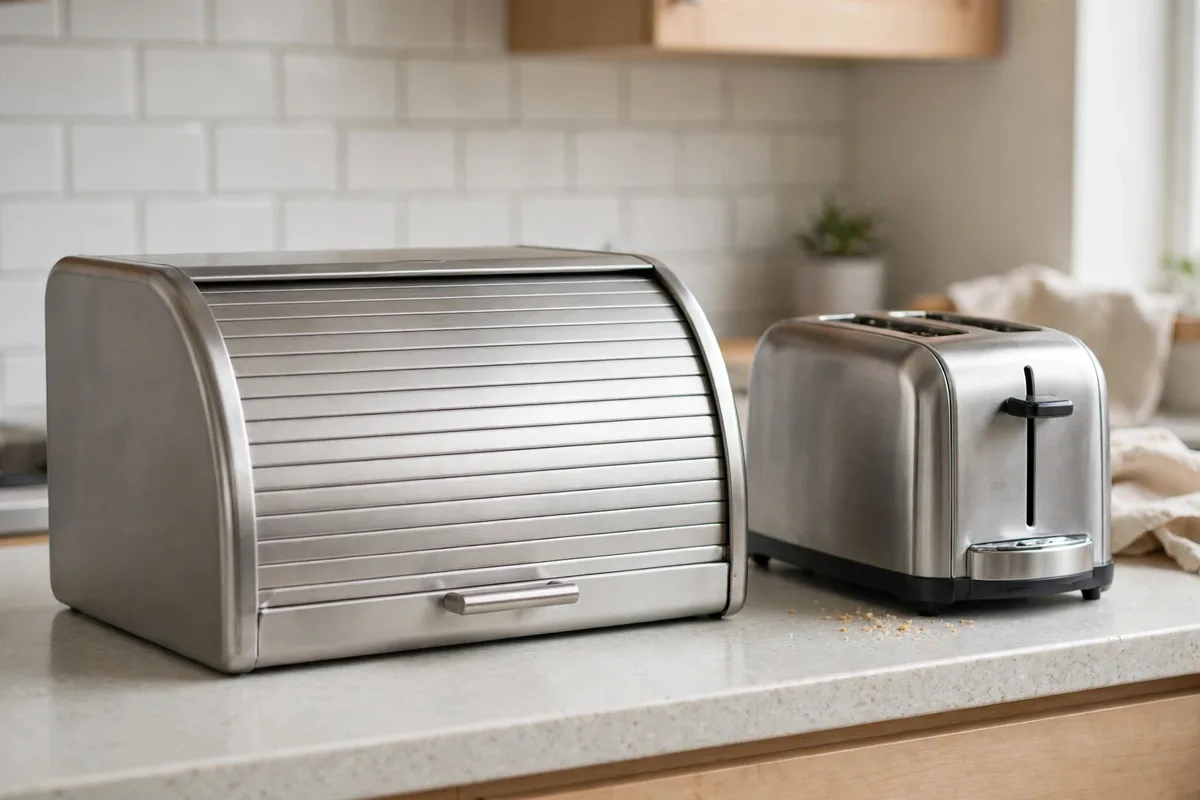
Home Basics’ stainless box is the category’s value play in metal: a roll-top-format steel box with a generous door, a vented back panel, and a price that undercuts the Dutch original several times over. The steel is thinner and the roll action less silky — you feel the economy in the door’s travel — but the fundamentals are right: a smooth interior, real capacity for a family loaf, and a shape that sits tidily under standard cabinets.
In use it performs the box’s core job credibly: bread keeps better than in the bag, the counter looks intentional, and the interior wipes clean. The venting is on the minimal side, so in humid kitchens soft loaves should be checked a day earlier than the Brabantia schedule; crusty loaves, which prefer drier air, suit it well. Owner reports are the usual budget pattern — most boxes serve for years, a minority arrive with a door that needs a nudge — and the price makes that gamble rational.
For a first bread box, a cottage, or a household testing whether the category earns counter space at all, this is the sensible spend. It is stocked widely in Canadian home stores, which makes the see-it-first purchase easy. If it converts you to bread-box life, the Brabantia is the upgrade waiting; if it does not, the experiment cost a pizza night.
The budget box’s realistic lifespan, from owner patterns, is three to five years before the door’s travel or the finish gives the owner an excuse — which, at its price, still prices out to less per year than the bag clips and wasted loaves it replaced in the same period.
Yay · Pros
- Real steel box at a fraction of the Dutch price
- Generous door; family-loaf capacity
- Widely stocked in Canadian home stores
Hmm · Cons
- Thinner steel; door action less refined
- Venting is minimal — watch soft loaves
- Finish quality varies by batch in owner reports
Best for: Budget buyers who want steel and a big door Skip if: You want the decade-grade mechanism and finish
4. Suncoo Bamboo Bread Box (Clear Front) — Best bamboo (breathable)
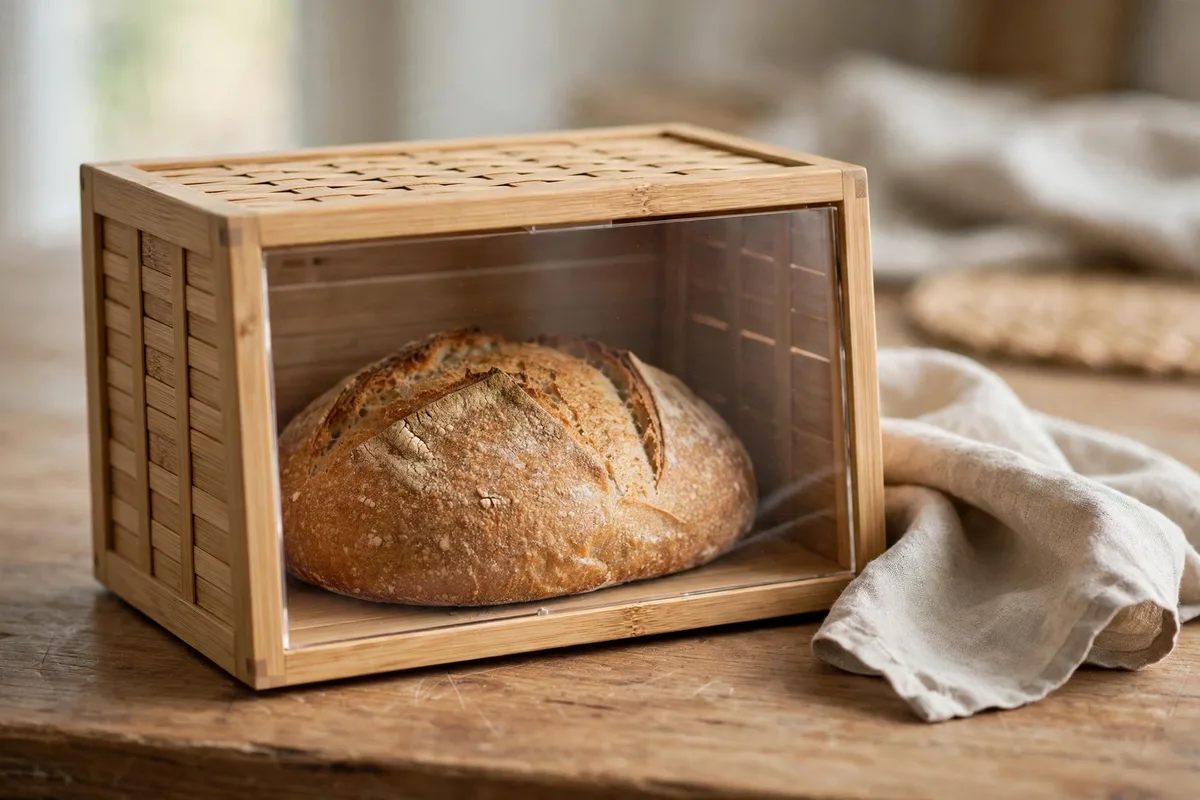
Bamboo changes the physics: the material itself breathes, absorbing and releasing small amounts of moisture, so a bamboo box moderates humidity passively without vents at all — the quality sourdough bakers praise, because crusts emerge from bamboo still crackling rather than leathery. Suncoo’s box pairs that material with a clear front panel (so the loaf’s state is visible without opening) and a drop-front door with a magnetic catch, in a footprint sized for a serious single loaf or two smaller ones.
The construction is the honest bamboo pattern: light, warm to the eye, and variable in a way factory steel is not — most owners report tidy joints and smooth doors, a minority report a catch that needed adjusting. Care is the timber routine: crumbs out, a barely-damp wipe, dry fully, never soak. In exchange, the box asks for no shelf above it and looks like furniture rather than equipment, which in open-plan kitchens is a genuine feature.
Canadian availability runs through online retail with the usual marketplace variance; buy where returns are painless. For the sourdough household whose current system is a tea towel and hope, this is the upgrade that matches the bread’s own material logic — wood, air and time, in a box that breathes with the loaf.
Suncoo’s clear front changes behaviour in a way owners mention often: you see the loaf’s remaining third and plan around it, instead of discovering the heel on sandwich day. Visibility, in a storage box, turns out to be a freshness feature of its own.
Yay · Pros
- Bamboo breathes — crusts stay crisp naturally
- Clear front: see the loaf without opening
- Furniture looks; light and quiet door
Hmm · Cons
- Wood needs the dry-wipe routine; no soaking
- Capacity suits one large or two small loaves
- Craftsmanship varies more than factory steel
Best for: Sourdough households wanting natural humidity exchange Skip if: You want dishwasher-simple cleaning — timber asks for a dry wipe
5. Prep Naturals Bamboo Bread Box (Double Layer) — Best double-decker
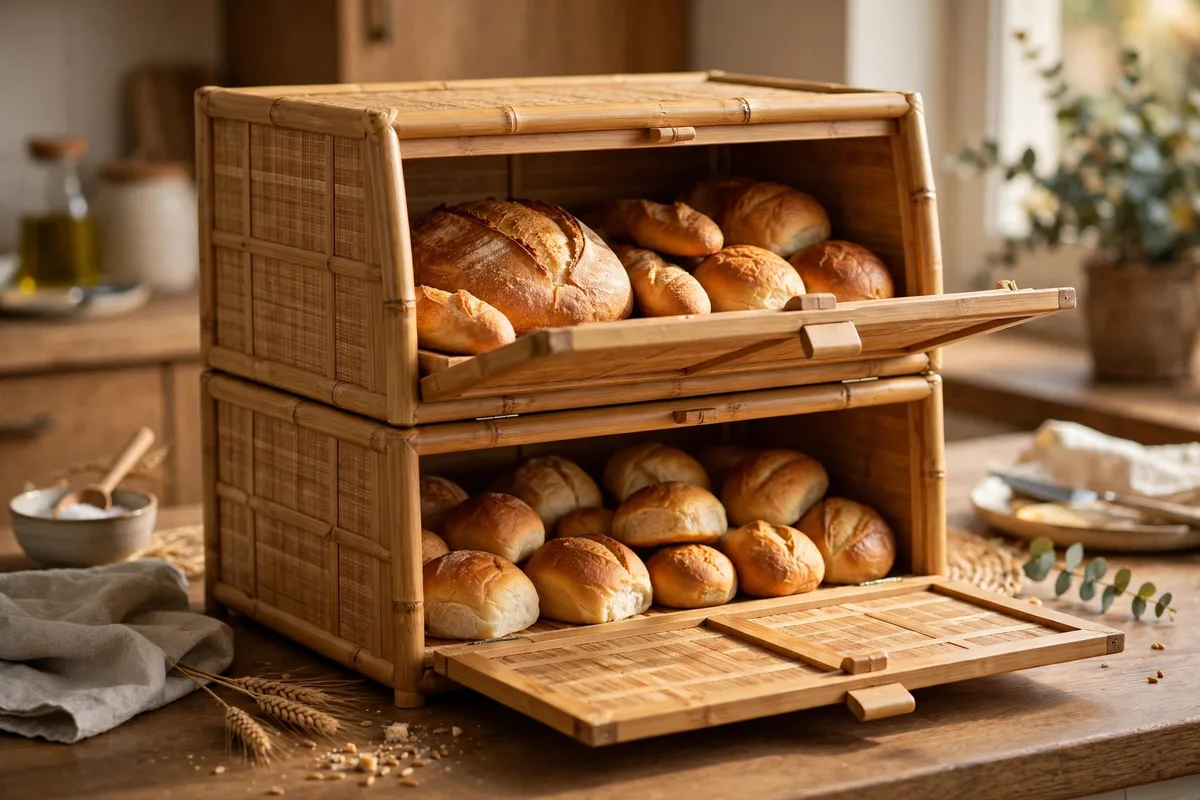
Prep Naturals builds the two-storey answer: a double-decker bamboo box whose two compartments separate the household’s bread economy — sourdough below, sandwich loaf and buns above — each with its own drop-front door, so opening one does not vent the other. For families whose bread box doubles as the pastry and bagel station, the separation is the feature: humidity and crumbs stay in their lanes, and the counter’s clutter compresses into one handsome footprint.
The bamboo construction breathes as bamboo does, moderating both compartments gently, and the flat top takes a fruit bowl or the toaster’s parking spot. The footprint is the honest cost — this is the largest box in the guide, and it wants a counter with room to be furniture. Assembly, where required, is the usual bamboo pattern of clear instructions and a few minutes with the included hardware; owner reports describe a sturdy result.
In Canada it sells through online channels at a price that reflects the two-box-in-one proposition. Households currently running a bread box plus a counter pile — the universal second system — will find the maths persuasive: one object, two climates, no pile. Measure first; if it fits, it consolidates beautifully.
The double-decker’s compartments also solve the household negotiation nobody lists as a feature: one person’s crusty sourdough and another’s soft sandwich loaf stop compromising each other’s air. Two breads, two climates, zero daily diplomacy — families rate this higher than the capacity itself.
Yay · Pros
- Two compartments, two climates, one footprint
- Separates crusty and soft storage properly
- Flat top adds a storage surface
Hmm · Cons
- Large footprint — measure the counter
- Timber care routine, like all bamboo
- Top tier only suits flatter items
Best for: Two-loaf households and bread-plus-pastry storage Skip if: Counter space is tight — this is the biggest box here
The humidity paradox: why bread dies three different ways
Bread stales fastest at refrigerator temperature, because cold accelerates the starch recrystallization that causes staling — the fridge is bread’s worst home, and a countertop box is its best. Bread staling is not drying, exactly — it is starch retrogradation, the starch molecules recrystallizing and squeezing out water, a process that runs fastest at refrigerator temperature, which is why the fridge is bread’s worst home and the counter its best. A bread box’s job is to hold the loaf’s own humidity in a narrow band: enough moisture retained that the crumb stays supple, enough exchanged that the crust stays crisp and mould stays discouraged. Sealed plastic traps the full humidity and softens crust to leather while inviting mould; open air dries the crumb within a day. The box is the engineered middle.
That is why venting is the category’s real specification. Adjustable vents let you tune the exchange to your kitchen’s humidity and your bread’s crust; fixed small vents (the Brabantia pattern) assume an average kitchen and serve it well; bamboo’s natural micro-exchange is the passive version of the same idea. None of them perform magic — a crusty loaf still peaks on day one — but the difference between a good box and a plastic bag across days two and three is the difference between toast-worthy and bin-worthy.
Mould deserves its plain sentence: a bread box slows mould by avoiding the sealed, saturated environment spores love, but it does not sterilize anything, and a box that is never wiped becomes its own spore reservoir. The two-minute weekly wipe — crumbs out, a vinegar-damp cloth, dry before reloading — is the maintenance the category actually runs on. Boxes whose interiors resist that wipe (raw wood needs the dry version of it) carry their care honestly in their sections above.
Sliced sandwich bread plays by different rules: its preservatives and soft crust are designed for the bag, and a box gains it little beyond counter order. The box earns its footprint for bakery loaves, sourdough, rye and homemade bread — the breads with crusts worth protecting and no preservative shield. Households that bake or buy artisan loaves are the audience; households living on bagged sliced bread should spend the money on the bread itself.
Finally, size the box to the loaf, not the counter’s spare corner: a box too large for its contents exchanges too much air per loaf and underperforms its design, while a crammed box crushes crusts. One-loaf households should buy the compact sizes and resist the two-loaf estate models. The paradox resolves simply — the right-sized box, wiped weekly, turns a two-day loaf into a four-day one, and that is the whole, honest promise of the category.
One sizing fact deserves its own paragraph because listings obscure it: a bread box’s litre rating counts the whole interior, but a loaf needs clearance on every side for air to circulate — a box rated just above your loaf’s volume will underperform a roomier one, and the standard 16- to 17-inch boxes in this guide fit a 900 g bakery loaf with exactly that working clearance.
The category’s most common disappointment is not the box but the starting point: no humidity band can resurrect a loaf that was already stale when it went in, so judge any box by what it does for a fresh loaf across days two to four.
Bread box questions, answered
Do bread boxes really keep bread fresh longer?
For bakery and homemade loaves, measurably yes: a ventilated box holds humidity in the band that keeps crumb supple and crust crisp, typically doubling a crusty loaf’s good days versus a plastic bag (which softens crust and invites mould) or open air (which dries it). For preservative-rich sliced sandwich bread, the gain is mostly tidiness — that bread was engineered for its bag.
Should I refrigerate bread instead?
Never the fridge — refrigeration is the temperature zone where starch retrogradation (staling) runs fastest, so fridged bread stales quicker than counter bread. For longer keeping, slice and freeze in a sealed bag, then toast from frozen; freezing halts staling entirely. The box owns days one to four; the freezer owns everything after.
What is better for sourdough: a vented or sealed box?
It depends on your bread: crusty artisan loaves prefer a vented or bamboo box that lets the crust breathe, while softer loaves tolerate sealed steel well. Adjustable-vent designs split the difference and suit mixed households. The universal rule is to avoid the fully sealed plastic environment for anything with a crust worth keeping.
How do I stop mould in a bread box?
Weekly: empty the crumbs, wipe the interior with a cloth dampened with diluted vinegar, and let it dry fully before reloading. Crumbs and moisture are mould’s whole business plan. Wood and bamboo boxes get the same routine with a barely-damp cloth and immediate drying — never soak timber.
What size bread box do I need?
Match the box to your largest regular loaf with a little air around it — most family loaves suit the standard 16- to 17-inch boxes in this guide. A box much larger than its contents underperforms (too much air exchange per loaf), and a crammed box crushes crusts. One-loaf households should choose the compact sizes without apology.
Can I store pastries and rolls in a bread box too?
Buns and rolls, briefly, yes — a day or two in the box beats the counter. Pastries with fillings, glazes or custard belong in the fridge for food-safety reasons regardless of the box’s charms, and croissants lose their shatter in any enclosed space. The box is a bread tool; let it be a great one rather than a general one.
Placement is the box’s last variable: keep it away from the oven’s heat vent and the dishwasher’s steam plume, both of which pump warm moisture past the box’s defences and undo its careful humidity balance. A shaded stretch of counter, out of direct sun, is the bread box’s natural habitat — and a loaf stored there will outlast the same loaf in the same box parked beside the stove, which is the cheapest freshness upgrade in this entire guide.
The short version
Buy the Brabantia Roll Top for the classic steel answer, or its Fall Front sibling if your loaves are tall and homemade. Bamboo breathes best for sourdough — the Suncoo for one loaf, the Prep Naturals double-decker for a family’s whole bread economy — and the Home Basics is the honest budget test drive. Whatever you choose: wipe it weekly, never fridge the bread, and freeze what the box cannot save by day four.
Last updated: November 18, 2026. We refresh this guide each season and whenever a pick is replaced by a better one.