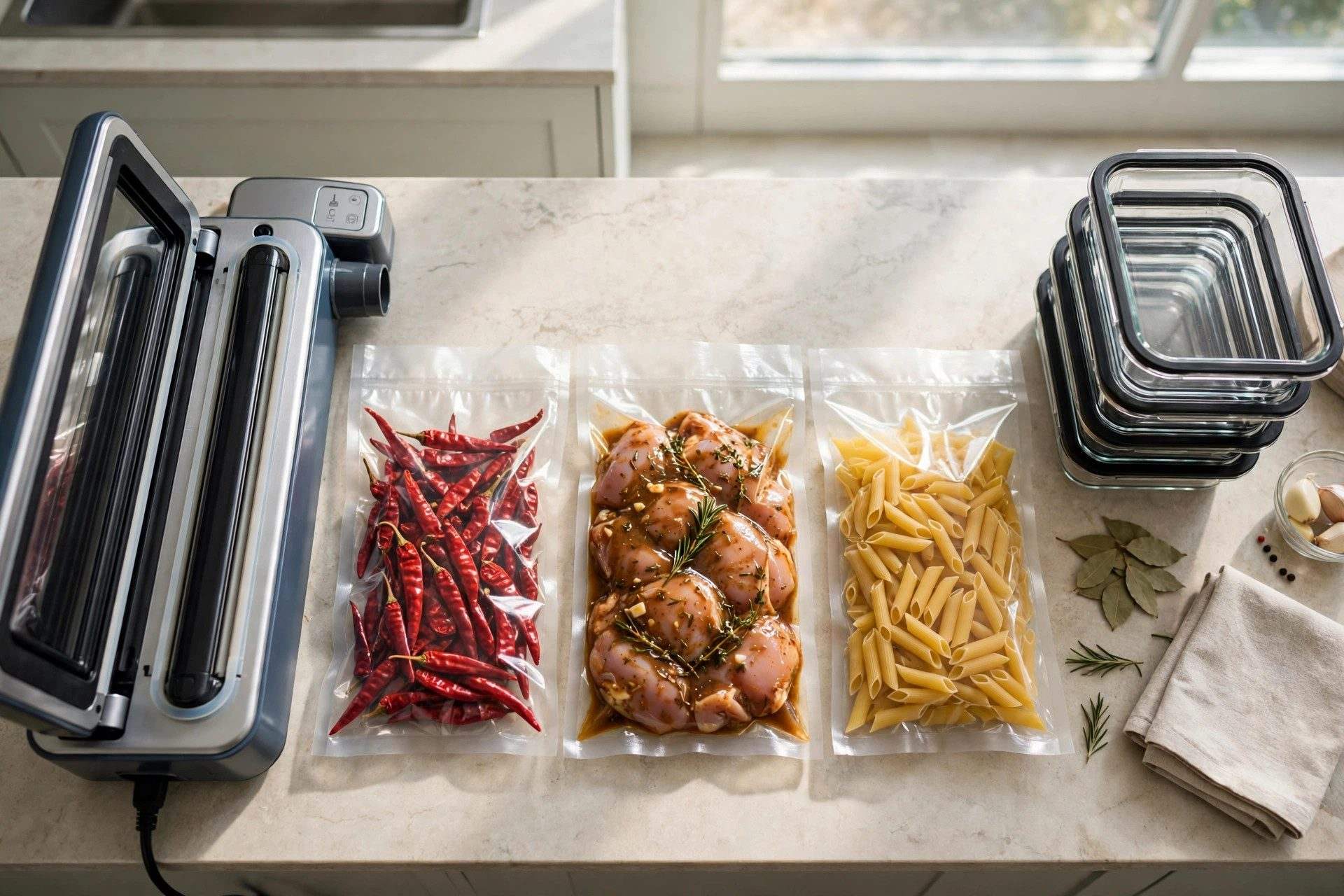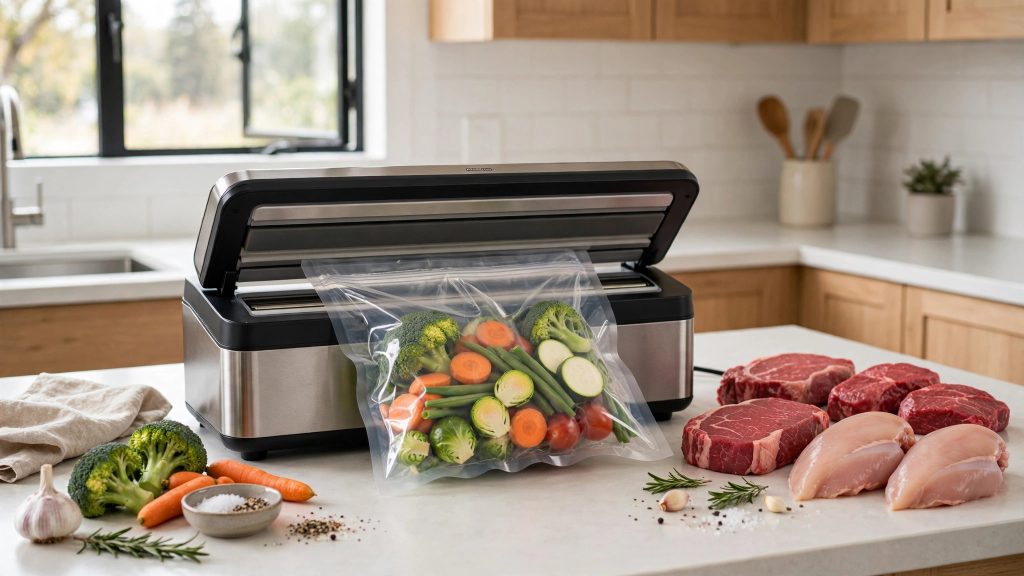
If you are shopping for the best vacuum sealers, start with the seal itself — not the suction number on the box. A vacuum sealer earns its counter space months later, when a bag of ground beef comes out of the freezer without freezer burn and a seal has not quietly let go. Strong suction with a weak, single seal is how good food gets wasted slowly.
This guide ranks the nine vacuum sealers that matter in 2026 for home kitchens in Canada and the USA, from compact edge sealers for occasional use to chamber machines that can seal a bag of soup. We built the list from the hands-on testing and published findings of the expert outlets that test this category — including Serious Eats’ vacuum sealer testing, Wirecutter, BestReviews and Epicurious — cross-checked against manufacturer specifications and current Canadian and US availability. One honest note up front: these outlets do not publish a single comparable numeric score across the whole field, so we have not invented one — where testers disagreed about a model, we say so.
The split that matters most is edge versus chamber. An edge (suction) sealer pulls air out through the open end of a textured bag and suits most homes; a chamber sealer evacuates the whole chamber the bag sits in, which is why it can seal liquids cleanly and use plain, smooth pouches. This guide includes both, because the right answer depends on whether you mostly freeze meat or regularly seal marinades, soups and sous vide bags.
Best Vacuum Sealers at a Glance
- Nesco Deluxe VS-12 — Best Overall Vacuum Sealer
- Anova Precision Vacuum Sealer Pro — Best for Wet Foods and Sous Vide
- Anova Precision Vacuum Sealer (ANVS01) — Best Compact Vacuum Sealer
- Mueller Vacuum Sealer — Best Budget Vacuum Sealer
- FoodSaver V4840 — Best for Automatic, Hands-Off Sealing
- Weston Pro-2300 — Best for Large Cuts and Heavy Batches
- Anova Precision Chamber Vacuum Sealer — Best Home Chamber Sealer with Extra Functions
- Avid Armor USV20 — Best Compact Chamber Sealer for Liquids
- VacMaster VP210 — Best Heavy-Duty Chamber Sealer
How we score
The scores in this guide are CookSmartPicks’ own editorial ratings. We set them from our research of the expert reviews and sources listed in this post — they are our ratings, not scores quoted from another publication.
1. Nesco Deluxe VS-12 — Best Overall Vacuum Sealer
Among the best vacuum sealers, this is the rare machine two independent test programs landed on. Serious Eats named the Nesco Deluxe VS-12 a co-winner of its 10-model test, saying it “aced all of our tests”: it produced one of the smallest amounts of freezer burn in the three-month frozen beef test, yet its gentle setting broke a minimal amount of delicate cereal. It is also the only model in that test offering a choice of a single (dry or moist) or a double seal, with roll storage and a cutter positioned to feed straight into the sealing bar, plus a hose accessory for canisters. Wirecutter has long-term tested the VS-12 since 2017 and reports that ground beef and pork chops sealed with it showed minimal freezer burn after more than two years, with no broken seals.
Epicurious’ tested guide reached a similar verdict from a different angle, rating the VS-12 its best affordable pick: performance nearly identical to its top pick, a digital countdown display, wet and dry modes plus pulse, and a lower profile. Serious Eats measured its vacuum at 25 inHg — the strongest figure in its test group. Judge the trade-offs honestly, though: Serious Eats found it on the noisier side, with the longest wait between seals of its favourites (about 60 seconds) and no removable drip tray, and it cannot be stored with the handle locked, which makes it slightly awkward in a cabinet.
Yay · Pros
- Co-winner of Serious Eats’ 10-model test; minimal freezer burn in long-term tests by both Serious Eats and Wirecutter
- Only tested model with a choice of single or double seal, plus gentle and manual pulse control
- Built-in roll storage and cutter; canister hose included
- Works with any brand of vacuum sealer bags
Hmm · Cons
- About a 60-second wait between seals — slow for very large batches (Serious Eats)
- On the noisier side, and no removable drip tray
- Cannot be stored with the handle in the locked position
Check Price on Amazon.ca Check Price on Amazon.com
2. Anova Precision Vacuum Sealer Pro — Best for Wet Foods and Sous Vide
The Anova Pro is Serious Eats’ other co-winner, and the one to buy if your bags regularly contain liquid. Serious Eats found it was one of the only models that explicitly allows liquids in the bag and can seal with moisture in or on the bag — and its high-power double seal stood up to every test, including the harshest one in the program: 36 hours in a 197°F water bath. It also has no wait time between seals, rated by the manufacturer for up to 100 continuous sealings, which makes a bulk-freezing session dramatically faster than on machines that force a cool-down pause.
The built-in roll storage and cutter are so well placed that Serious Eats’ testers found themselves using this machine to cut bags for other models. Wirecutter likewise concluded the Anova Pro “offers the best combination of powerful suction and useful features” in its guide, after sealing meat, nuts, crackers and fruit and checking the seals over several months. The honest downside is cost and little else: Serious Eats noted that, outside of sales, it costs more than the Nesco above — “it was hard to think of something not to like.”
Yay · Pros
- Double seal survived Serious Eats’ 36-hour, high-temperature water-bath test
- Explicitly rated for sealing wet foods and liquids — rare for an edge sealer
- No wait between seals; built-in roll storage and cutter
- Wirecutter pick for best combination of suction and features
Hmm · Cons
- Costs more than the Nesco VS-12 when not on sale
- Still an edge sealer — free liquid in a bag needs care and headspace
- Accessory hose and containers add to the total setup
Check Price on Amazon.ca Check Price on Amazon.com
3. Anova Precision Vacuum Sealer (ANVS01) — Best Compact Vacuum Sealer
If a vacuum sealer only earns its keep if it disappears into a drawer, this is the pick. Serious Eats named the original Anova Precision Vacuum Sealer its best compact model: sleek, simple and easy to store at just 2 lb 5 oz, with three buttons — vacuum and seal, seal only, and manual pulse — that make it genuinely beginner-friendly. Wirecutter reached the same conclusion for small kitchens, calling the ANVS01 one of the smallest models it tested and the right option if you plan to vacuum-seal only occasionally.
Know what the small size trades away. Serious Eats measured noticeably weaker vacuum than the Pro version, the compact Anova is not recommended for use with wet items (though it survived the testers’ liquid-rich test without an issue), and it did not do quite as well in the frozen beef test. There is no cutter or roll storage, though it comes with 10 pre-cut bags to start. For occasional portions and sous vide for one or two, those are sensible trades; for a chest freezer you fill every autumn, step up to the Pro or the Nesco.
Yay · Pros
- Smallest, lightest full sealer here — stores in a drawer
- Three-button controls; manual pulse for delicate foods
- No wait time between seals (Serious Eats)
- Recommended by both Serious Eats and Wirecutter for small kitchens
Hmm · Cons
- Weaker vacuum than the Pro; not recommended for wet items
- No built-in cutter or roll storage
- Slightly weaker long-term freezer results in Serious Eats’ beef test
Check Price on Amazon.ca Check Price on Amazon.com
4. Mueller Vacuum Sealer — Best Budget Vacuum Sealer
The Mueller is the proof that the basics of vacuum sealing do not require a big machine or a big spend. Serious Eats named it its best affordable vacuum sealer after it “did pretty well in every test we put it through, even against models sold at triple the price,” with all the major functions, an air suction hose for canisters, and one of the lightest bodies in the test at 2 lb 12 oz. Its seals also held strong through prolonged high-temperature testing, which is exactly where cheap seals usually fail.
The compromises are about control and convenience, not the seal itself. There is no manual or pulse function, so in Serious Eats’ delicate-food test it crushed the cereal the Nesco and Anovas could protect; there is no double seal, no built-in bag storage or cutter, so you cut bags yourself; liquids are not explicitly allowed; and the roughly 40-second wait between seals is on the longer side. If you mostly seal dry goods, cheese and portions of meat — and can pre-freeze anything juicy — it is the value pick of this guide.
Yay · Pros
- Serious Eats’ best affordable pick — performed well against far costlier models
- Seals held through prolonged, high-temperature testing
- Very light and compact; canister hose included
- All the major basic functions, nothing to learn
Hmm · Cons
- No manual/pulse mode — crushed delicate foods in testing
- No double seal, no bag storage or cutter
- About a 40-second wait between seals; liquids not explicitly allowed
Check Price on Amazon.ca Check Price on Amazon.com
5. FoodSaver V4840 — Best for Automatic, Hands-Off Sealing
FoodSaver is the brand most buyers meet first, and the V4840 is its full-featured 2-in-1 design: automatic bag detection starts the cycle for you, built-in roll storage and a cutter make custom bags, and a built-in handheld accessory seals FoodSaver zipper bags, canisters and marinating containers without a separate hose setup. America’s Test Kitchen’s published vacuum sealer coverage has listed the V4840 among its highly recommended models, and for a beginner who wants the machine to make the decisions, the automation is the appeal.
Here is where we have to be straight with you, because the hands-on testers were cooler on it. In Serious Eats’ program the V4840 was consigned to “the competition”: it offers the Anova Pro’s feature list in a much larger, heavier package, its automatic bag detection can be clumsy — a curled bag end may not be detected at all — and it needs at least an inch of bag before it recognises one, wasting plastic. Most importantly, its single seal gave trouble under long, hot conditions, and Serious Eats recorded the FoodSaver’s seal failing in the extended water-bath test where the double-seal machines held. Buy it for automation and the accessory ecosystem, not for marathon sous vide.
Yay · Pros
- Automatic bag detection — the most hands-off operation here
- Built-in handheld sealer covers zipper bags, canisters and marinators
- Roll storage and cutter built in; the widest retail accessory ecosystem
- Listed among America’s Test Kitchen’s highly recommended models
Hmm · Cons
- Single seal failed Serious Eats’ extended high-temperature water-bath test
- Bag detection can be clumsy and wastes bag length
- Large and heavy compared with the Anova Pro it competes with
Check Price on Amazon.ca Check Price on Amazon.com
6. Weston Pro-2300 — Best for Large Cuts and Heavy Batches
The Weston Pro-2300 is the edge sealer built like a small commercial machine: a double-piston pump, a fan-cooled motor made for repetitive use, and an extra-wide sealing bar — about 15 inches — that takes the wide bags a whole brisket, a side of salmon or a hunter’s harvest actually needs, where standard 11-inch machines simply cannot close the bag. Wirecutter’s guide credits it with “an extra-wide sealing bar and a powerful vacuum for packaging large cuts of meat,” and it offers both automatic one-touch operation and a manual mode for delicate items.
Wirecutter also recorded the quality caveat we will not hide: the Teflon tape covering its heating bar began to peel after only a couple of uses in its testing, which is why it is a specialist pick rather than our overall winner. It is also a big, heavy, countertop-committed machine with no roll storage, and its manual advises waiting between cycles to protect the seal bar. If your sealing life is bulk meat days, no compact model substitutes for the wide bar and fan-cooled motor; if it is weeknight portions, everything above it on this list is easier to live with.
Yay · Pros
- Extra-wide, roughly 15-inch seal bar — the widest here, for large cuts
- Double-piston pump and fan-cooled motor built for repetitive batches
- Powerful vacuum for large cuts of meat (Wirecutter)
- Automatic and manual seal modes
Hmm · Cons
- Seal-bar Teflon tape began peeling after a couple of uses in Wirecutter’s testing
- Big and heavy; a permanent countertop resident
- No built-in roll storage or cutter
Check Price on Amazon.ca Check Price on Amazon.com
7. Anova Precision Chamber Vacuum Sealer — Best Home Chamber Sealer with Extra Functions
This is the chamber machine built for home cooks rather than delis. Serious Eats tested it for more than a month — sealing pork loins and salmon for sous vide, ground turkey and fries for the freezer — and found it easy and intuitive, with a touchscreen offering normal and strong vacuum and seal settings. Because the whole chamber is evacuated, liquids stay in the bag instead of being dragged toward a pump, and the extra functions are the fun part: infuse/extract, dry/cool, and a compress/pickle mode that turned out tasty quick dill pickles and daikon kimchi in minutes.
Serious Eats was equally clear about the limits. Moist proteins sometimes kept small air pockets where meat met plastic (harmless in its sous vide cooks, but not the perfect vacuum expected), ground turkey juices were pressed out and formed ice crystals in the freezer, and delicate cereal cracked under the pressure release — a chamber machine has no gentle mode. It is also cube-shaped and bulky outside (about 8 x 13.5 x 10.25 inches, 23 lb) yet only about four inches deep inside, and its tests found Anova’s own chamber pouches sealed best. Buy it for liquids, marinades and kitchen experiments — not as a first sealer for simple freezer portions.
Yay · Pros
- Seals liquids and marinades cleanly — the chamber advantage, in a home-size machine
- Infuse, compress/pickle and dry/cool functions no edge sealer offers
- Easy touchscreen controls in Serious Eats’ month-long test
- Sealed foods cooked sous vide without issues in testing
Hmm · Cons
- Small air pockets remained on moist meats in Serious Eats’ tests
- No gentle mode — delicate foods can crack under pressure release
- Bulky outside, shallow inside (about 4 inches deep); brand pouches performed best
Check Price on Amazon.ca Check Price on Amazon.com
8. Avid Armor USV20 — Best Compact Chamber Sealer for Liquids
The USV20 is the chamber sealer for people who want the liquid-sealing physics without a commercial footprint. In comparative chamber-sealer testing roundups, it consistently lands as the home pick: a stainless chamber of about four litres behind an 11.5-inch seal bar, adjustable vacuum time, a marinate function, and a dry piston pump that never needs oil — all in a body of roughly 17.5 lb that one person can lift onto the counter, where most chamber machines are furniture. Chamber bags for it are the plain, smooth pouches chamber machines use, which are simpler than the textured bags edge sealers require.
Treat it as a serious tool with serious-tool trade-offs. The chamber limits you to what fits inside it — this is a portion and batch machine, not a whole-turkey machine — and reviewers note the warranty is short for a machine in this class, so the value case rests on years of use. It also costs several times what a good edge sealer costs. If soups, sauces, stocks and marinated meats are your weekly reality, the roundups’ verdict is that this is the smallest machine that seals them properly; if they are not, the Anova Pro above handles ordinary wet foods for far less commitment.
Yay · Pros
- True chamber sealing of soups, sauces and marinades in a movable, home-size body
- 11.5-inch seal bar and adjustable vacuum time; marinate function
- Oil-free dry piston pump — no pump maintenance
- Uses plain smooth chamber pouches rather than textured edge-sealer bags
Hmm · Cons
- Chamber size caps bag and food size — portions, not bulk carcasses
- Short warranty for its class, noted in comparative coverage
- Costs several times a good edge sealer
Check Price on Amazon.ca Check Price on Amazon.com
9. VacMaster VP210 — Best Heavy-Duty Chamber Sealer
The VP210 is the step from home chamber machines toward the deli counter: a commercial-style chamber sealer with a 10.25-inch seal bar, double seals, and room for bags up to about 10 x 13 inches. The Spruce Eats’ chamber coverage highlighted its durability and performance, and its defining practical feature is the pump: a maintenance-free dry (air) pump, so unlike oil-pump chamber machines there are no oil levels to check and no oil changes — plug it in and seal soups, sauces and stocks as often as you like.
Be clear-eyed about what “commercial-style” means at home. Comparative roundups put the VP210 at roughly 72 lb — it needs a permanent home on a counter or cart, not a cupboard — and the learning curve is steeper than a three-button edge sealer’s. Dry pumps also do not pull quite as deep a vacuum as the oil-pump commercial models, a difference roundups found negligible for ordinary freezer storage and sous vide but worth knowing. For a household that portions bulk buys, garden produce and batch cooking every week, it is the buy-once end of this guide.
Yay · Pros
- Commercial-style chamber durability, highlighted by The Spruce Eats
- Maintenance-free dry pump — no oil changes, ever
- Double seal on a 10.25-inch bar; seals liquids cleanly
- Built for frequent, high-volume batch work
Hmm · Cons
- Very heavy (roughly 72 lb in roundup specs) — needs a permanent spot
- Steeper learning curve than an edge sealer
- Dry pump pulls slightly less deep vacuum than oil-pump commercial models
Check Price on Amazon.ca Check Price on Amazon.com
How to Choose the Best Vacuum Sealers
Decide edge versus chamber first — it decides everything else. Serious Eats limited its main test to suction (edge) sealers for home use because chamber machines are larger and far more expensive, and Wirecutter likewise recommends external sealers for most homes: more powerful than handhelds, smaller and cheaper than chamber models. Choose a chamber sealer only if sealing liquids, soups and marinades is a core job, or your volume is genuinely weekly and large — the chamber models above start where the edge sealers’ prices end, and they live permanently on a counter.
Judge the seal, then the suction, then the wait time. Serious Eats’ central finding was that seal quality decided its long tests: double seals (Nesco VS-12 on its double setting, Anova Pro) survived 36 hours of high-temperature water bath and months in the freezer, while single seals were the ones that failed. Suction cuts both ways — the strongest vacuum crushed delicate food unless the machine offered a gentle or pulse mode — and the wait between seals (the refractory period) ranged from none on the Anovas to about 60 seconds on the Nesco, which is the difference between a fast batch session and a slow one.
Match the controls to your wettest, softest food. For moist foods in an edge sealer, Serious Eats found headspace is the hidden spec: with less than about 10 to 12 inches between food and seal, liquid gets pulled into the machine and prevents sealing. A moist mode, a gentle/pulse setting and a removable drip tray are what make wet food routine rather than risky. Never vacuum seal raw garlic, raw onions or mushrooms — Serious Eats and food-safety guidance warn these create anaerobic conditions and gases that can break seals and harbour dangerous bacteria — and keep vacuum-sealed perishables refrigerated or frozen, since sealing is not preservation by itself.
Budget for bags, not just the machine. Edge sealers need textured (embossed) bags or rolls; rolls you cut yourself cost less per bag than pre-cut bags, and a built-in roll holder and cutter (Nesco, Anova Pro, FoodSaver V4840) quietly saves money and waste on every bag. Serious Eats’ criteria add a rule worth copying: unless there is a very good reason, a sealer should not lock you into brand-specific bags, so you can shop around. Chamber machines flip the economics — they use plain smooth pouches — but the machines themselves cost far more.
Sealing is only half of a food-storage system. The sealed portions themselves stack neatly beside the picks in our food storage container guide, the batch cooking that fills those bags starts in our multi-cooker guide, and for the fries, wings and reheats on the other side of the freezer door, our air fryer guide completes the kitchen. If freezer burn is the problem you are solving, the best vacuum sealers above are the shortlist to start from.
Frequently Asked Questions
How much do vacuum sealer bags cost over time?
Bags are the real running cost, and the format decides it. Rolls you cut to length are the cheapest way to seal with an edge sealer, pre-cut textured bags cost more per bag for the convenience, and machines that accept any brand of bag — like the Nesco VS-12 — let you shop sales instead of paying one brand’s shelf price. Chamber sealers use plain smooth pouches, a different and generally simpler bag type, which is one reason heavy users accept the chamber machines’ higher purchase cost.
Can you vacuum seal wet foods and liquids?
Wet foods, yes, with the right machine and technique; free liquids, realistically only with a chamber sealer. Serious Eats found the Anova Pro was one of the only edge sealers explicitly rated for liquids in the bag, and its tests showed bag headspace of about 10 to 12 inches is what keeps liquid out of the machine on an edge sealer — pre-freezing juicy food first is the classic workaround. A chamber sealer evacuates the whole chamber instead of sucking through the bag, so soups, sauces and marinades seal without being dragged toward a pump.
Do I need a vacuum sealer for sous vide?
For most sous vide cooking, yes — a tight, water-tight seal keeps water out of the bag and food in full contact with the bath. Every sealer in Serious Eats’ test sealed a bone-in pork chop that survived a four-hour cook, but the extended test separated them: seals were pushed for 36 hours at 197°F, and double seals were the ones that held while some single seals failed past the 12-hour mark. If long cooks are your plan, choose a double-seal model like the Nesco VS-12 on its double setting or the Anova Pro.
Does vacuum sealing really prevent freezer burn?
It is the most effective home defence, because freezer burn is driven by air and moisture migration at the food’s surface — remove the air and the process slows dramatically. The long tests are the evidence: Serious Eats froze sealed ground beef for three months and checked monthly for freezer burn against a zipper-bag control, with its winning machines showing the least damage, and Wirecutter’s beef and pork sealed with the Nesco VS-12 showed minimal freezer burn after more than two years with no broken seals. The seal has to hold, which is why seal quality outranks raw suction in this guide.
Is a chamber vacuum sealer worth it over an edge sealer?
Only if liquids or volume are your main jobs. A chamber machine seals soups and marinades cleanly, uses plain pouches, and runs batch after batch; in exchange it costs several times more, weighs far more, and the food has to fit inside the chamber — Serious Eats found its home chamber test unit bulky outside yet only about four inches deep inside. For weekly freezer portions of meat and vegetables, a good edge sealer like the Nesco VS-12 or Anova Pro does the same job on a fraction of the counter.
Last updated: November 1, 2026