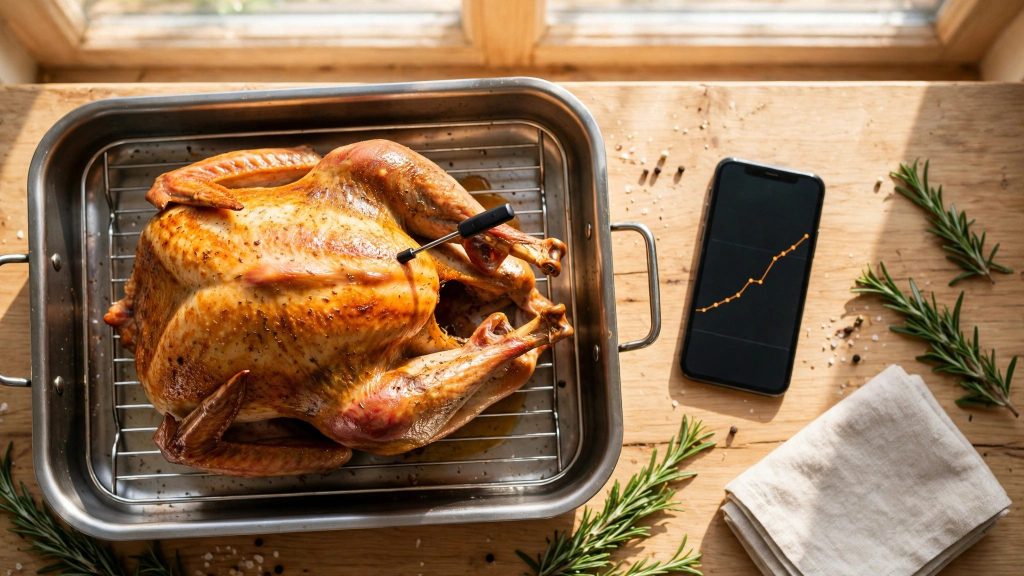
Best Wireless Meat Thermometer for Turkey: Hands-Off Probes for Christmas Roasts
This guide compares the best wireless meat thermometer for turkey by the standard that matters on December 25: can you leave the bird alone and go be a host? It is research-based — built from named testers’ published results, manufacturer specifications and USDA food-safety guidance, not from hands-on testing in our own kitchen. Where another site’s test or verdict is quoted, it is named. Last updated: November 6, 2026.
A turkey punishes hovering. Every oven-door opening dumps heat, stretches the cook and dries the breast, and a big Christmas bird can spend four hours in the oven while its cook is also making sides, gravy and conversation. That is the whole case for a wireless probe: it goes into the thickest part of the breast before the pan goes in, and it reports to your phone — or to a base station on the counter — until the meat reaches temperature. No door openings, no guessing, no carving into the bird to check the juices. But the category is full of headline numbers that collapse in a real kitchen: open-field range claims measured across empty air, accuracy figures that only apply to part of the range, and ambient heat ratings that decide whether a probe survives a sear or a hot roast. We ranked six leave-in probes on the numbers underneath the marketing: connection type, heat rating, sensor honesty and what independent testers actually found.
Leave-In, Wired or Instant-Read: Decide How You Want to Cook
Three shapes answer the same question — is it done? — at different moments. An instant-read answers in one to three seconds when you open the oven and poke the meat; America’s Test Kitchen’s testers, summarised in Slopsheets’ 19-model comparison, are blunt that an instant-read is the one thermometer every kitchen needs. A wired leave-in probe stays in the meat and trails a cable to a countertop box — dependable, app-free, and one more cable to route around a roasting pan. A truly wireless leave-in probe has no cable at all: it sits in the bird and talks to a base or your phone by Bluetooth, Wi-Fi or a low-frequency radio link. For a turkey specifically, wireless earns its premium, because the bird is big, the cook is long, and the cook has other jobs. The safety anchor for everything below is the USDA’s: turkey is done at 165°F in the innermost thigh, the wing joint and the thickest part of the breast — and a probe that reads early or late by several degrees is worse than no probe, which is why accuracy claims get audited in this guide rather than repeated.
How We Judge a Wireless Probe for a Roast
Our criteria, stated up front. Connection that survives a closed oven: metal lids and foil are radio shields, so we separate Bluetooth-only probes from models with a Wi-Fi or radio base, and we treat every range figure as a maker’s claim with conditions attached — TrendyTechTribe’s November 2026 comparison makes the point well, noting that MEATER quotes the same probe at 2,500 feet in open air and about 250 feet as a typical home range. Ambient heat rating: the probe’s handle sits in oven air, not in meat, so its rating — not the internal sensor’s — decides whether it survives a 450°F roast start or a sear; internal sensors on every wireless probe here stop around 212–221°F by design, because that is all meat temperature ever needs. Accuracy band: the stated tolerance, and how much of the cooking range it covers — the field spans roughly ±0.4°F to ±1.8°F in Slopsheets’ spec audit. Prediction honesty: cook-time estimates are models, not measurements; testers found they firm up late in the cook. Ownership: dishwasher-safe probes, battery life across a long roast, and whether the thing still works when your phone dies — a base with its own screen is worth real money on Christmas Day.
At a Glance: Six Wireless Probes for Holiday Roasts
| Model | Probes | Connection | Ambient rating (maker) | Best for |
|---|---|---|---|---|
| MEATER Pro | 1 | Bluetooth (no built-in Wi-Fi) | 1,000°F | The proven single-probe default |
| Typhur Sync One | 1 | Wi-Fi base with its own screen | 752°F | Hosts who do not want to watch a phone |
| MEATER Pro Duo | 2 | Built-in Wi-Fi | 1,000°F | Turkey and ham at the same time |
| Combustion Predictive Thermometer | 1 | Bluetooth; Wi-Fi via booster/display | 900°F peak | Cooks who want a predicted finish time |
| ThermoWorks RFX | 1 (expandable) | Radio link to a Wi-Fi gateway | Maker-rated for roasting and smoking | The strongest signal through metal and foil |
| TempPro TempSpike TP960 | 1 | Bluetooth with booster | 572°F | A first wireless probe on a budget |
The one-line version: buy the MEATER Pro if you want the established single probe and your phone stays nearby; buy the Typhur Sync One if you want a screen on the counter and Wi-Fi reach; buy the MEATER Pro Duo if Christmas means two roasts in two places at once.
How we score
The scores in this guide are CookSmartPicks’ own editorial ratings. We set them from our research of the expert reviews and sources listed in this post — they are our ratings, not scores quoted from another publication.
1. MEATER Pro — The Proven Single Probe
Probes: 1 · Sensors: five internal plus one ambient · Connection: Bluetooth · Ambient rating: 1,000°F · Accuracy claim: ±0.5°F · Cleaning: dishwasher safe
The MEATER Pro is the category’s reference point, and its specification is genuinely strong for roasting: five internal sensors plus an ambient sensor in one cable-free probe, an accuracy claim of ±0.5°F, a dishwasher-safe body, and an ambient rating of 1,000°F that MEATER says covers open flames and searing — the highest handle rating in this guide alongside its Duo sibling. Outdoor Life gave the MEATER app its “Best App” nod and lost no connection over a six-hour smoke, per Slopsheets’ comparison. The honest catch is connectivity architecture: MEATER states plainly that the Pro “does not have built-in WiFi,” so following a cook from another floor means MEATER Link or MEATER Cloud through a second phone or tablet left near the oven (TrendyTechTribe, prices and specs read November 2, 2026). And ownership data cuts both ways: The Backyard Showdown’s October 2026 reliability scoring flagged the Pro’s one-star owner share as the reason it marked the model down despite testers liking it — worth knowing before you pay premium money.
Yay · Pros
- Highest ambient rating here: the probe can stay in through a hot roast start or a sear
- Five internal sensors reduce the cost of slightly-off placement in a big breast
- Dishwasher safe, and the app is the one independent testers praise most
- Sold in Canada by MEATER’s own Canadian storefront as well as in the US
Hmm · Cons
- No built-in Wi-Fi: long-range monitoring needs a second device left near the oven
- Owner reliability reports are mixed — one reliability-focused roundup scores it down for early failures
- Single probe: a turkey and a ham means choosing which one gets watched
Check Price on Amazon.ca Check Price on Amazon.com
2. Typhur Sync One — The Screen on the Counter
Probes: 1 · Connection: Wi-Fi base station with display, plus Bluetooth · Ambient rating: 752°F · Cleaning: dishwasher safe
The Sync One solves the MEATER Pro’s two annoyances in one design: the probe talks to a base station, the base joins your home Wi-Fi, and the base has its own screen — so the turkey’s temperature lives on the counter where the cook actually is, and your phone becomes a second screen instead of the only one. Typhur rates the probe’s ambient limit at 752°F, comfortably above any roasting temperature, and quotes range at 400 feet in open space and 135 feet enclosed — quote the second number to yourself, because a closed oven in a real house is the enclosed case. TrendyTechTribe’s November 2026 roundup placed it as its Wi-Fi-base pick. What it does not have is the Pro’s sear-proof 1,000°F rating or a second probe; and like every model here, its accuracy figure is a maker’s claim — Typhur’s dual-probe flagship carries NIST-verified ±0.5°F, but treat the Sync One’s own tolerance as claimed, not certified, until a lab publishes on it.
Yay · Pros
- Base station with a screen: no phone required to follow the roast
- Wi-Fi reach beats Bluetooth-only probes through walls and floors
- 752°F ambient rating covers any oven roasting temperature
- Dishwasher-safe probe; base doubles as storage and charger
Hmm · Cons
- One probe only — the two-probe version is a different, pricier model
- Enclosed range (about 135 feet) is the honest number, and a foil-wrapped bird still shields signal
- Accuracy is a maker claim; the NIST verification belongs to its bigger sibling
Check Price on Amazon.ca Check Price on Amazon.com
3. MEATER Pro Duo — Two Roasts, Two Probes
Probes: 2 · Connection: built-in Wi-Fi plus Bluetooth · Ambient rating: 1,000°F per probe · Cleaning: dishwasher safe
Christmas is the two-roast holiday: a turkey in the oven and a ham in the second oven, the smoker or the slow cooker — or one probe in the breast and one in the thigh of a very large bird, which is the placement perfectionists actually argue for. The Pro Duo is MEATER’s answer, and it fixes the single Pro’s connectivity gap at the same time: Wi-Fi is built in, so both probes report through your home network rather than depending on a phone left in the kitchen. Each probe keeps the family’s 1,000°F ambient rating and dishwasher-safe build. The costs are literal and practical: it is the most expensive way to watch a turkey in this guide, the block is a bigger piece of countertop, and Typhur’s own head-to-head testing (a brand source, read with that in mind) found the Duo’s readings drifted slightly more than its rival’s and its connection struggled when meat was wrapped in foil — a reminder that no wireless probe loves a foil tent, whatever the brand.
Yay · Pros
- Two probes with built-in Wi-Fi: turkey and ham, or breast and thigh, watched together
- Same 1,000°F ambient rating and dishwasher-safe build as the single Pro
- The established MEATER app and guided-cook system
Hmm · Cons
- The premium option here — two probes cost well beyond any single-probe pick
- Foil wrapping still degrades the connection, as with every wireless probe
- The charging block is a permanent countertop resident
Check Price on Amazon.ca Check Price on Amazon.com
4. Combustion Predictive Thermometer — The One That Forecasts Dinner
Probes: 1 · Sensors: eight along the probe, including a surface sensor · Connection: Bluetooth; Wi-Fi with the booster or display · Ambient rating: 900°F peak, 750°F continuous · Accuracy claim: ±0.4°F on core sensors (maker)
Every other probe here tells you the temperature now. The Combustion tries to tell you when dinner will be ready: it is the only design with a sensor at the meat’s surface as well as its core, and that surface reading is what lets it model carryover cooking and predict a finish time — the specific behaviour AmazingRibs praised, per PulseRevOps’ cross-check of Wirecutter, Serious Eats, AmazingRibs and America’s Test Kitchen findings. Its stated core accuracy of ±0.4°F is the tightest claim in Slopsheets’ 19-model audit. The caveats are equally well documented: ATK’s testers found the app great when it worked, but pairing probe, booster and display took effort, and the cook-time predictions only firmed up near the end of the cook — so plan your sides by the clock, not by the forecast, until the bird is close. Wi-Fi also costs extra here: out of the box it is Bluetooth, and the booster or display that adds range is a second purchase decision.
Yay · Pros
- Surface plus core sensing predicts finish time and carryover — unique in this guide
- Tightest stated accuracy claim of the six, and a safe-temperature alert feature
- 900°F peak ambient rating shrugs off roasting and searing
Hmm · Cons
- Predictions firm up late; early estimates can move a lot
- Wi-Fi needs the booster or display, sold as an add-on
- Setup is the fiddliest here — pair everything before Christmas morning
Check Price on Amazon.ca Check Price on Amazon.com
5. ThermoWorks RFX — The Signal That Gets Through
Probes: 1 in the starter kit, expandable · Connection: radio-frequency link to a Wi-Fi gateway · Design brief: built for smokers and metal cookers
ThermoWorks is the name test kitchens reach for in instant-reads — its Thermapen ONE is the top instant-read in Serious Eats’ meat-thermometer guide, per SimplyTheBest’s six-source analysis — and the RFX is the company’s answer to the wireless category’s weakest point: the link itself. Instead of asking Bluetooth to escape a steel oven, the RFX probe talks by radio frequency to a gateway, and the gateway joins your Wi-Fi; PulseRevOps’ cross-check credits it with 1,000+ feet of measured link range and notes the RF signal punches through metal smoker bodies and foil wrap where Bluetooth simply drops, with Engadget praising its accuracy. For a foil-tented turkey in a heavy oven, that architecture is the argument. The buying caveat is distribution: ThermoWorks sells primarily through its own store, so Amazon availability for the RFX varies by country and season — check both stores below, and if the listing is absent, that is a stocking fact, not a verdict on the instrument.
Yay · Pros
- Radio link plus Wi-Fi gateway: the most drop-resistant connection design here
- From the maker of the test-kitchen standard instant-read
- Expandable system — add probes for multi-roast cooks later
Hmm · Cons
- Amazon listings come and go; ThermoWorks is mainly a direct seller
- The gateway is one more box to place near the oven
- Premium pricing, and the ecosystem rewards buying in
Check Price on Amazon.ca Check Price on Amazon.com
6. TempPro TempSpike TP960 — The Budget Way In
Probes: 1 · Connection: Bluetooth with a signal booster · Ambient rating: 572°F · Accuracy claim: ±1.8°F · Battery: up to 48 hours per charge (maker)
TempPro (the brand formerly called ThermoPro) sells the TempSpike as the affordable version of the same idea: a cable-free probe, a booster to stretch the Bluetooth link — the maker claims 500 feet, and itself notes a smoker or grill lid cuts that, so park the booster beside the oven — and a battery rated for 48 hours, which swallows any roast ever cooked. The Backyard Showdown’s October 2026 testing calls it the wireless probe for a long cook, cheaply, and its needs are honest ones: the probe wants about three inches of meat depth, which a turkey breast provides and a chicken breast may not. The trade-offs are in the small print its own page prints: the ambient sensor is rated to 572°F, so this probe comes out before any sear, and the stated accuracy of ±1.8°F is the loosest in this guide — on a bird you will rest and carryover-cook anyway, set your target a couple of degrees early and verify with an instant-read at the end.
Yay · Pros
- The lowest-cost route to a genuinely cable-free probe
- 48-hour battery claim outlasts any holiday cook
- Booster included, which plain Bluetooth probes lack
Hmm · Cons
- 572°F ambient rating: remove it before searing or broiling
- ±1.8°F stated accuracy is the loosest here — pair it with a spot check
- Needs deep meat; not the probe for thin cuts
Check Price on Amazon.ca Check Price on Amazon.com
Probe Placement: The Two Minutes That Decide Everything
A wireless probe reads where its tip sits, and a turkey offers plenty of wrong places. Push the probe into the thickest part of the breast, angled so the tip sits in the centre of the meat and the probe’s minimum-depth mark is fully buried — a half-seated probe reads oven air at its base and meat at its tip and averages out to a lie. Keep the tip clear of bone, which runs hotter than meat, and clear of the pan. If your bird will be tented with foil for part of the roast, expect the connection to weaken while the foil is on — radio-based models cope best — and do not open the oven to fix a dropped signal; the reading resumes when the foil comes off. Finally, rest the bird: carryover will carry the breast several degrees after it leaves the oven, which is why the predictive model in pick four exists, and why pulling at 160–162°F at the breast with a verified 165°F in the thigh after the rest is how experienced cooks play it. The USDA number is the floor, not a suggestion.
Which One Should You Buy?
One turkey, phone nearby, proven default: MEATER Pro. You want the temperature on the counter, not in an app: Typhur Sync One. Turkey plus ham, or breast plus thigh: MEATER Pro Duo. You plan the whole dinner around a finish time: Combustion Predictive. Your oven eats Bluetooth signals: ThermoWorks RFX. First probe, smallest budget: TempPro TempSpike. Pair whichever you choose with the pan it will live in — our guide to the best roasting pan for turkey sizes five pans by bird weight and checks them against real oven interiors — and with the carving end of the meal: our best electric knives roundup covers the slice itself, and the best knife sets guide covers the manual route.
Frequently Asked Questions
What temperature should a Christmas turkey reach?
The USDA’s safe minimum is 165°F, checked in the innermost part of the thigh, the wing joint and the thickest part of the breast. Rest the bird tented for at least 20 minutes before carving: carryover heat evens out the temperatures, the juices settle back into the meat, and your final readings climb a few degrees.
Wireless vs instant-read thermometer for turkey — which do I need?
They do different jobs. A wireless leave-in probe watches the whole roast and warns you before the bird overshoots, which is what a four-hour turkey needs. An instant-read verifies in seconds at the end, in spots the probe was not sitting. Serious cooks own both; if budget forces one choice for roasting, choose the leave-in.
Can a wireless probe stay in the turkey for the whole roast?
Yes — that is what it is built for, provided its ambient rating clears your oven temperature. Every pick in this guide is rated at 572°F or far higher, and roasting happens at 325–450°F. The exception is searing and broiling: only the 900–1,000°F-rated probes should stay in over open flame or under a broiler.
Why does my wireless thermometer keep losing connection in the oven?
Because a closed oven is a metal box, and foil makes it a better one. Bluetooth has to escape through seals and glass, so it drops first; Wi-Fi bases placed near the oven do better, and radio-link systems like the RFX were designed specifically to punch through metal and foil. Moving the base closer fixes most drops.
Is a wireless meat thermometer worth it for roasting?
For a turkey, yes: the cook is long, the meat is expensive, and every door opening to check costs heat and moisture. A leave-in probe turns doneness from a guess into a notification, and it earns its keep the first time it saves a holiday bird. For weeknight chicken breasts, an instant-read alone is honestly enough.
Last updated: November 6, 2026. Prices and availability change frequently — use the buttons above to check the current price on Amazon.ca or Amazon.com before you buy.