Best Vegetable Chopper with Container: Six Choppers Ranked on Prep Time and Cleanup
This guide compares the best vegetable chopper with container by the two numbers that decide whether a gadget survives in a real kitchen: how long the prep takes, and how long the cleanup takes after it. It is research-based — built from named testers’ published results and manufacturer specifications, not from hands-on testing in our own kitchen. Where another site’s test or verdict is quoted, it is named. Last updated: November 6, 2026.
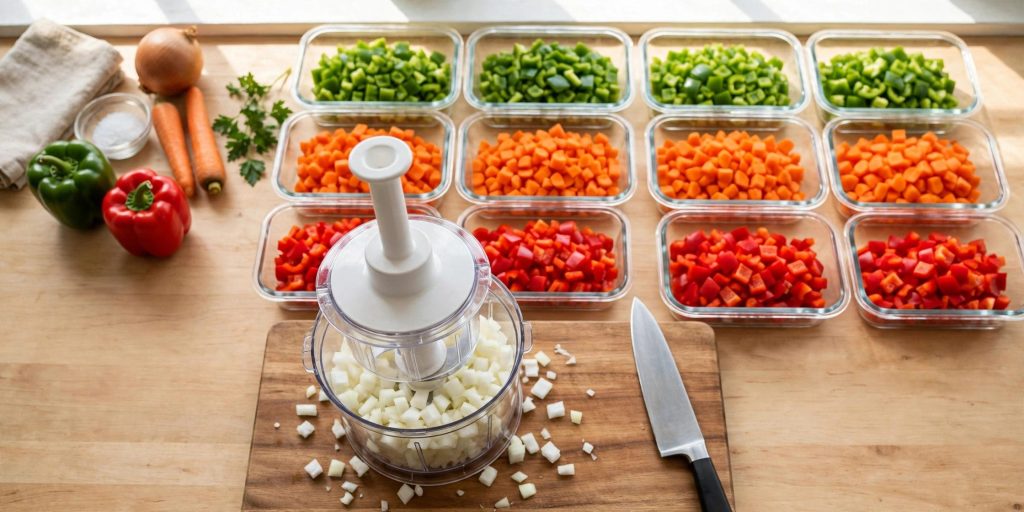
Every vegetable chopper promises to save you time, and on the chopping itself most of them deliver: a press chopper turns a halved onion into a uniform dice in seconds, with no tears and no knife skills. The lie hides in the second half of the job. A chopper with five inserts to wash, a blade grid that traps onion skins, and a container too small for a family-sized batch can hand back every minute it saved — at the sink, with your fingers near a blade grid. So this guide ranks six choppers the way meal preppers actually live with them: dice quality and effort first, container capacity second (measured in onions, not marketing cups), and cleanup third — including the question nobody asks until week three, which is whether you can buy a replacement blade when the grid dulls. Google Ads data tracked by Trendosaur puts the category at an estimated 63,400 US searches in both November and December 2025, the holiday and meal-prep peak; the field below is the six models the independent testers keep converging on.
Three Designs, Three Different Deals
Press choppers push food through a fixed blade grid into a container: fastest for uniform dice, one vegetable at a time, and the grid is the part your fingers meet at washing time. Multi-insert kits add slicers, julienne blades, graters and spiralizers around the same press idea — more capability, more parts, more storage, more washing. Pull-cord choppers spin blades inside a bowl with a tug of a cord: nothing to press down on, kind to weak grips, but they mince rather than dice. And small electrics chop in a work bowl at a button press — the true low-effort option, with a cord, a counter footprint and results closer to a rough mince than a dice. The container question runs through all four: a catch box around one litre handles a couple of onions before it needs emptying, while the largest here holds roughly five cups, enough for a full prep session. Size claims conflict between makers and testers on almost every model below, so we give both where they disagree.
How We Judge a Meal-Prep Chopper
Our criteria, stated up front — and stated as the test protocol we will publish results against when our own units arrive. The timed prep test: one onion, one bell pepper, two carrots; clock the full job including emptying the container. Dice quality: uniform pieces versus the wedges and mush a dull or flexing grid produces, and how much force hard vegetables demand — the axis on which Food & Wine’s testing separated its winner. The cleanup test: time from counter to cupboard, counting parts, whether the blade grid rinses clean or needs picking, and which parts are genuinely dishwasher-safe versus hand-wash in the small print. Ownership: are replacement blades sold at all, is there a warranty in writing, and what do roundups report about grids dulling or housings loosening over months of weekly use. A chopper is a wear item pretending to be an appliance; we grade it as one.
At a Glance: Six Choppers With Containers
| Chopper | Type | Container | Blades in the box | Dishwasher | Replacement blades |
|---|---|---|---|---|---|
| Mueller Pro-Series 10-in-1 | Press + inserts | About 4–7.5 cups (sources differ) | 8 | Top rack | Not sold |
| Fullstar Pro Original 4-in-1 | Press + inserts | About 5 cups | 4 | Top rack | Yes |
| Vidalia Chop Wizard | Press | 2 cups | 2 grids | Yes | Not sold |
| Kuhn Rikon Pull Chop | Pull-cord | About 2 cups | 1 blade unit | Bowl and blades | Not sold |
| Ninja Express Chop | Electric | 16 oz (2 cups) | Stacked blade | Parts yes | Not sold |
| Cuisinart Elemental Chopper/Grinder | Electric | Work bowl, larger batches | Reversible blade | Parts yes | Not sold |
The one-line version: buy the Mueller Pro-Series 10-in-1 for the easiest press and the most uniform dice; buy the Fullstar Pro Original if you prep weekly and want replacement blades to exist when the grid dulls; buy the Kuhn Rikon Pull Chop if pressing down is the part your hands object to.
How we score
The scores in this guide are CookSmartPicks’ own editorial ratings. We set them from our research of the expert reviews and sources listed in this post — they are our ratings, not scores quoted from another publication.
1. Mueller Pro-Series 10-in-1 — The Easiest Press in the Field
Type: Press chopper with insert kit · Blades: 8 (two dice grids, slicer, wavy, julienne, three graters, per KEOUKE’s spec audit) · Container: 7.5 cups by the maker; about 4 cups as measured by Food & Wine · Size: 11.2 × 5.5 × 5.2 in
The Mueller earns first place on the evidence of the labs that measured effort. Food & Wine named it Best Overall because it “required the least amount of pressure” of the choppers tested while producing “extremely uniform pieces,” and Reviewed’s head-to-head against the Fullstar found the Mueller’s “blades are much sharper, resulting in cleaner cuts,” including celery the Fullstar choked on — celery being the grid chopper’s classic failure, all strings and jamming. KEOUKE’s November 2026 comparison, which checked the field against nine test kitchens, ranks it first overall on the same logic: cut quality and effort first, then capacity and ownership. The ownership file is where the shine comes off, and we will not hide it: KEOUKE’s audit found no replacement blades sold for this model and no warranty term stated in writing, which makes the Mueller a consumable with a premium feel — excellent while the grid is sharp, on your own when it is not.
Yay · Pros
- Least pressing force and most uniform dice in Food & Wine’s testing
- Eight inserts cover dice, slice, julienne and grating in one container system
- Handles celery and pepper skins that jam lesser grids
- All parts top-rack dishwasher safe
Hmm · Cons
- No replacement blades sold and no written warranty term found — when the grid dulls, the unit is done
- Container capacity is overstated by the maker versus tester measurement
- Hard vegetables still need a firm two-handed press
Check Price on Amazon.ca Check Price on Amazon.com
2. Fullstar Pro Original 4-in-1 — The Weekly Prepper’s Workhorse
Type: Press chopper with insert kit · Blades: 4 (two dice grids, spiralizer, ribbon) · Container: about 5 cups · Blades: 420 stainless, rust-resistant per the maker
If the Mueller is the sprinter, the Fullstar is the marathoner. It is the chopper in the viral videos — four inserts instead of eight, a five-cup catch container, a soft-grip handle and a non-skid base — and it tops or nearly tops most of the field’s roundups: Antifoodie’s October 2026 test of five Amazon bestsellers calls it “the one that just works,” praising the even dice across onions, peppers and potatoes and genuinely dishwasher-safe parts, and KEOUKE ranks it best for meal prep specifically. The deciding detail for a weekly prepper is in KEOUKE’s ownership column: Fullstar sells replacement blades, and the Mueller does not. A grid you can renew for a few dollars beats a sharper grid you have to landfill. The honest limits: the fine grid struggles with celery strings (Reviewed, via KEOUKE), four inserts still means four parts to wash and store, and the blade edges demand respect at the sink — Antifoodie’s reviewer names rinsing the grid as the one real safety complaint in an otherwise easy cleanup.
Yay · Pros
- Replacement blades are sold — the only press kit here you can actually maintain
- Five-cup container swallows a full prep session without mid-task emptying
- Even dice on the everyday vegetables, per hands-on roundups
- Soft-grip handle and non-skid base keep it planted under a firm press
Hmm · Cons
- Fibrous vegetables like celery can jam the fine grid
- Four inserts to wash, dry and store after every session
- Blade grids are genuinely sharp at rinsing time — use the cleaning comb, not fingers
Check Price on Amazon.ca Check Price on Amazon.com
3. Vidalia Chop Wizard — The Original, Still the Onion Answer
Type: Press chopper, single purpose · Blades: 2 grids · Container: 2 cups, with measurement marks
The Chop Wizard is the “as seen on TV” original this whole category descends from, and its survival is the review: one moving part, two blade grids, a two-cup container, and a press that turns a whole onion into a uniform dice in about two seconds with zero tears — Antifoodie’s summary gives it a long-running 4.6-star owner average and calls it dead simple, which is exactly the point. There is nothing to configure and almost nothing to store, and every part goes in the dishwasher. What you give up is everything else: the two-cup container empties twice during a family-sized batch, there is no slicer or julienne, soft tomatoes crush rather than dice, and the grid size you get is the grid size there is. For a household whose chopper use is 90 percent onions for weeknight cooking, that trade is not a compromise at all — it is the correct amount of gadget.
Yay · Pros
- The simplest mechanism in the field: one press, one part to wash
- Onion dice in seconds, tear-free, with a marked measuring container
- Fully dishwasher safe and small enough for a drawer
- Decades-long track record at a budget price
Hmm · Cons
- Two-cup container means mid-batch emptying on big prep days
- Dice only — no slicing, julienne or grating
- Soft produce crushes instead of cutting cleanly
Check Price on Amazon.ca Check Price on Amazon.com
4. Kuhn Rikon Pull Chop — For Hands That Hate Pressing
Type: Pull-cord chopper · Container: about 2 cups · Result: mince to coarse chop, controlled by pull count
Every press chopper in this guide asks for the same thing: body weight through the palms, again and again. The Pull Chop asks for something else entirely — a few tugs on a cord, like starting a tiny lawn mower, while blades spin inside a sealed bowl. Antifoodie places it as the quiet, no-blade-touching option for garlic, herbs and nuts, and that is its honest territory: five pulls for a coarse chop, fifteen for a fine mince, nothing pressed, nothing forced, and no grid for onion skins to weld themselves into at cleanup. It will not give you a dice — the result is a chop, uneven in the way hand-chopping is uneven — and the bowl is a two-cup affair suited to salsa, gremolata, nuts and herbs rather than a Sunday batch of peppers. As the second chopper in a kitchen, or the first chopper for arthritic hands, it solves a problem the other five do not touch.
Yay · Pros
- No pressing force at all — the grip-friendliest design here
- Sealed bowl: no tears, no flying onion, no countertop scatter
- Rinses clean without fingers meeting a blade grid
- Chop size is controlled by pull count, coarse to fine
Hmm · Cons
- Chops and minces; it cannot produce a uniform dice
- Small bowl — a flavour-base tool, not a batch-prep tool
- The cord mechanism is one more thing that can eventually wear
Check Price on Amazon.ca Check Price on Amazon.com
5. Ninja Express Chop — The Electric Shortcut for Small Batches
Type: Electric mini chopper · Container: 16 oz (2 cups) · Control: one-touch pulse
The Express Chop is the pick that keeps appearing whenever testers sort this category by format: the best electric in multiple roundups, and The Vegetable Chopper’s choice for tiny kitchens. Its deal is simple — a stacked blade in a two-cup bowl, one big pulse button, and chopped onions, salsa or nuts in seconds with zero physical effort, which makes it the other honest answer for cooks whose hands cannot press or pull. The limits are the format’s limits: two cups is a small batch, the result is a chop that goes past dice to mince if you hold the button a second too long, and a corded appliance with a motor base is a bigger storage and washing commitment than a plastic press. If your prep is mostly small and frequent rather than one big Sunday session, those limits may never bind. For the wider electric field, our dedicated guide to electric mini food choppers goes deeper on this format alone.
Yay · Pros
- Zero-effort chopping: one button, no pressing or pulling
- Consistent results on salsa, nuts, herbs and onion in seconds
- Small footprint; parts go in the dishwasher
- The established budget electric in roundup after roundup
Hmm · Cons
- Two-cup bowl means batch cooking happens in relays
- Easy to over-process dice into mince
- Motor base cannot be immersed; one more cord on the counter
Check Price on Amazon.ca Check Price on Amazon.com
6. Cuisinart Elemental Chopper/Grinder — The Electric for Volume
Type: Electric chopper/grinder · Role: hard roots, nuts and sauces at batch scale
Where the Ninja covers small electric jobs, The Vegetable Chopper’s testing puts the Cuisinart Elemental as the best electric outright — the one that “handles hard roots, nuts and sauces that would wreck a plastic blade frame” and the pick if you prep in volume. That is the dividing line in this guide: a press grid asks the vegetable to be weaker than the blade, and mostly it is — until sweet potato, hard carrot or a double batch of nuts arrives, at which point motor torque stops being a luxury. The Elemental’s reversible blade also grinds spices and works sauces and purées, territory no manual here enters. The costs are counter space, noise, and a work bowl and blade that still need washing like everything else; and like every electric, it minces more readily than it dices. Buy it as a small food processor that happens to chop, not as a dice machine, and it will not disappoint.
Yay · Pros
- Motor torque handles hard roots and nuts that stall press grids
- Grinds and purées as well as chops — a small-processor skill set
- Batch capacity beyond the two-cup minis
- Named best electric in format-focused testing
Hmm · Cons
- Counter footprint and noise the manuals do not have
- Chops toward mince; not a uniform-dice tool
- Overkill — in size and price class — for a nightly single onion
Check Price on Amazon.ca Check Price on Amazon.com
Cleanup, Honestly: Where Choppers Give the Time Back
Three patterns from the roundups are worth more than any single pick. First, the grid is the job: every press chopper’s cleanup is really about one blade insert, and the included cleaning comb or a brush under running water — never fingertips — is the difference between thirty seconds and five minutes. Second, dishwasher-safe is a spectrum: the press kits here are top-rack safe as systems, but tester notes flag blade inserts as the parts that age fastest in a dishwasher, and one long-term roundup reported container measurement markings fading after repeated cycles — hand-rinsing the grid while everything else rides the top rack is the ownership compromise most weekly preppers land on. Third, part count is cleanup time: the Chop Wizard washes in under a minute because it is one part; an eight-insert kit never will. Choose your chopper by the cleanup you will actually do in February, not the demo you watched in November.
Which One Should You Buy?
Best dice with least effort: Mueller Pro-Series 10-in-1. Weekly meal prep, maintained for years: Fullstar Pro Original 4-in-1. Onions, nightly, nothing else: Vidalia Chop Wizard. Weak grip or arthritic hands: Kuhn Rikon Pull Chop for manual, Ninja Express Chop for electric. Hard roots and volume: Cuisinart Elemental. Then close the loop on prep day: chopped vegetables keep best in the best glass meal prep containers from our storage guide, the batches themselves freeze flatter with the machines in our best vacuum sealer for meal prep guide, and the knife work that remains goes faster with the best knife sets we have ranked.
Frequently Asked Questions
Are vegetable choppers worth it for meal prep?
Yes, if your prep involves repeated dice — onions, peppers, carrots, celery — in weekly volume. A press chopper turns each onion into uniform pieces in seconds with no tears, and testers consistently measure the saving in minutes per session. For one onion on a Tuesday, a knife is honestly just as fast once washing is counted.
Can you put a vegetable chopper in the dishwasher?
Mostly, yes: the press choppers in this guide are top-rack dishwasher safe as systems, and the electrics’ bowls and blades are too. The exception in spirit is the blade grid itself — testers note inserts age fastest in the dishwasher, so many owners rinse the grid by hand and let the container and lid ride the rack.
Vegetable chopper vs food processor — which is better for weekly prep?
For dice, the chopper: it produces uniform cubes a processor cannot, at a fraction of the washing-up. For volume, sauces, doughs and hard roots, the processor or an electric chopper wins on torque. Most meal preppers end up with a press chopper for the weekly dice and reach for a processor only when a recipe demands it.
How do you clean a vegetable chopper without cutting yourself?
Rinse the blade grid immediately, before food dries into it, and clear stuck pieces with the cleaning comb or a stiff brush — never with fingertips, because grid blades are sharp in both directions. Work under running water so debris floats free, let the grid air-dry, and store inserts in their case rather than loose in a drawer.
What is the best vegetable chopper for arthritic hands?
Skip the press designs: they need firm downward force through the palms. A pull-cord chopper like the Kuhn Rikon Pull Chop replaces pressing with a light tugging motion, and an electric like the Ninja Express Chop removes effort almost entirely — one button, no grip strength required. Both chop rather than dice; that is the honest trade.
Last updated: November 6, 2026. Prices and availability change frequently — use the buttons above to check the current price on Amazon.ca or Amazon.com before you buy.