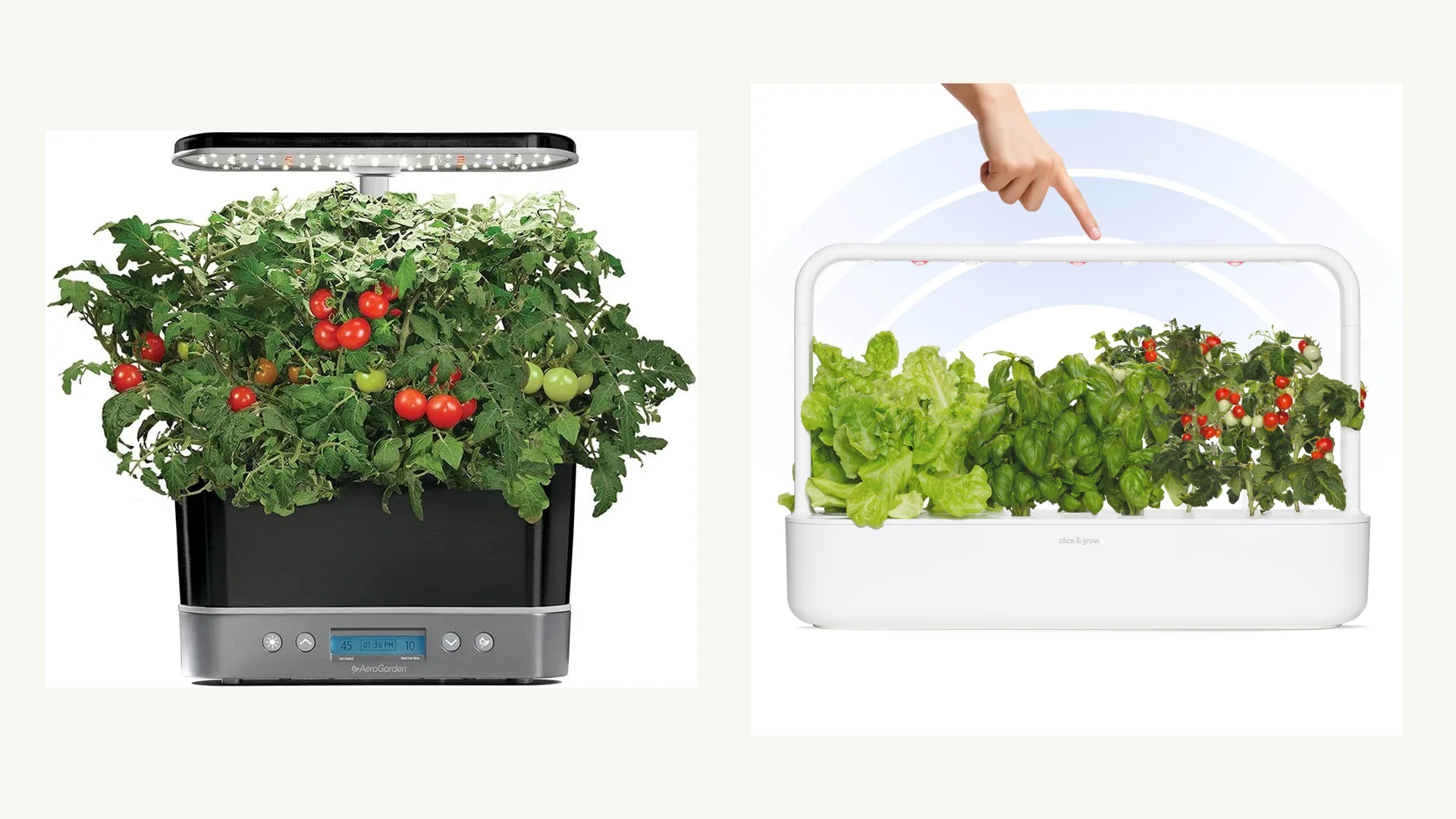
Fresh basil in January is the whole pitch of an indoor herb garden, and the modern versions actually deliver it: a water tank, an LED light on a timer, and plants growing in water or smart soil with no windowsill required. The ten gardens here split into two philosophies. The brand ecosystems — AeroGarden and Click and Grow — sell you pre-seeded pods and do everything for you. The open systems — iDOO, LETPOT, Ahopegarden — take generic sponges and your own seed, and cost far less to feed. Gardyn, the tower, plays a different sport entirely.
One piece of recent history belongs up front, because it affects buying advice. AeroGarden — the biggest name in this category — paused operations in late 2025 and relaunched in spring 2026 under Scotts Miracle-Gro. The gardens and pods are on sale again, and we still recommend two of them below, but that pause is exactly the risk of a closed ecosystem, and it is priced into their scores. Where a garden sits in this list reflects its hardware and the company standing behind its refills.
Smart Indoor Herb Gardens at a Glance
| Garden | Pods | Light | Best for |
|---|---|---|---|
| AeroGarden Harvest Elite | 6 | 20W LED | The default AeroGarden for most kitchens |
| AeroGarden Bounty | 9 | 40W LED | Tall plants — tomatoes and peppers, 24 in of height |
| AeroGarden Sprout | 3 | 10W LED | The tiniest starter — while clearance stock lasts |
| Click and Grow Smart Garden 3 | 3 | 8W LED | Lowest upkeep — no pump, wick-fed pods |
| Click and Grow Smart Garden 9 PRO | 9 | 13W LED | Best overall smart garden in this guide |
| iDOO 12-Pod Hydroponics Growing System | 12 | 22W LED | Value: 12 pods, own seed, no app |
| LETPOT LPH-SE | 12 | 24W LED | App control outside the big ecosystems |
| LETPOT LPH-Max | 21 + 2 | 36W LED | Maximum automation — auto water and feeding |
| Ahopegarden 10-Pod | 10 | LED, 16h timer | Budget 10-pod with taller headroom |
| Gardyn Studio 2 | 16 plants | 52W LED | A vertical tower for serious greens |
How We Researched This Guide
CookSmartPicks is a research-based guide. We do not run a test kitchen, and we never claim hands-on testing we have not done. For this guide we compared manufacturer specifications (AeroGarden/Scotts, Click and Grow, LETPOT, iDOO, Ahopegarden and Gardyn manuals and listings) with independent coverage — Wirecutter, The Spruce, Good Housekeeping, Food Network and specialist hydroponics publications — plus retailer listings in Canada and the USA and owner reviews. The AeroGarden pause-and-relaunch timeline and the Sprout clearance status come from 2026 retail coverage, rechecked at build time. Product photos are the makers' own listing photos, each checked against the named model.
Where a product carries scores in this guide, they are CookSmartPicks editorial scores. Running Costs is where the ecosystems separate: proprietary pods cost more per crop than generic sponges and your own seed, and the scores say so.
How we score
The scores in this guide are CookSmartPicks’ own editorial ratings. We set them from our research of the expert reviews and sources listed in this post — they are our ratings, not scores quoted from another publication.
1. AeroGarden Harvest Elite — Best AeroGarden for Most Kitchens
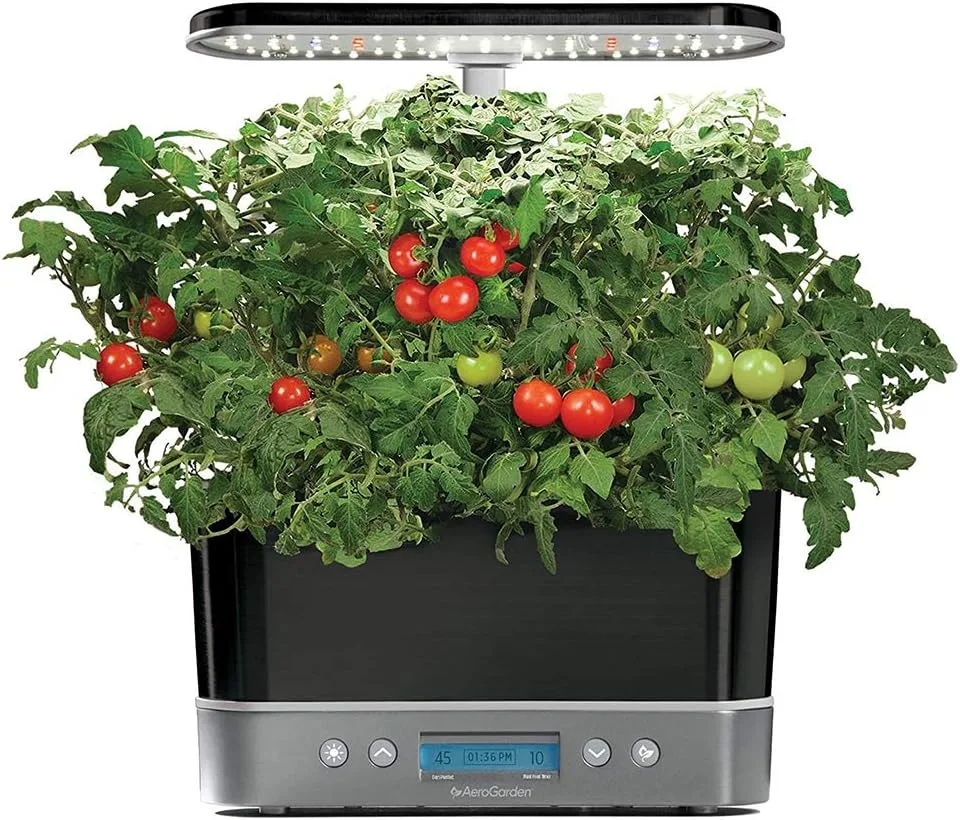
The Harvest line is the default AeroGarden for a reason, and the Elite is its best-equipped form: six pods under a 20W LED, 12 inches of grow height, a digital display with water and plant-food reminders, and a vacation mode that stretches the tank while you are away. A herb seed kit and liquid plant food are in the box, so the first crop starts the day it arrives. The Spruce, Good Housekeeping and Wirecutter coverage all treat the Harvest as the standard six-pod pick — the deepest independent record in this guide.
Two cautions, both about the ecosystem rather than the garden. Refills are proprietary pods, so your running costs are AeroGarden's prices. And the brand's late-2025 pause, reversed with a spring-2026 relaunch, is recent enough that we score the ecosystem risk openly. The hardware earns its place; just buy it knowing the pods are a subscription in disguise.
Yay · Pros
- 20W LED, automatic timer, 12-inch grow height
- Digital display, water and food reminders, vacation mode
- Herb kit and liquid plant food included
- Deepest independent coverage in this guide
Hmm · Cons
- Brand paused in late 2025, relaunched spring 2026
- Proprietary pods tie costs to one ecosystem
- 6 pods fill quickly once herbs bush out
Best for: most kitchens wanting a proven garden. Skip if: anyone avoiding a single-brand ecosystem — see iDOO or LETPOT.
2. AeroGarden Bounty — Best for Tall Plants and Bigger Harvests
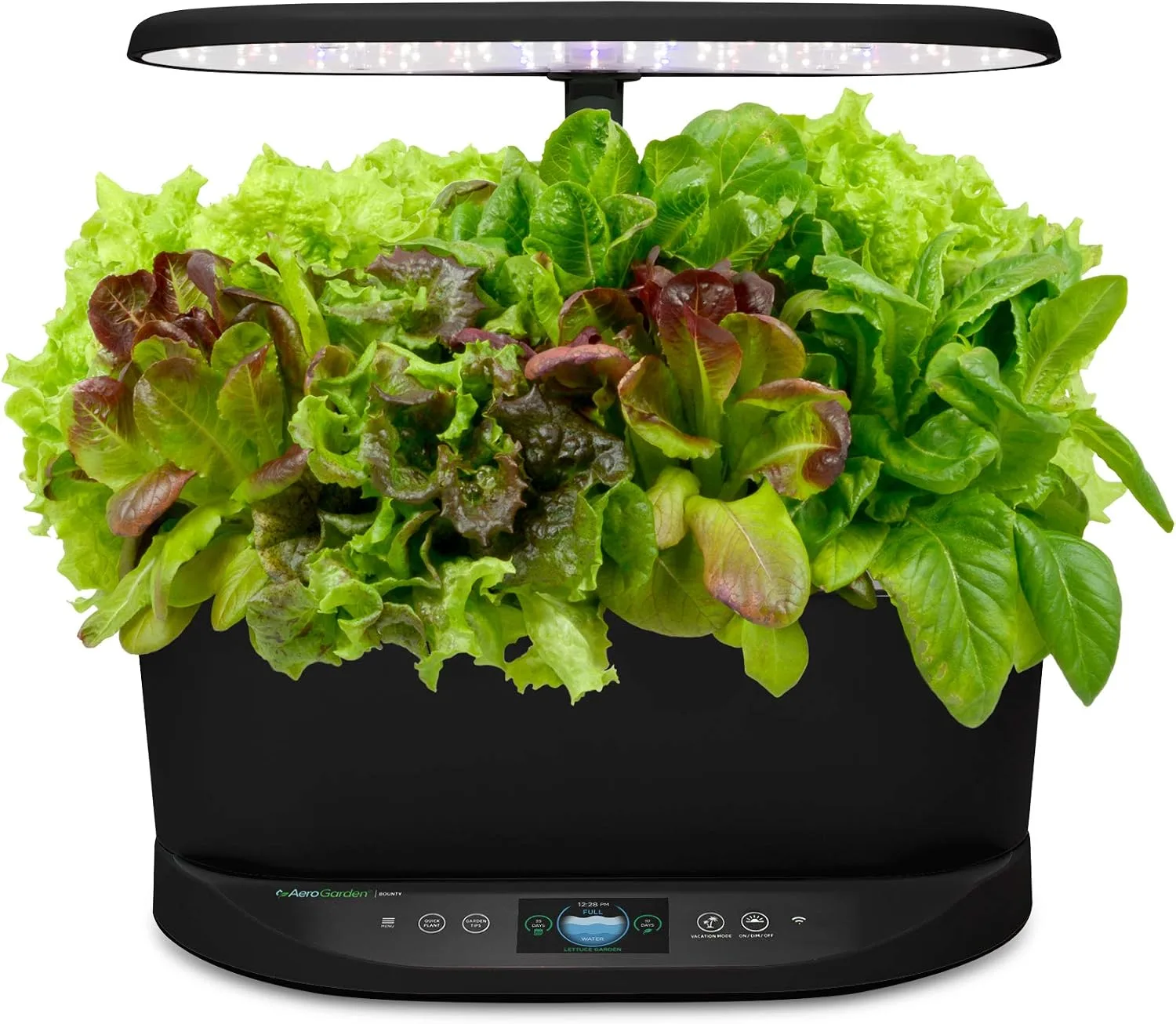
Everything about the Bounty is the Harvest scaled up: nine pods, a 40W LED — the strongest in AeroGarden's countertop range — and 24 inches of grow height, which is the number that changes what you can grow. Herbs are easy at 12 inches; dwarf tomatoes and peppers need the Bounty's headroom, and a trellis is included for them. The touchscreen, Wi-Fi app control and vacation mode match the spec, and the bowl is AeroGarden's largest countertop one, so refills come less often.
It takes the most counter space of the AeroGarden picks, and it carries the same two ecosystem notes as its sibling: proprietary pods as the default refills, and a brand whose app needs continued support after a pause-and-relaunch year. Households that cook with herbs most days will use the capacity; everyone else is buying headroom they may never need.
Yay · Pros
- 9 pods, 24 inches of height for tomatoes and peppers
- 40W LED — strongest in AeroGarden's countertop range
- Touchscreen, Wi-Fi app control, vacation mode
- Largest AeroGarden countertop bowl; longer between refills
Hmm · Cons
- Pause-and-relaunch history; app needs continued support
- Most counter space of the AeroGarden picks
- Proprietary pods and food are the default refills
Best for: households cooking with herbs most days, and anyone growing dwarf tomatoes or peppers indoors. Skip if: small kitchens, and anyone wanting an app-free garden.
3. AeroGarden Sprout — Best Compact Starter Garden
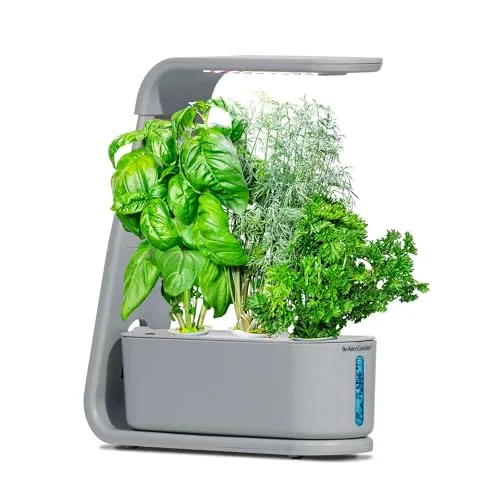
The Sprout is the smallest AeroGarden: three pods, a 10W LED, ten inches of height, one button, and a herb kit and plant food in the box. It sits happily on a windowsill or a desk, runs quietly, and teaches the whole hydroponic idea — fill, drop pods in, top up water — for the lowest commitment in the AeroGarden range. As a first garden or a gift, the shape is perfect.
Now the status, stated plainly: 2026 retail coverage puts the Sprout on the brand store's final clearance list, with stock not being restocked. Three pods and ten inches are also outgrown fast — one basil plant can want the whole garden. Buy it as the cheap, cheerful starter it is, while it is around, and not as the foundation of a long-term herb supply.
Yay · Pros
- Slim footprint suits windowsills and tiny kitchens
- 10W LED, automatic timer, one-button control
- Herb kit and food included — starts immediately
- Quiet, simple way to learn hydroponics
Hmm · Cons
- Only 3 pods, 10-inch height — outgrown quickly
- On final clearance in 2026 coverage; stock uncertain
- No Wi-Fi or app control at this tier
Best for: first-time growers and gift buyers. Skip if: anyone cooking with herbs several times a week.
4. Click and Grow Smart Garden 3 — Best Low-Maintenance, No-Pump Design
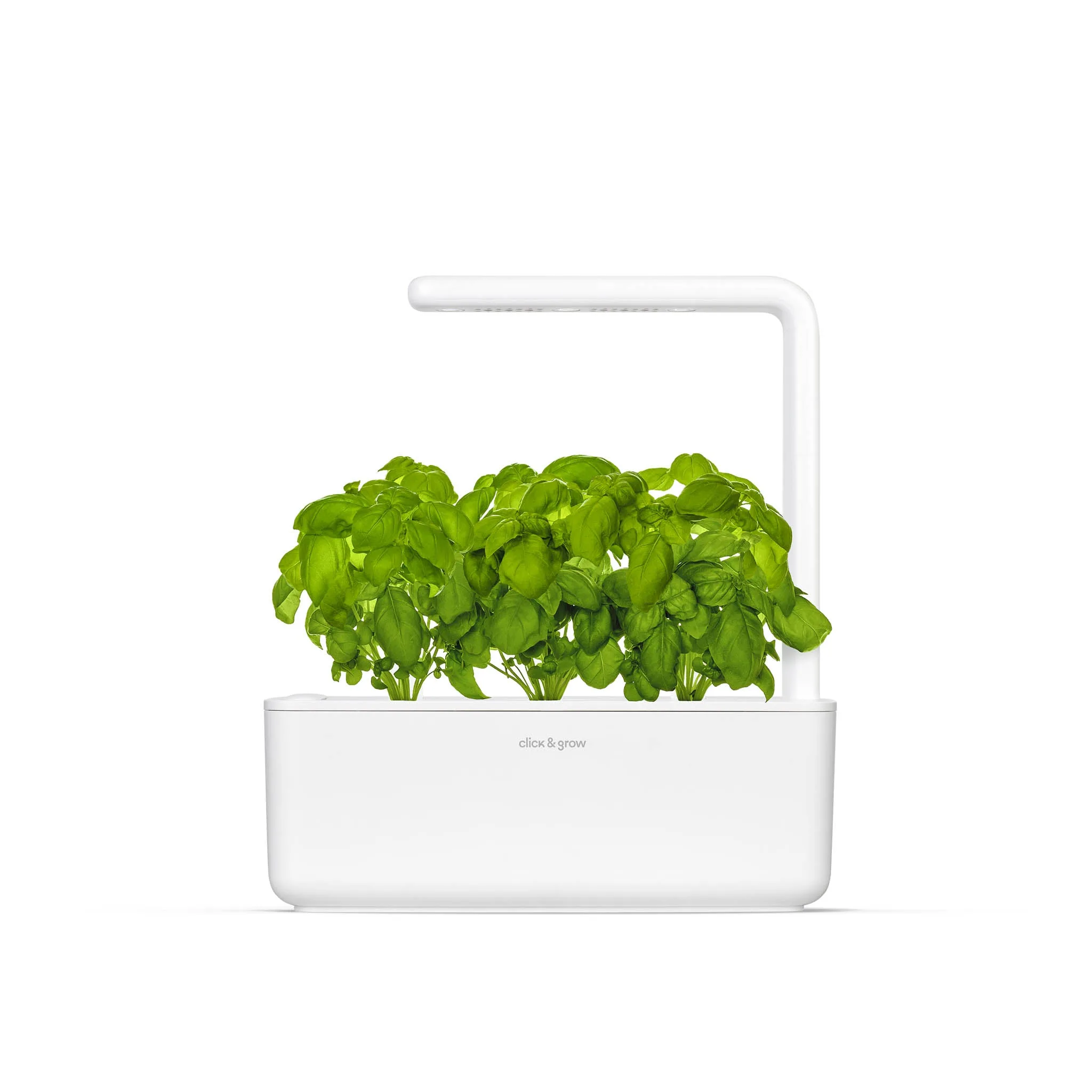
Click and Grow takes the opposite engineering route from the pump-driven gardens: its pods are wick-fed from a 1.2-litre tank, so there is no pump to clog, hum or fail. The smart soil in each pod holds nutrients, an 8W LED runs a fixed 16-hour cycle, and a tank lasts roughly two to three weeks — the lowest-upkeep garden in this guide, in a clean design that looks right on a visible counter. Wirecutter and design coverage praise exactly that simplicity, and the ecosystem — 70-plus pod varieties — has run without interruption.
Three pods is an accent, not a supply: this is a basil-and-garnish garden. The fixed cycle means no app and no adjustments, and refills are proprietary pods rather than your own seed. For a beginner who wants fresh basil with the least possible fuss, those limits are the product working as designed.
Yay · Pros
- Wick-fed pods: no pump, no noise, minimal upkeep
- Tank lasts roughly two to three weeks
- 70-plus pod varieties in an established ecosystem
- Clean design for visible counters
Hmm · Cons
- Only 3 pods — an accent, not a main supply
- Fixed 16-hour cycle; no app control
- Proprietary refill pods, not own-seed sponges
Best for: beginners wanting fresh basil with the least upkeep. Skip if: high-volume users — see the 9 PRO or the 12-pod picks.
5. Click and Grow Smart Garden 9 PRO — Best Overall Smart Garden
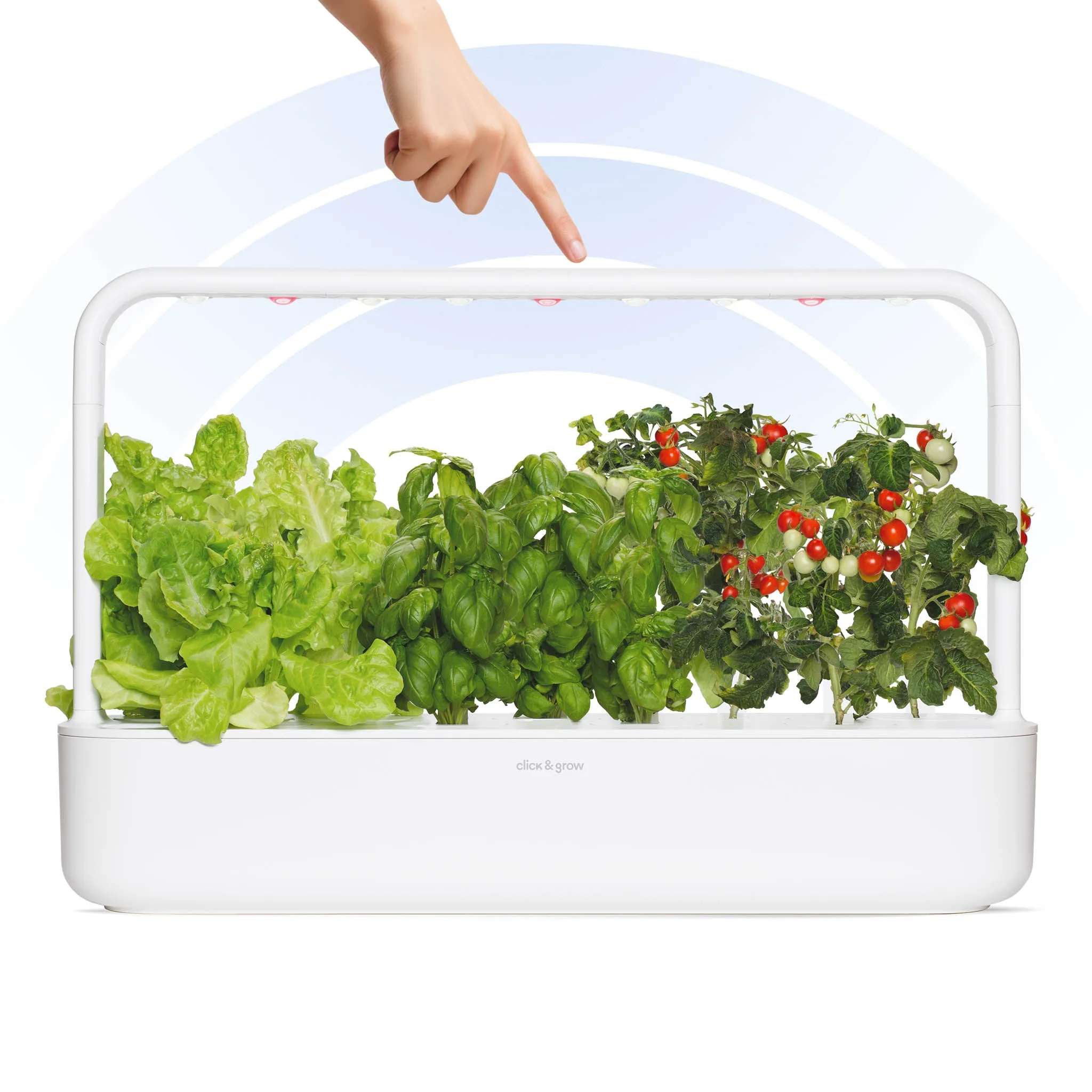
The 9 PRO is where Click and Grow's quiet approach scales into a serious garden: nine pods, a 4-litre tank rated at three to four weeks per fill, a 13W LED on an adjustable arm, and app plus touch control over lighting and care. Basil, lettuce and mini-tomato starter pods are included. The SG9 family sits at the top of the category in Wirecutter and Spruce coverage year after year, and the ecosystem behind it has had no interruptions — after the AeroGarden year described above, that steadiness counts.
It is a premium-positioned garden, and its refills are proprietary pods that recur with every crop. The wick system also means no active hydroponics — growers who want pumps, fans and faster cycles should look at LETPOT or iDOO. And the app covers lighting and care tips, not watering; the tank still needs your eyes. On balance: the best all-round smart garden here.
Yay · Pros
- 9 pods; basil, lettuce and mini tomato starters included
- App and touch light control; adjustable arm
- 4L tank rated at three to four weeks per fill
- Established ecosystem; no recent interruption
Hmm · Cons
- Premium positioning; proprietary refill pods recur
- No pump — active-hydroponics fans should see LETPOT or iDOO
- App covers lighting and care tips, not watering
Best for: households wanting a serious herb and salad garden. Skip if: own-seed growers — see iDOO and LETPOT.
6. iDOO 12-Pod Hydroponics Growing System — Best Value 12-Pod Garden With No App
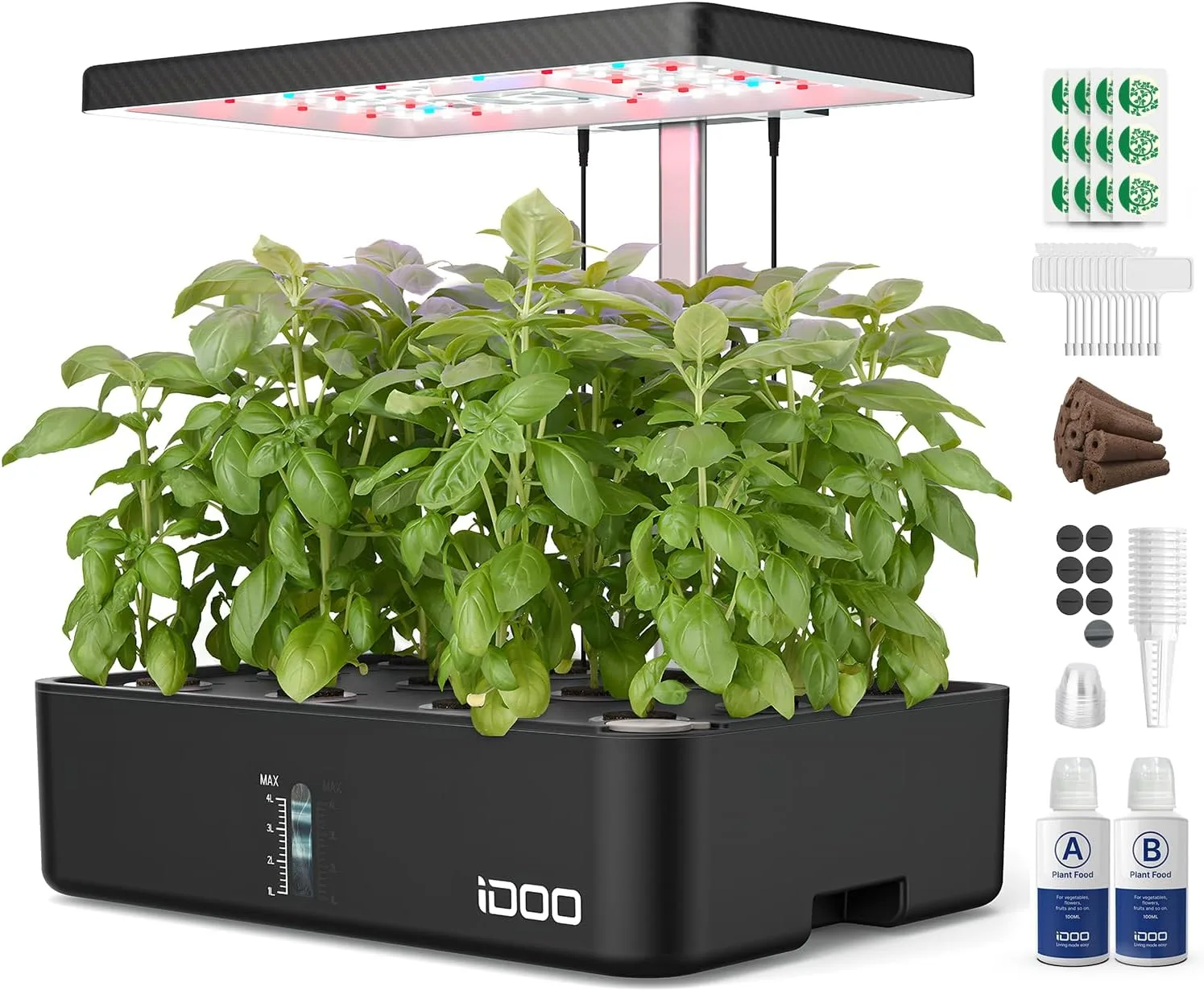
The iDOO is the value engine of this guide: twelve pods, a 22W LED with two grow modes, a pump and a fan, and a 4.5-litre removable tank with a viewing window — growing in generic sponges with your own seed, which collapses the running cost compared with any pod ecosystem. There is no app and no Wi-Fi on the base model, which many owners count as a feature: nothing to log into, no server to depend on, nothing to discontinue.
The limits are physical. Grow height is about 11 inches, so this is an herbs-and-greens machine, not a tomato machine. No seeds are included — your first crop needs a seed purchase alongside it — and owner reports note the pump gets more audible as the water level falls, your reminder to top up. For a budget-conscious cook who wants a dozen herbs growing at once, it is the strongest price-to-plants ratio here.
Yay · Pros
- 12 pods on generic sponges; own seed, low refill costs
- No app or Wi-Fi on the base model; no server dependence
- 22W LED, two grow modes, pump and fan
- 4.5L removable tank with viewing window
Hmm · Cons
- About 11-inch grow height — herbs and greens only
- No seeds included; first crop needs a seed purchase
- Pump noise grows as the water level falls
Best for: budget-conscious cooks wanting a dozen herbs at once. Skip if: tomato growers, or anyone wanting app alerts.
7. LETPOT LPH-SE — Best App-Controlled Countertop Garden
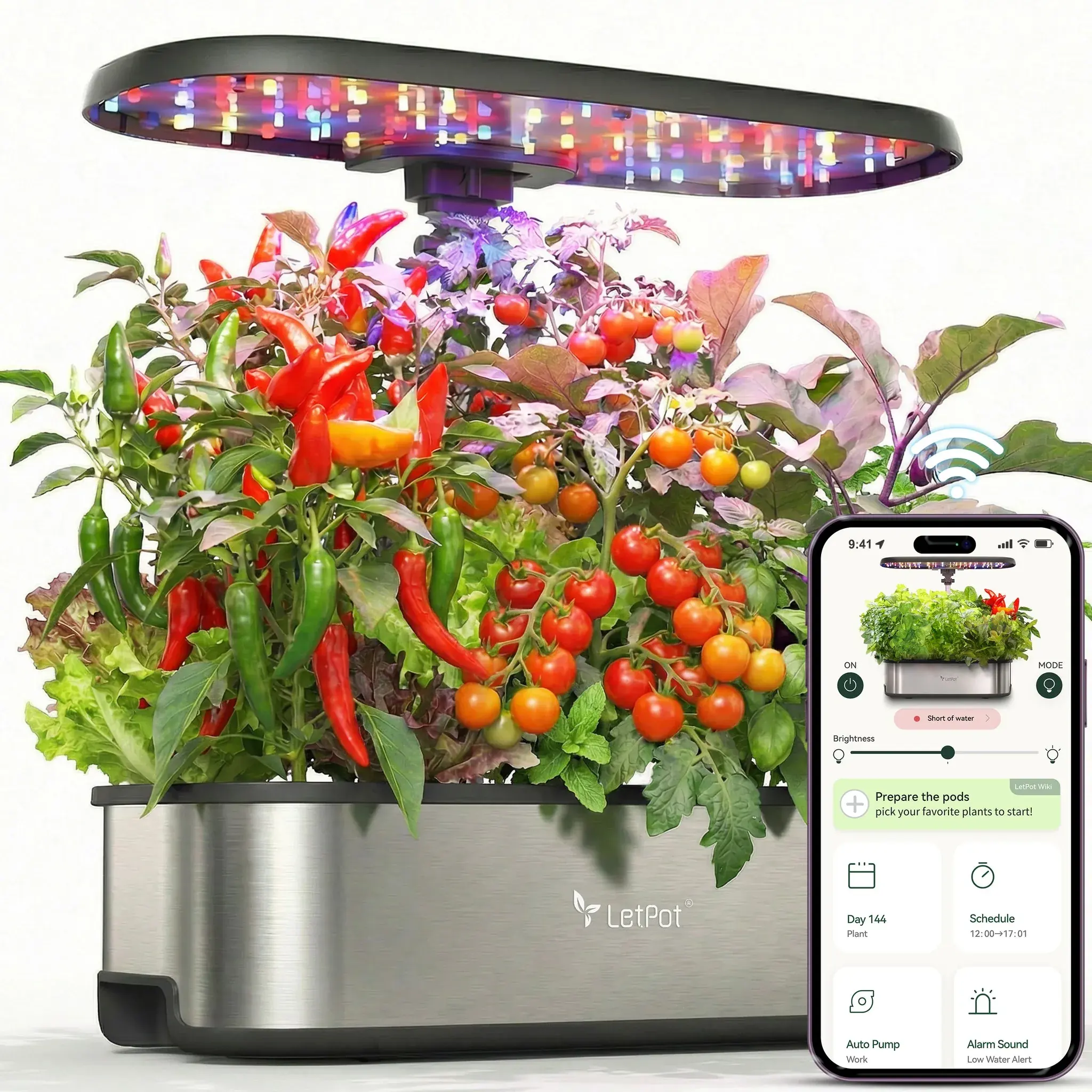
The LPH-SE is the best-specified app-controlled countertop garden outside the big ecosystems: twelve pods, a 24W LED on a tall adjustable panel, a 5.5-litre tank — the largest of the countertop picks — and control by Wi-Fi app (2.4 GHz) or the touch panel on its stainless-steel body. Like the iDOO it grows in standard sponges with your own seed, so the app convenience does not come with pod lock-in.
The brand is the caveat. LETPOT is a smaller name still building its long-term record, so support longevity is less proven than the big two, and pump longevity is the watch item here as it is across the pumped category. If you want app scheduling without joining an ecosystem, this is the pick — bought with that one open question understood.
Yay · Pros
- 12 pods, 5.5L tank, tall adjustable light panel
- Wi-Fi app plus touch panel for schedules
- Standard sponges; own seed, no proprietary pods
- Stainless-steel body for visible counters
Hmm · Cons
- App connects over 2.4 GHz Wi-Fi only
- Smaller brand; long-term support less proven
- Pump longevity is the watch item, category-wide
Best for: growers wanting app control outside AeroGarden. Skip if: anyone preferring a fully offline garden.
8. LETPOT LPH-Max — Best High-Capacity Automated Garden
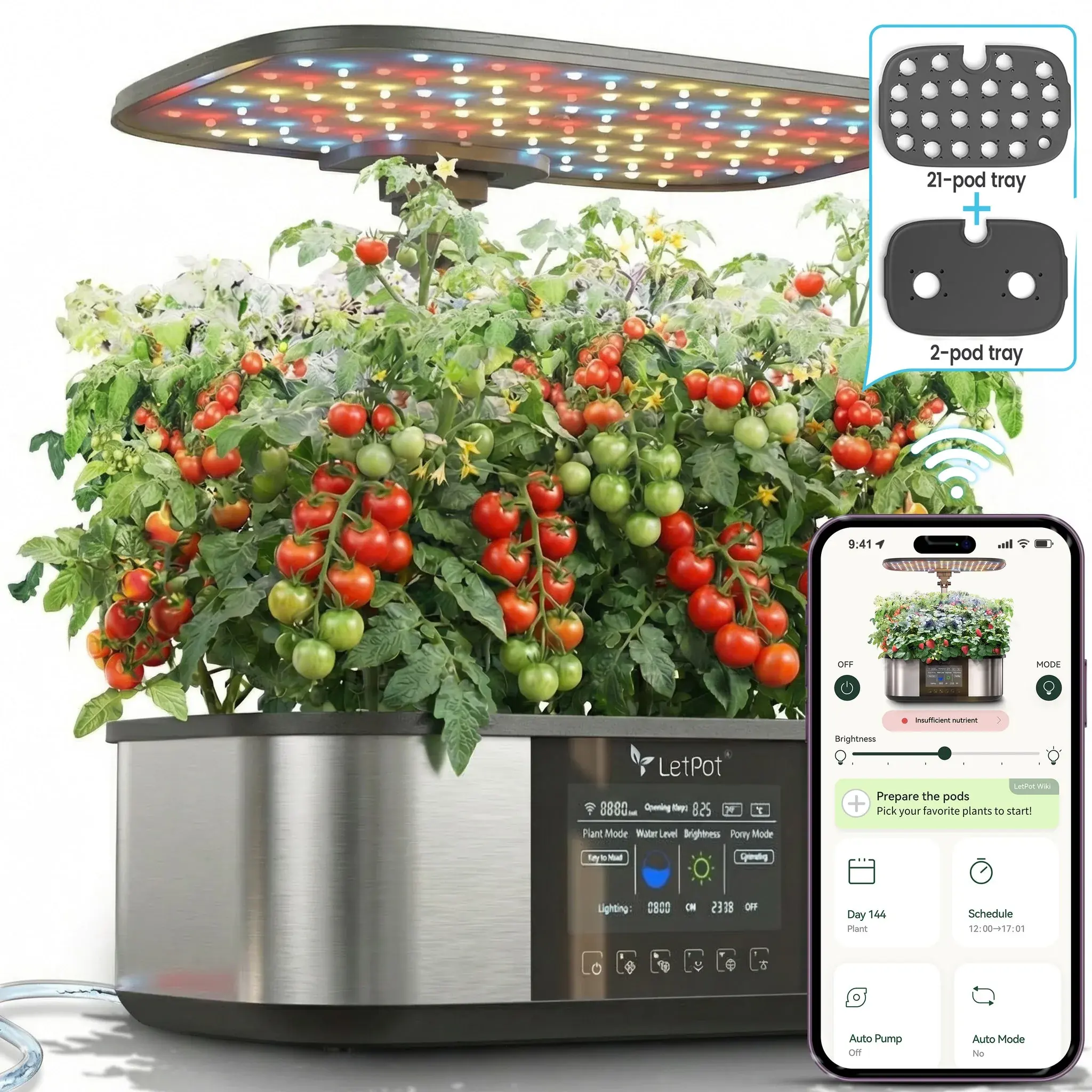
The LPH-Max is the most automated garden here, and the most mislabelled: some secondary reviews call it a 12-pod system, but LETPOT's own documentation says a 21-pod tray plus a separate 2-pod tray for large plants, and 21 is the number we use. Around that capacity sits a 36W dimmable LED, a 7.5-litre tank rated to about 30 days, a level sensor, automatic watering and automatic nutrient dosing, and an LCD touchscreen with app control. It is less a gadget than a small appliance for growing.
Automation cuts both ways: this is the most complex machine in the guide, with the most parts to clean and maintain, and no seeds are included. First-time growers should start smaller and cheaper. Keen growers who have already outgrown a 12-pod unit will find the headroom — and the month-long tank — exactly what they were missing.
Yay · Pros
- Automatic watering and dosing with a level sensor
- 21-pod tray plus a 2-pod large-plant tray
- 7.5L tank — largest here, rated to 30 days
- 36W dimmable LED, app control, LCD touchscreen
Hmm · Cons
- Most complex here — more parts to maintain
- No seeds included; bring your own seed
- Brand support record still developing
Best for: keen growers wanting maximum capacity and automation. Skip if: first-time growers — start with the Smart Garden 3 or Sprout.
9. Ahopegarden 10-Pod — Best Budget 10-Pod Garden
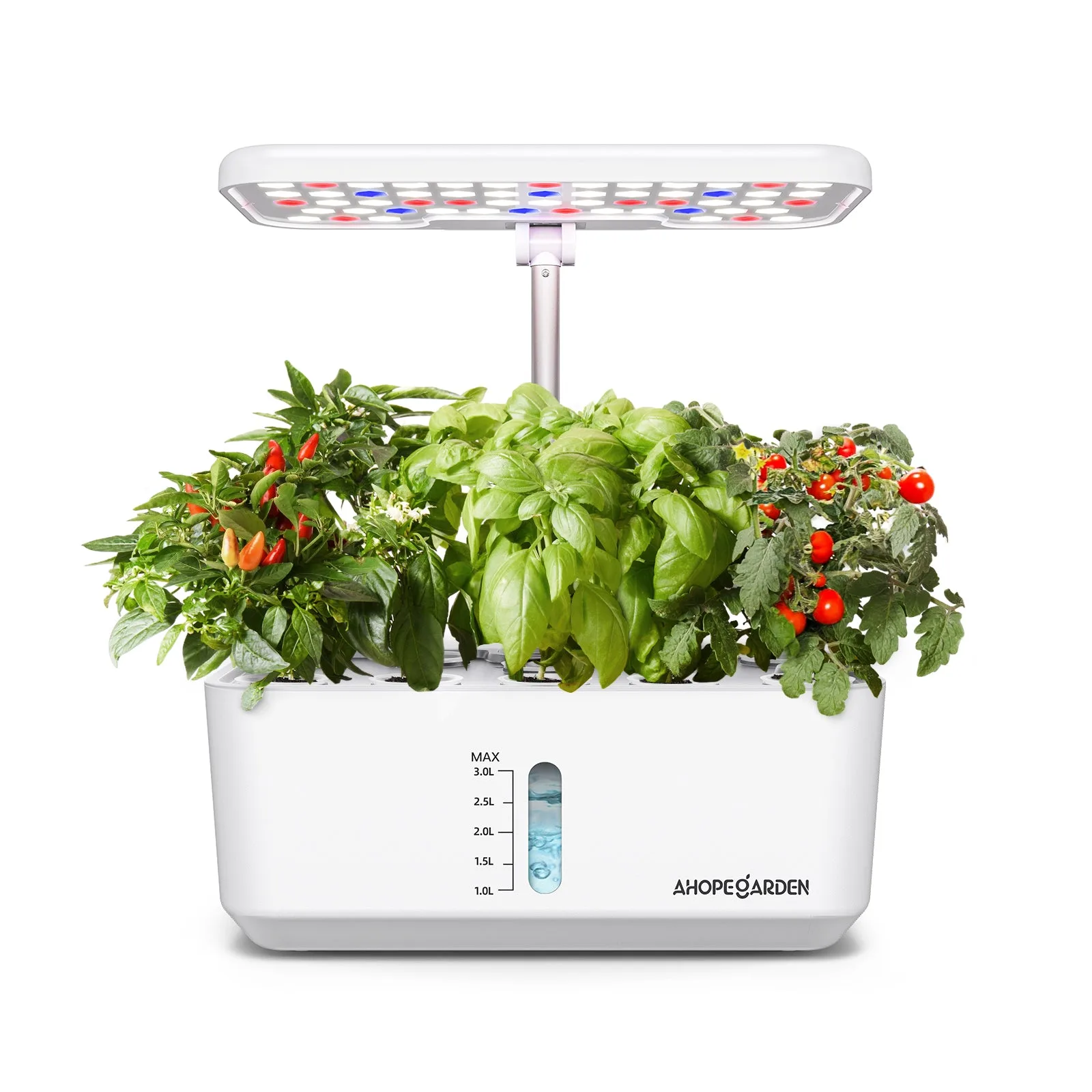
Ahopegarden's pitch is a complete garden at a budget position: ten pods, about 14.5 inches of light-post adjustment — noticeably more headroom than the iDOO — two light modes on an automatic 16-hour timer, a water-level window for at-a-glance top-ups, and generic sponges that take your own seed. On specifications per dollar, it is hard to argue with.
The tank is where the budget shows: at 3 litres it is the smallest of the 10- to 12-pod picks, so it drinks more often, and travellers should look at the bigger tanks above. The timer is fixed, there is no app, and the brand's long-term coverage is thinner than the established names. As a first full-size garden that does not lock you into pods, it earns its slot.
Yay · Pros
- 10 pods, about 14.5 inches of post adjustment
- Generic sponges and own seed; low running costs
- Two light modes, automatic 16-hour timer
- Water-level window for at-a-glance top-ups
Hmm · Cons
- 3L tank — smallest of the 10- to 12-pod picks
- Fixed timer; no app or remote alerts
- Thinner long-term coverage than established brands
Best for: beginners wanting a complete 10-pod garden on a budget. Skip if: frequent travellers — bigger tanks last longer.
10. Gardyn Studio 2 — Best Vertical Tower for Serious Greens
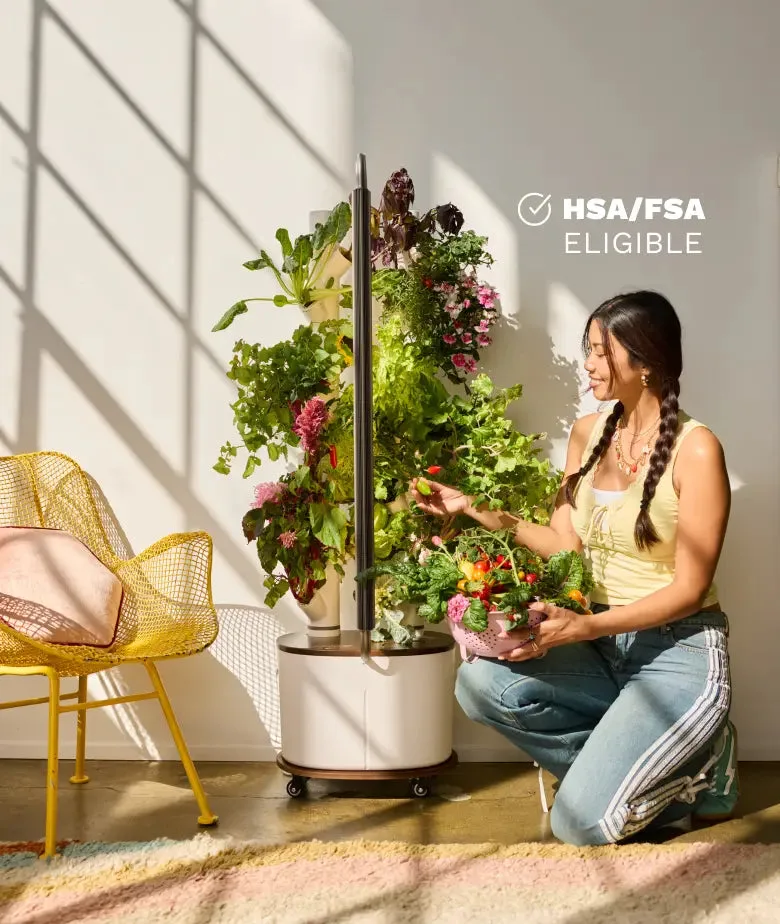
The Gardyn is not a countertop garden at all — it is a 54-inch floor tower that grows 16 plants in about 1.4 square feet, under a 52W LED, with a tank over four gallons, sensors and an 8MP camera feeding the Kelby AI app, which watches the plants and coaches their care. Gardyn claims yields around four to five pounds of produce a month, the sealed columns cut the scrubbing that hydroponics usually involves, and a vacation mode keeps things alive while you travel.
It is also the highest commitment here, by a distance. Plants grow in proprietary yCubes, the best refill value comes with a membership, and a 54-inch tower needs a floor corner and a household that actually eats salads like it means it. For that household, nothing else in this guide produces at this scale. For a few herbs, it is a monument to overkill.
Yay · Pros
- 16 plants in 1.4 square feet — largest capacity here
- Camera, sensors and Kelby AI guidance; vacation mode
- Claimed yields of roughly 4 to 5 pounds a month
- Sealed no-clean columns cut scrubbing
Hmm · Cons
- Proprietary yCubes; best refill value needs a membership
- 54-inch tower needs a floor corner, not a counter
- Highest commitment here; overkill for a few herbs
Best for: salad-eating households with a spare corner. Skip if: anyone who only wants basil and mint.
How to Choose a Smart Indoor Herb Garden
Decide the ecosystem question first. Pre-seeded proprietary pods (AeroGarden, Click and Grow, Gardyn) are the easiest growing there is — drop in, add food, harvest — and they charge for that ease with every crop. Open systems (iDOO, LETPOT, Ahopegarden) grow in generic sponges with your own seed for a fraction of the running cost, and ask a little more of you. Neither is wrong; the mistake is buying a pod garden without knowing the refills are the business model.
Then match the tank and the height to your life. Tank size is really a holiday question: 1.2 litres needs attention twice a week, 4 litres lasts most of a month, 7.5 litres outlasts your vacation. Grow height decides the menu — 10 to 12 inches is herbs and lettuce, 24 inches adds dwarf tomatoes and peppers. And if you travel often, a vacation mode or a big tank is not a luxury feature; it is the difference between a garden and a chore.
Frequently Asked Questions
Can I grow my own seeds in an indoor herb garden?
In the open systems, yes — iDOO, LETPOT and Ahopegarden grow in generic sponges that take any seed, which is their main cost advantage. AeroGarden sells Grow Anything kits that let you seed its baskets yourself, and Click and Grow and Gardyn are built around their own pre-seeded pods and cubes, where own-seed workarounds exist but are not the intended path.
What do indoor herb gardens cost to run?
Electricity is minor — these are 8W to 52W lights on timers. The real running cost is refills: proprietary pod kits are priced per crop and add up over a year of continuous growing, while generic sponges plus a packet of seed cost very little per crop. Liquid plant food is the other small recurring item. Compare a year of refills, not just the garden, before choosing an ecosystem.
How often do I need to add water?
It follows the tank. Small gardens (Sprout, Smart Garden 3) want a check every few days to two weeks; mid-size tanks run two to four weeks; the LETPOT LPH-Max's 7.5-litre tank is rated around 30 days. Gardens with reminders or app alerts (AeroGarden, LETPOT, Gardyn) tell you; the rest rely on a water window and a habit.
Do indoor gardens attract bugs or smell?
Much less than soil gardening — there is no soil for fungus gnats to live in, and a healthy system smells like plants, faintly. Problems start with neglect: old roots left in a tank, or algae from light leaking into the reservoir. Rinse the tank between crops, keep the deck covered, and both issues mostly disappear.
What is the best indoor herb garden for a complete beginner?
The Click and Grow Smart Garden 3, for the least upkeep — no pump, a tank that lasts weeks, nothing to configure. If you want to cook with the harvest rather than garnish with it, start one size up: the AeroGarden Harvest Elite for the guided ecosystem route, or the iDOO 12-pod if you would rather own your seeds from day one.
The Short Version
The Click and Grow Smart Garden 9 PRO is the best all-round smart garden here — nine pods, a month-sized tank, a steady ecosystem. The AeroGarden Harvest Elite and Bounty remain the guided-route defaults, bought with open eyes about the brand's pause and its pod costs. The iDOO 12-pod is the value pick, the LETPOT LPH-SE the app pick, and the Gardyn Studio 2 the serious-greens tower. And when the herbs are harvested and the scraps need somewhere to go, the electric kitchen composter guide closes the loop.