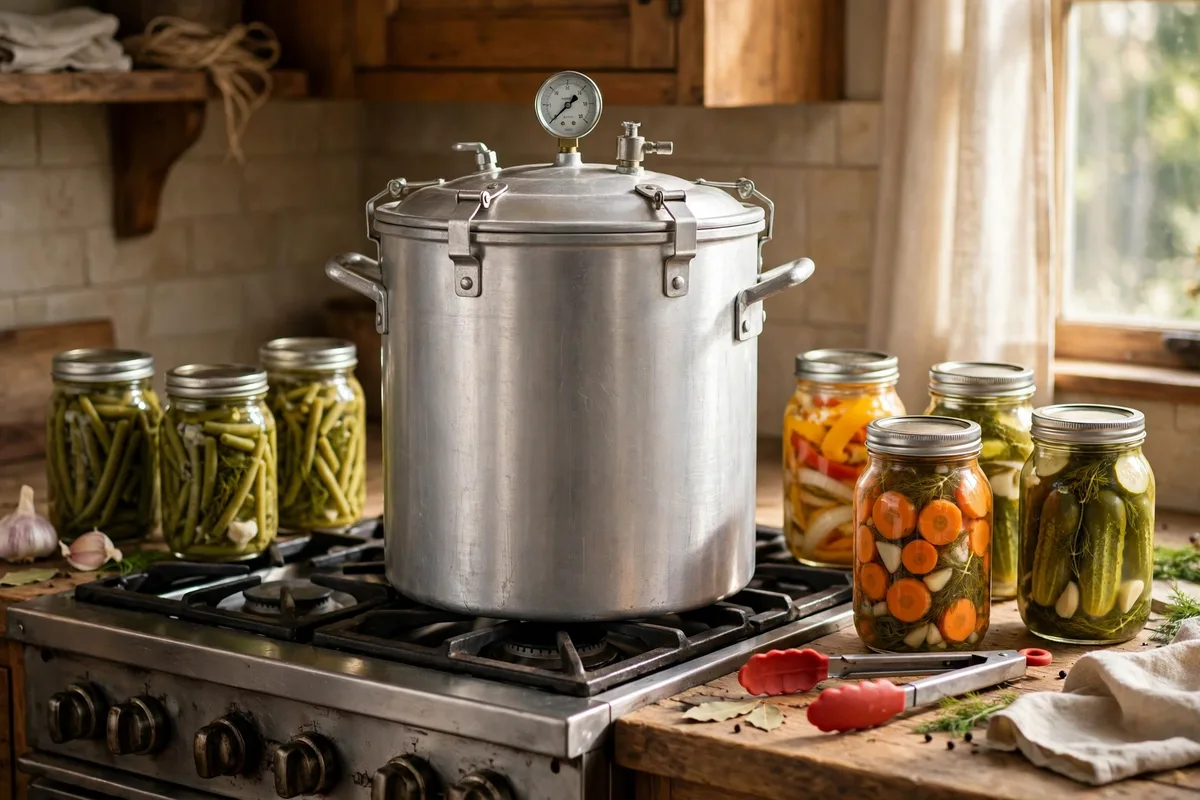
The best pressure canner for most households is the Presto 23-Quart: it is a true canner — not a pressure cooker — with a weighted and dial system that follows current USDA procedures, capacity for about 7 quart jars per load, and a price that makes safe canning accessible. The All American 921 is the lifetime alternative: a gasket-free, cast-aluminium canner built to be inherited. Everything else in this guide is secondary to the rule that governs the category: low-acid food is canned only in a real pressure canner, at the pressure your altitude demands, for the full time in a current tested recipe.
The five picks divide by regulation and build: Presto’s dial-gauge pair in two sizes, the All American’s metal-to-metal flagship, and the weighted-gauge value models from Mirro and T-fal. Each entry states jar capacities and the maintenance its system honestly requires. For the rest of the preserving kitchen, our best vacuum sealers in Canada and the USA guide seals, the best food storage containers in Canada and the USA guide stores, and the best multi-cookers in Canada and the USA picks handle the everyday pressure cooking that is a different job entirely.
Disclosure: CookSmartPicks is reader-supported. When you buy through links on this page, we may earn an Amazon commission at no extra cost to you. Prices and availability change often — check the current price on Amazon before you decide.
How we chose these pressure canners
Safety governed this shortlist before capacity or price were allowed to speak. Every pick is a true pressure canner — a vessel designed, sized and regulated for canning under current USDA and National Center for Home Food Preservation procedures — not a pressure cooker with a canning claim, because the authorities do not validate cookers for canning at any size. We then compared the two regulation systems honestly: dial gauges (fine altitude steps, but they drift and need annual accuracy checks) against weighted gauges (physically incapable of drifting, coarser steps), and favoured models whose manuals state jar capacities and altitude procedures in full.
Construction came second: sealing system (replaceable gasket versus the All American’s gasket-free metal-to-metal clamp), body weight — an All American full of quarts is a serious lift — and stove compatibility, including the glass-top cautions several makers publish. Canadian availability and parts support (gaskets, gauges, weights through domestic channels) closed the screen. This guide summarizes safe practice; it does not replace the current USDA Complete Guide or Bernardin recipes that every batch must follow exactly.
The lineup at a glance
| Product | Best for | Why it stands out |
|---|---|---|
| Presto 23-Quart Pressure Canner & Cooker (01781) | Best overall | The standard canner: 23 quarts, dial-plus-weight regulation, safe canning at an accessible price |
| Presto 16-Quart Pressure Canner & Cooker (01755) | Best smaller canner | The small-batch Presto: same regulation, faster heats, easier shelf |
| All American 921 Pressure Canner (21.5-Quart) | Best lifetime canner | The heirloom: gasket-free cast aluminium, dual regulation, built since the 1930s |
| Mirro 22-Quart Pressure Canner (Weighted Gauge) | Best weighted-gauge value | Weighted certainty on a budget: 22 quarts, three weights, no gauge to drift |
| T-fal 22-Quart Pressure Canner (Dial Gauge) | Best retail-friendly starter | The one-trip starter: a full safety system stocked beside the jars |
1. Presto 23-Quart Pressure Canner & Cooker (01781) — Best overall
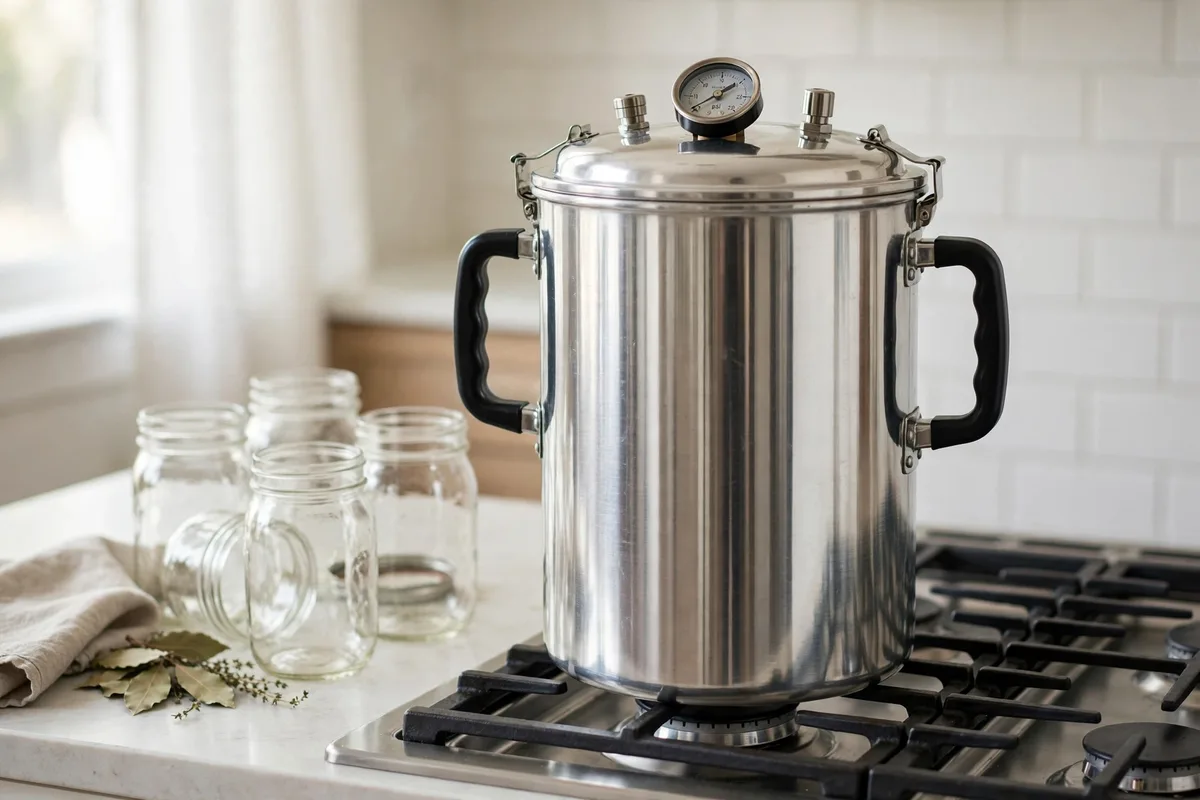
The 23-quart Presto is the canner that fills North America’s pantries: an aluminium pressure canner with both a dial gauge for altitude-precise reading and a weighted regulator system, a locking lid with a steam-release and overpressure plug, and capacity for about 26 half-pints, 20 pints or 7 quarts per load (double-stacked pints and half-pints on the included racks). It doubles as a water-bath canner for high-acid foods and as a very large pressure cooker for stocks, which is how many households justify its shelf.
The Presto’s safety system is the standard one, honestly maintained: the dial gauge should be checked for accuracy annually (extension services commonly test them), the sealing gasket replaced when it stiffens or shrinks — a few dollars and a few years apart — and the vent pipe kept clear. None of this is burdensome; all of it is the price of the dial’s precision, and the manual lays it out plainly. The body’s aluminium keeps the loaded weight manageable on home stoves, with the maker’s guidance to check glass-top compatibility for your range.
Canadian availability is broad and parts are stocked domestically, which matters for a tool whose consumables are safety components. Priced at a fraction of the cast flagship, the 23-quart Presto is where safe canning starts for most households, and — maintained as directed — where it can stay for decades.
Ownership settles into the canning season’s rhythm: a spring gauge check, a gasket inspection, and a shelf of tested recipes that grows more confident each year. Presto’s manuals and support treat the owner as a practitioner, not a customer, which is the correct relationship for this category.
Yay · Pros
- True canner: dial gauge plus weighted regulator
- ~7 quarts / 20 pints per load
- Doubles as water-bath canner; parts stocked in Canada
Hmm · Cons
- Gasket needs periodic replacement
- Dial gauge needs annual accuracy checks
- Aluminium body — check glass-top stove guidance
Best for: Most households — the accessible standard Skip if: You want zero gauge maintenance — the weighted-only or All American systems reduce it
2. Presto 16-Quart Pressure Canner & Cooker (01755) — Best smaller canner
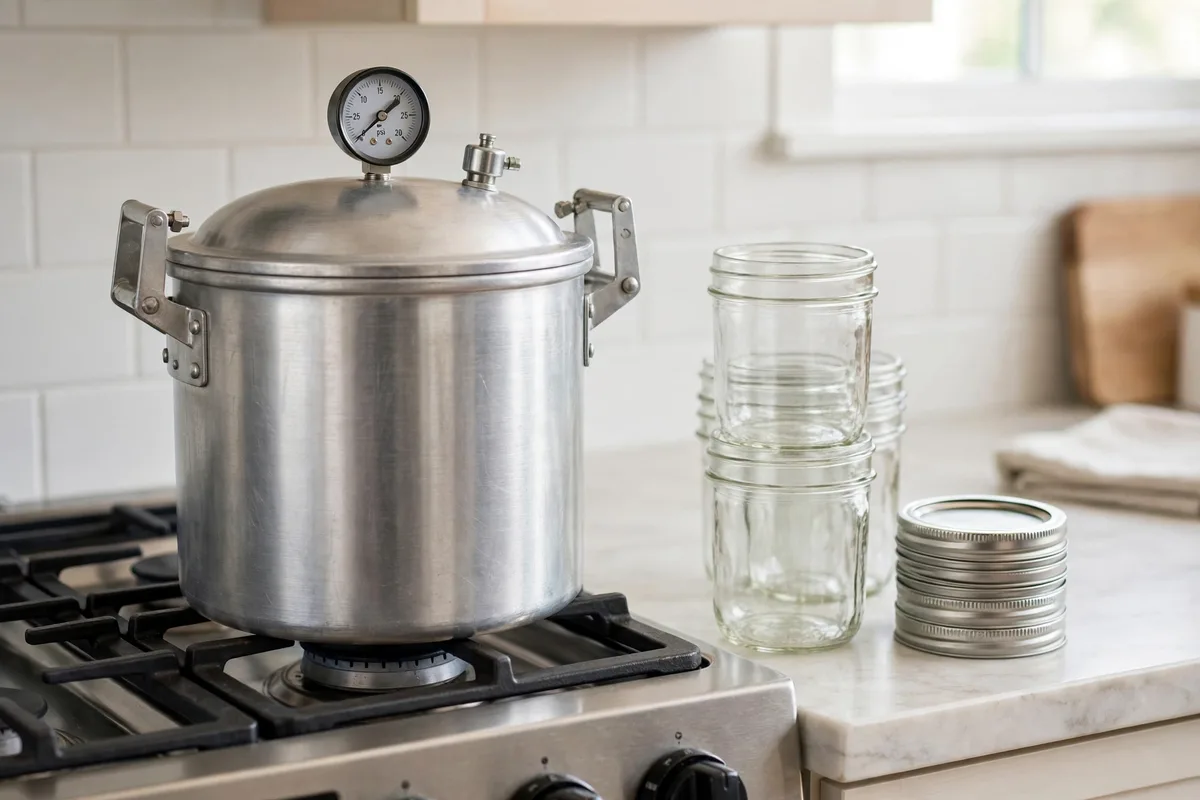
The 16-quart Presto is the same safety system in a smaller vessel: dial gauge, weighted regulator, locking lid, and capacities around 12 half-pints, 10 pints or 4 quarts per load. For the household whose garden produces a row of beans and a basket of tomatoes rather than a homestead’s harvest, the smaller canner heats faster, stores easier, and runs more often — and a canner that runs often in small batches often preserves more food across a season than a giant that waits for a perfect weekend.
Its limits are arithmetic, not quality: quart jars — the soup and stew format — fit only four at a time, so big-batch households will feel the queue. Pints and half-pints, the jam, salsa and vegetable formats, run at a respectable pace, and the canner doubles as the household’s large pressure cooker and water-bath vessel exactly as its sibling does. The same annual gauge check and gasket care apply; the manual is the same honest document.
Canadian availability mirrors the 23-quart’s, at a lower price. For apartment-scale preserving, small gardens, and the beginner who wants to learn the discipline on forgiving batch sizes, the 16-quart is the correct first canner — and many owners keep it for life beside a larger stablemate bought later.
Ownership’s charm is frequency: the small canner comes out for a single basket of market beans on a Tuesday, where the big vessel would have waited for a harvest that justified it — and food canned on Tuesday is food not lost on Friday.
Yay · Pros
- Full Presto safety system in a compact vessel
- ~10 pints per load; heats and stores easily
- Lower price; same parts ecosystem
Hmm · Cons
- Quart capacity is small — big harvests queue
- Same gauge and gasket maintenance as its sibling
- Too small for some community-kitchen ambitions
Best for: Smaller gardens and households canning in modest batches Skip if: You can quarts by the dozen — the 23-quart’s capacity is the point
3. All American 921 Pressure Canner (21.5-Quart) — Best lifetime canner
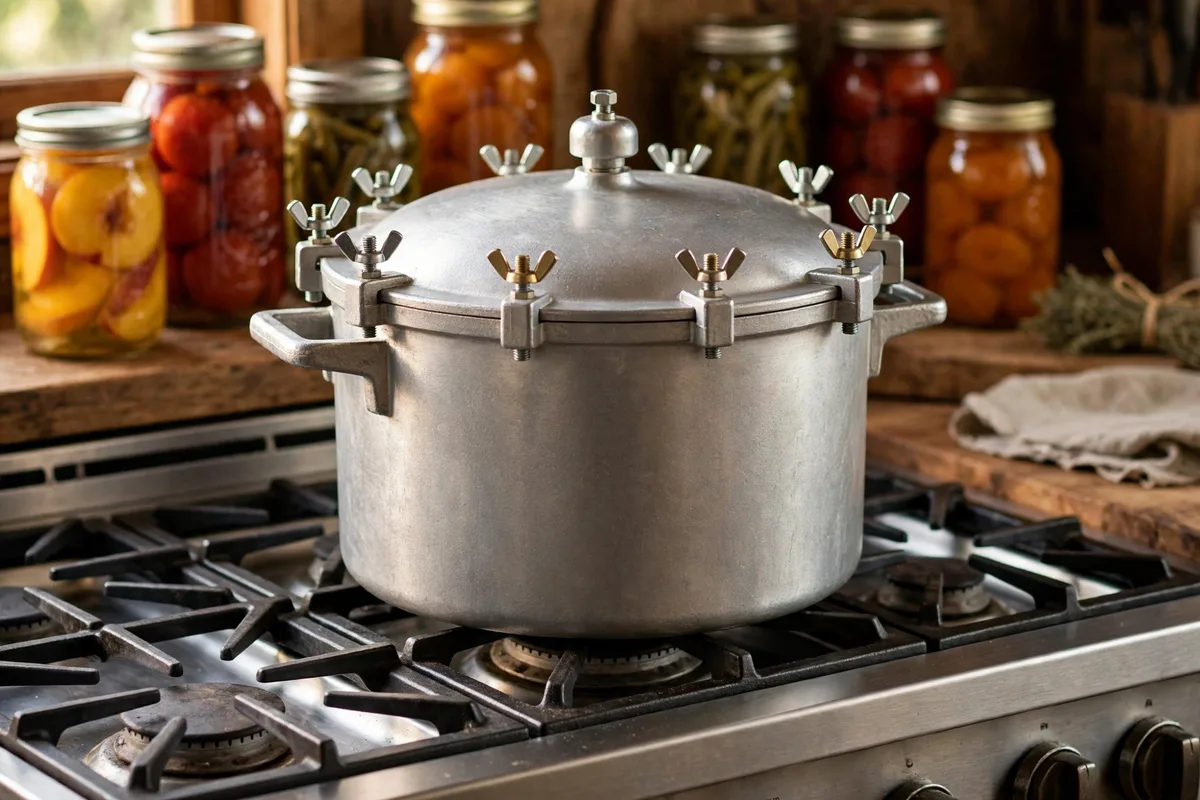
The All American 921 is the canner as heirloom: cast aluminium walls machined in Wisconsin, a lid that seals metal-to-metal with six clamp bolts and a film of oil — no gasket exists to age, crack or be replaced — and a regulation system that pairs a geared dial gauge with weighted control, so the certainty of the weight backs the precision of the dial. Capacity runs about 19 pints or 7 quarts. The 21.5-quart body is the heaviest in this guide by a wide margin, and the maker is explicit that it is not for glass-top stoves; on a gas or coil range, it is effectively permanent.
The ownership proposition is the absence of the maintenance calendar: no gasket schedule, a gauge that is read against the weight’s physical authority, and a vessel whose failure modes are essentially unknown across its multi-decade service record. All American has made these canners since the 1930s, and used examples from mid-century remain in service — the strongest durability evidence any kitchen tool can offer.
Canadian availability runs through specialty and online retail at a price several times the Presto’s. The buyer is the serious preserver — the gardener whose autumn is measured in hundreds of jars — for whom the canner is infrastructure. For that household, the arithmetic of one purchase across forty seasons makes the flagship the economical choice, and this guide will not pretend otherwise.
Its presence in a kitchen changes the household’s relationship to the harvest: nothing is too much, no glut goes to waste, and the canner’s arrival each autumn is a ritual with its own apron. Tools that become traditions have usually earned it; this one demonstrably has.
Yay · Pros
- Metal-to-metal seal — no gasket, ever
- Weighted plus dial regulation
- Cast in Wisconsin; decades-long service record
Hmm · Cons
- Heaviest canner here — a full load is a serious lift
- Highest price in the guide by far
- Not for glass-top stoves, per the maker
Best for: The lifetime buyer who wants no gasket and no drift Skip if: You have a glass-top stove or a modest harvest — the Presto serves both better
4. Mirro 22-Quart Pressure Canner (Weighted Gauge) — Best weighted-gauge value
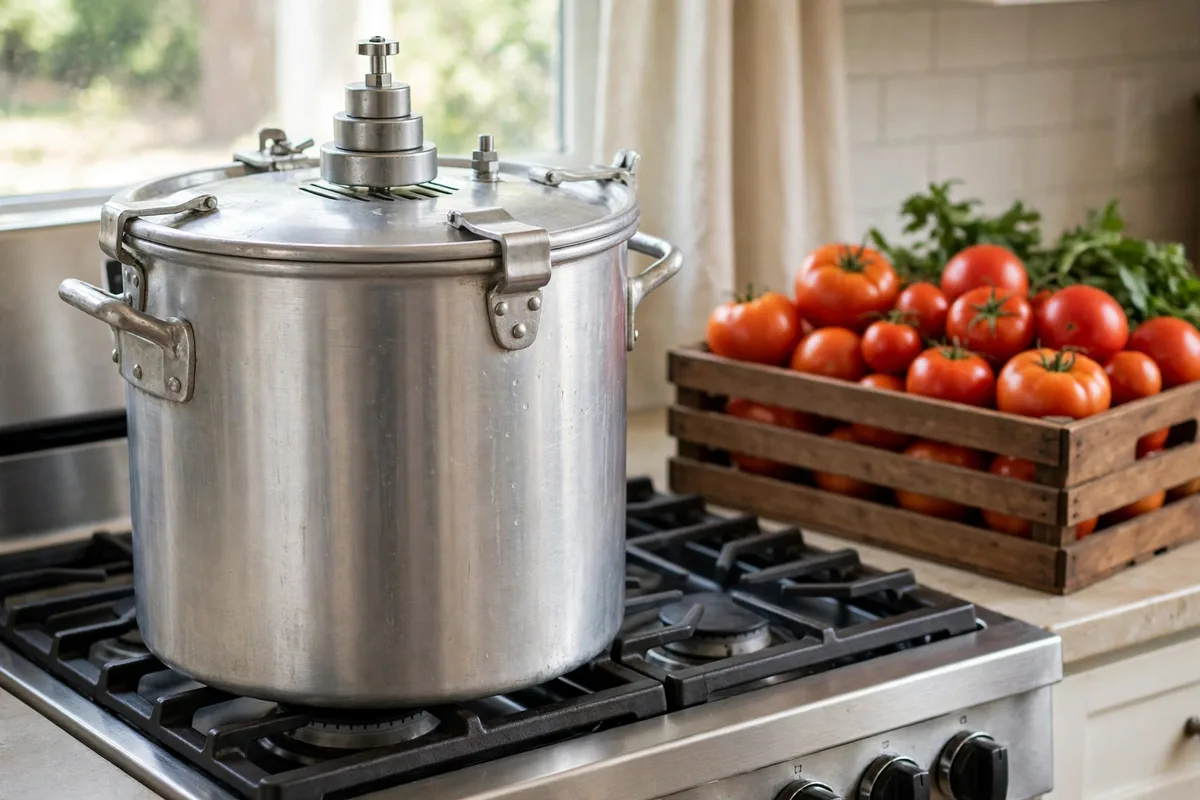
Mirro’s 22-quart canner is the weighted-gauge route at a value price: a polished aluminium vessel regulated by a three-piece weight set (5, 10 and 15 lb), which cannot drift because the weight’s mass is the calibration. For canners who distrust dials — or who simply want the audible, jiggling certainty of a weighted system and no annual gauge appointment — Mirro delivers the full safety function: proper venting, a locking lid, overpressure protection, and capacity in the 20-pint class (the maker’s listings put it around 20 pints or 7 quarts).
The coarse altitude steps are the design’s honest trade: above 1,000 ft you run the 15 lb weight where a dial might specify 12 or 13, processing safely with a margin the tested recipes accommodate. The vessel’s finish and fittings are a grade below Presto’s, and the brand’s support presence is thinner — gaskets and weights are standard enough to source, but the ecosystem is leaner.
Canadian availability is online-led at the guide’s friendliest big-canner price. For the household that wants weighted certainty without the All American’s cast-iron commitment, Mirro is the rational middle: the physics is identical, the polish is less, and the jars seal the same.
Ownership is admirably boring: a gasket every few years, a weight that will outlive the stove, and a jiggle that becomes the autumn kitchen’s metronome. Canners who switch to weighted systems rarely switch back, and Mirro is where many of them start.
Yay · Pros
- Weighted regulation — cannot drift
- 22-quart capacity at a value price
- Simple, proven safety system
Hmm · Cons
- No dial — altitude steps are coarse
- Finish and fittings are budget grade
- Brand support channels are thinner
Best for: Budget canners who prefer weighted-gauge certainty Skip if: Your altitude needs fine pressure steps — a dial gauge serves better
5. T-fal 22-Quart Pressure Canner (Dial Gauge) — Best retail-friendly starter
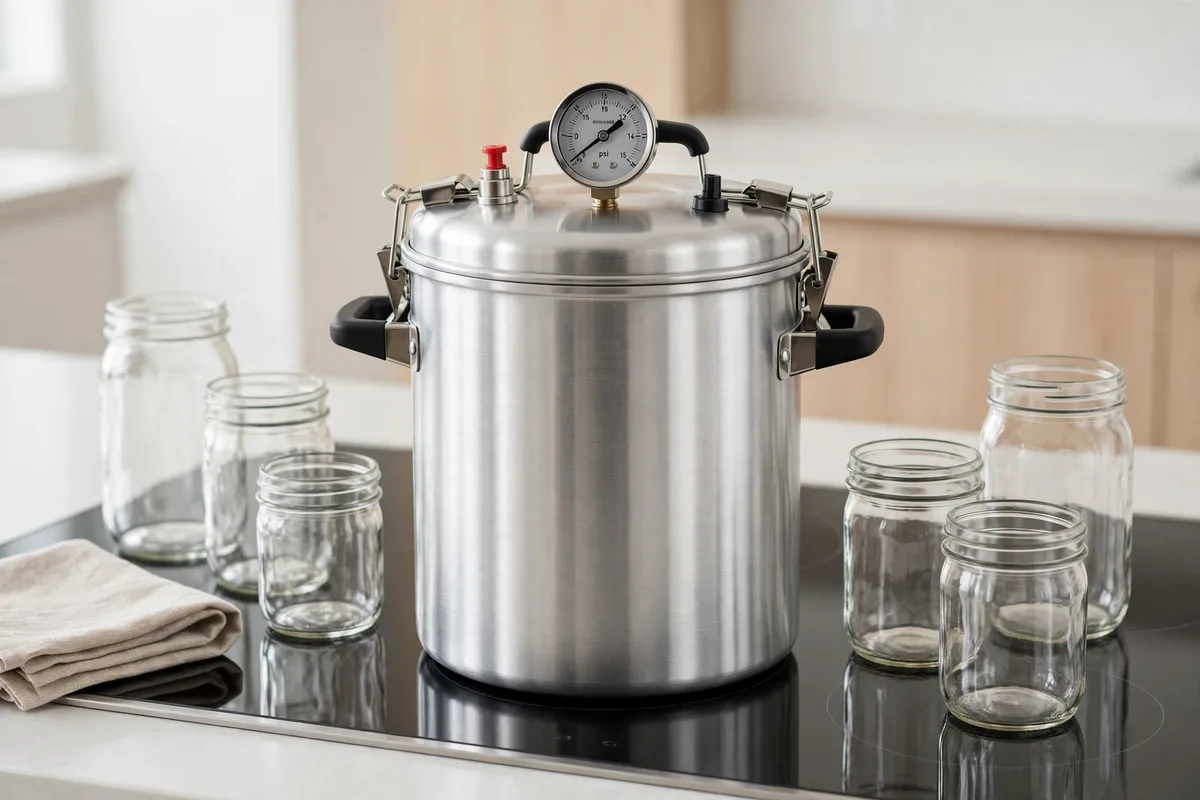
T-fal’s 22-quart canner is the modern retail entry: a dial-gauge aluminium canner with a weighted regulator, a secure locking system with multiple safety releases, and capacity in the same class as the big Presto (the maker lists it for quart, pint and half-pint loads in the twenties). T-fal’s distribution is its superpower — the canner and its gaskets appear in the same big-box aisles as the jars themselves, which removes the parts hunt that discourages beginners with older brands.
The canner follows the standard safety script without deviation: vent 10 minutes, process at the recipe’s pressure for your altitude, natural release, and the annual gauge check that every dial system in this guide requires. The body and fittings are competently mid-grade — a step above the budget tier in finish, a step below the heritage tools in heft — and the manual covers the procedures with the clarity a beginner needs.
In Canada, T-fal’s presence is among the strongest in small appliances, and Bernardin jars sit on the same shelves — the domestic preserving ecosystem in one trip. For the new canner who wants to start this season with everything findable in one store, T-fal is the path of least resistance that never asks you to compromise the safety system.
Ownership benefits from that ecosystem yearly: a fresh gasket is a shopping trip, not a search, and a tool whose consumables are effortless is a tool whose maintenance actually happens — which, in this category, is a safety feature in itself.
Yay · Pros
- Huge retail footprint — canner and parts in one store
- Full dial-plus-weight safety system
- Beginner-friendly manual and locking design
Hmm · Cons
- Gasket and gauge care, like all dial systems
- Newer to the category than Presto
- Heavier marketing than manual, in places
Best for: New canners wanting a modern, widely stocked starter Skip if: You want the heirloom or the lightest maintenance — see the picks above
The safety system, whole: gauges, altitude, and why the rules are the recipe
Botulism is the reason pressure canning exists: Clostridium botulinum spores survive boiling water indefinitely, and only the 240°F (116°C) environment inside a pressure canner, held for the full processed time in current USDA-tested recipes, destroys them. That single fact organizes everything else in this guide. A pressure canner is not a bigger pressure cooker — cookers are not tested or recommended for canning by the USDA or the National Center for Home Food Preservation, because their pressure stability and heat penetration have not been validated for it. Buy a canner to can; cook dinner in the cooker.
Altitude changes the pressure, not the time: water boils cooler as elevation rises, so the canner must run higher pressure to reach the same internal temperature. The rule of practice is that dial-gauge canners add pressure in steps with altitude (11 lb at 0–2,000 ft, rising to 15 lb above 6,000 ft for most recipes), and weighted-gauge canners switch from the 10 lb to the 15 lb weight above 1,000 ft. Every figure here is a summary, not a substitute: your recipe, from a current USDA or Ball/Bernardin source, states the exact pressure for your altitude, and it outranks this paragraph, the canner’s manual, and your grandmother’s notebook, in that order.
The dial gauge’s annual check is the ritual that keeps the system honest: gauges drift, and a dial reading 11 lb while delivering 9 has quietly under-processed a season’s work. Many county extension services in the US and some Canadian health and extension offices test gauges free or cheaply each year; a gauge off by more than 2 lb should be replaced, not compensated for. Weighted gauges cannot drift — the weight’s physics is the calibration — which is the deepest argument for the weighted design and for the All American’s dual system.
Venting is the step impatience ruins: the canner must exhaust a steady stream of steam for a full 10 minutes before the weight goes on or the petcock closes, because trapped air lowers the temperature at a given pressure — the gauge can read correctly while pockets of air keep parts of the load below temperature. Ten minutes of venting, every time, no exceptions for small loads or familiar recipes. The same discipline applies at the end: natural pressure release, fully to zero, before the weight moves. Rushing either end is how seals fail and how safety margins quietly vanish.
Jars, lids and headspace are the recipe’s other half: use proper Mason-type jars inspected for nicks, new flat lids each batch (the sealing compound is single-use by design), and the exact headspace the recipe states — too little and food forces out under the lid, too much and the jar may not seal or the food under-processes at the top. Rings go on finger-tight, not wrench-tight; air must escape during processing for the vacuum to form on cooling. Every one of these details is in the tested recipes, which is why the guide’s recurring sentence is the only one that matters: follow the current recipe exactly.
Finally, the Canadian note: home canning guidance in Canada flows from Health Canada and Bernardin (the domestic Mason brand), whose tested recipes align with USDA science; provincial health units can point you to local resources, and altitudes across the Prairies and the BC interior put many Canadian canners in the adjusted-pressure bands by default. Know your elevation before your first batch — it is printed on your town’s sign and in every recipe’s altitude table, and it is the difference between canning and hoping.
Pressure canning safety questions, answered
Can I use my Instant Pot or pressure cooker for canning?
No. The USDA and the National Center for Home Food Preservation do not recommend pressure cookers — including multi-cookers with a canning button — for canning, because their pressure stability and heat penetration are not validated for safe processing. Low-acid foods (vegetables, meats, soups, beans) require a true pressure canner reaching 240°F for the full tested time. Water-bath canning remains correct for high-acid foods: fruits, jams, pickles and properly acidified tomatoes.
Dial gauge or weighted gauge — which is safer?
Dial gauges offer fine steps for altitude adjustment but must be tested for accuracy every year — extension services often do it free — and replaced if off by more than 2 lb. Weighted gauges cannot drift (the weight’s physics is the calibration) and announce pressure audibly, but adjust in coarse steps: above 1,000 ft elevation you use the 15 lb weight where a dial would read a recipe-specific figure. Many experienced canners prefer weighted for its certainty; the All American offers both.
How does altitude change pressure canning?
Altitude raises the required pressure, because water boils cooler as elevation rises: as a summary, dial-gauge canners run 11 lb at 0–2,000 ft and step up to 15 lb above 6,000 ft, while weighted-gauge canners use the 15 lb weight above 1,000 ft. Processing times stay the same. Always follow your current recipe’s altitude table for the exact figure — it outranks any summary, including this one.
How many jars fit in a 23-quart vs 16-quart canner?
By jar count, the 23-quart Presto holds about 26 half-pints, 20 pints or 7 quarts in a double-stacked load (using both racks); the 16-quart holds roughly 12 half-pints, 10 pints or 4 quarts. Quart jars are single-layer in both. Your canner’s manual lists exact capacities per jar size — check it against your harvest before buying, since a garden’s peak week is the real specification.
Why do I have to vent the canner for 10 minutes?
A roar of steam for a full 10 minutes before you close the vent or set the weight. Trapped air inside the canner lowers the actual temperature at a given pressure, so skipping or shortening the vent can under-process food even when the gauge reads correctly. It is the most commonly rushed step and the one the tested procedures are most insistent about: 10 minutes, every batch, no exceptions.
What makes the All American different from the Presto?
The All American’s metal-to-metal seal uses no gasket — the lid clamps directly with a thin film of oil — so there is no rubber ring to age, crack or replace, and the heavy cast-aluminium body is built to outlast its owner. Presto’s gasket-seal canners are far cheaper and lighter, with gaskets replaced every few years as normal maintenance. Both designs are USDA-appropriate when maintained; the choice is lifetime cost structure, not safety.
The short version
Buy the Presto 23-quart for the standard safe canner, or its 16-quart sibling for small batches. The All American 921 is the lifetime, gasket-free flagship; the Mirro brings weighted-gauge certainty on a budget, and the T-fal makes starting easiest. Above every pick stands the same law: a real canner only, vent 10 minutes, the recipe’s pressure for your altitude, the full tested time — no shortcuts exist in this category.
Last updated: November 18, 2026. We refresh this guide each season and whenever a pick is replaced by a better one.