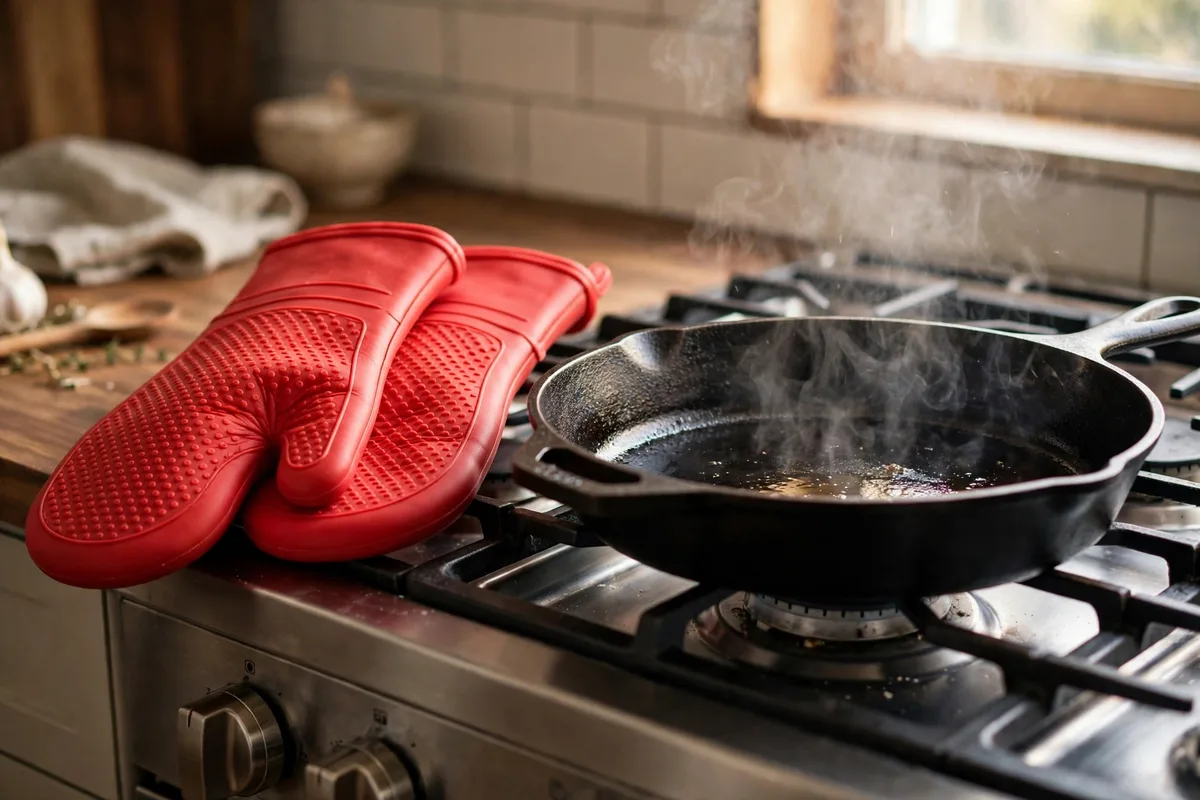
The best oven mitts for most households are lined silicone mitts rated to about 500°F (260°C): silicone grips greasy pans, sheds water completely — a wet cotton mitt can steam-scald you — and the OXO and Homwe picks below are the strongest versions of the design. A mitt’s rating buys you working seconds, not immunity: roughly 10 to 20 seconds of grip at the top of its range, which is plenty for a planned lift and nothing for a distracted one.
The five picks divide by material philosophy: two silicone leaders, a quilted cotton classic for traditionalists, aramid grill gloves for live-fire dexterity, and a design-house silicone pair. Each was judged on insulation construction, grip, cuff length and the thumb seam where mitts go to die. They guard the hands that lift the best cast iron skillets in Canada and the USA and the best dutch ovens in Canada and the USA from our cookware guides, and they make a genuinely useful gift from the best kitchen gifts in Canada and the USA list.
Disclosure: CookSmartPicks is reader-supported. When you buy through links on this page, we may earn an Amazon commission at no extra cost to you. Prices and availability change often — check the current price on Amazon before you decide.
How we chose these oven mitts
Heat ratings were read the way the fine print writes them: a maker’s figure (for example, protection to 500°F / 260°C) describes brief contact — the seconds needed to move a pan — and we favoured brands whose ratings and test language were specific over brands advertising round, unverifiable numbers. Construction came next: where the insulation lives (silicone shell over a lined interior beats a bare slab of either), seam placement at the thumb — the classic failure point — and cuff length measured in inches, not adjectives.
Grip was weighted as a safety feature equal to insulation, because a dropped Dutch oven does not care how heat-proof the mitt was: textured silicone surfaces, cotton’s dry grip, and aramid’s work-glove dexterity were each matched to the lifts they serve. Every pick is sold through normal Canadian retail. Two fashion mitts with thin, unrated insulation were cut without regret — an oven mitt is safety equipment that happens to come in colours.
The lineup at a glance
| Product | Best for | Why it stands out |
|---|---|---|
| OXO Good Grips Silicone Oven Mitt | Best overall | The lined silicone standard: 600°F-rated shell, real grip, a lining that lasts |
| Homwe Silicone Oven Mitts (Pair) | Best value pair | The pair-priced silicone: 450°F rating, real lining, two mitts in the box |
| KitchenAid Asteroid Oven Mitt Set | Best cotton classic | The cotton classic, fixed: quilted insulation with a silicone grip palm |
| Grill Armor Extreme Heat Gloves (Aramid, Pair) | Best for grilling (aramid gloves) | The grill glove: aramid to a claimed 932°F, with fingers that actually work |
| Five Two Silicone Oven Mitt (by Food52) | Best design pick | The designed mitt: full silicone performance in a kitchen-worthy silhouette |
1. OXO Good Grips Silicone Oven Mitt — Best overall
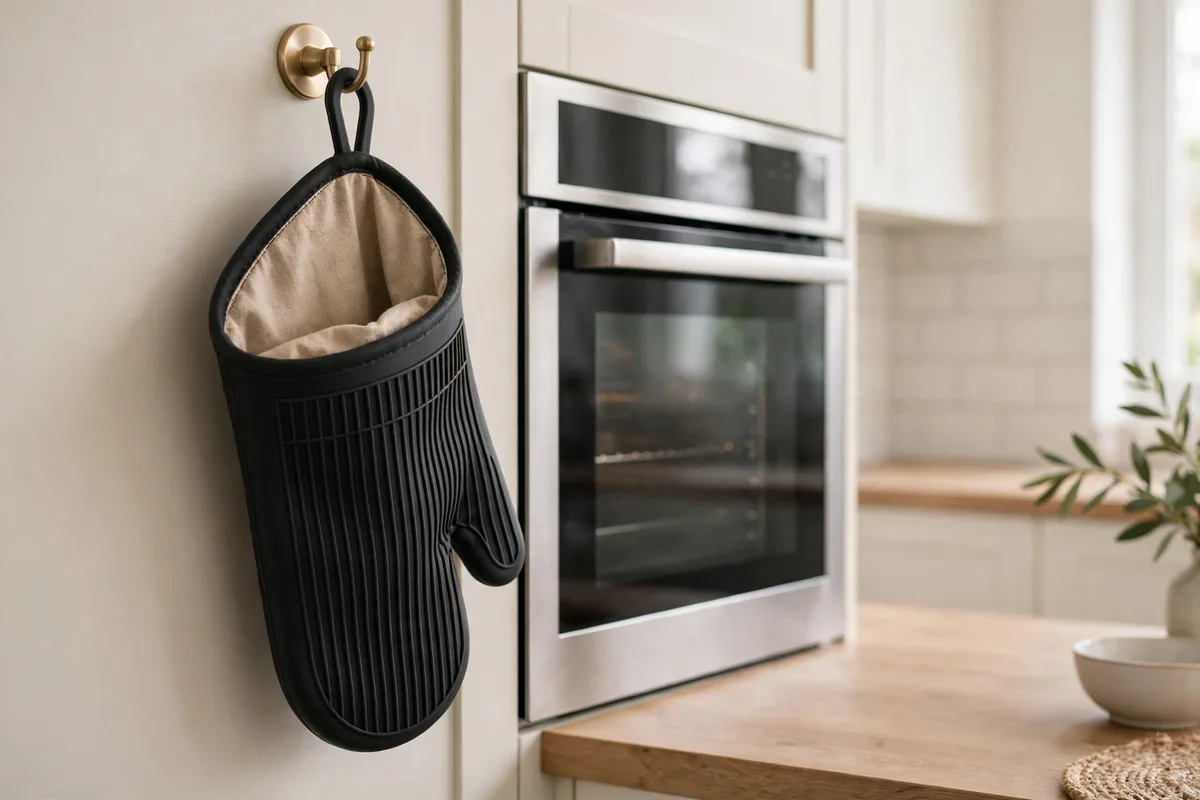
OXO’s silicone mitt is the category’s reference design: a ribbed silicone shell — rated by the maker to 600°F — over a soft fabric lining, so the hand gets silicone’s grip and water immunity without the clammy, bare-silicone interior of cheaper mitts. The ribs are functional, channelling grip across greasy sheet pans and Dutch oven lids, and the mitt’s cuff extends past the wrist where steam and oven racks threaten. The thumb is positioned for a natural pan grip rather than the lobster-claw compromise of symmetrical mitts.
In daily service, the details compound: the mitt rinses clean under the tap (or wipes down mid-service when the first lift was saucy), the lining keeps it comfortable across a long bake day, and the hanging loop means it lives on a hook rather than in a drawer’s archaeology. Owner reports across years describe the silicone staying flexible and the lining intact — the two aging failures of the class — longer than rivals at any price.
OXO’s Canadian distribution is complete, and the mitt is sold singly, so a pair is two purchases (or one, for the many households that work one-mitt-and-a-trivet). For the default recommendation — the mitt to buy when you do not want to think about mitts again for years — this is it.
The OXO’s lining has a second job owners discover in winter: the mitt doubles as the household’s hot-water-bottle and kettle handler without a thought, because a mitt you trust completely gets used for everything warm — trust, in safety equipment, is a usage statistic.
Yay · Pros
- Silicone shell rated to 600°F per OXO; fabric lining
- Ribbed grip excels on greasy pans
- Rinses clean; water cannot soak it
Hmm · Cons
- Costs more than basic silicone mitts
- snug fit for very large hands
- Silicone stiffness never fully disappears
Best for: Most households — the silicone standard Skip if: You want full-finger dexterity for grill tools — the aramid gloves below serve that
2. Homwe Silicone Oven Mitts (Pair) — Best value pair
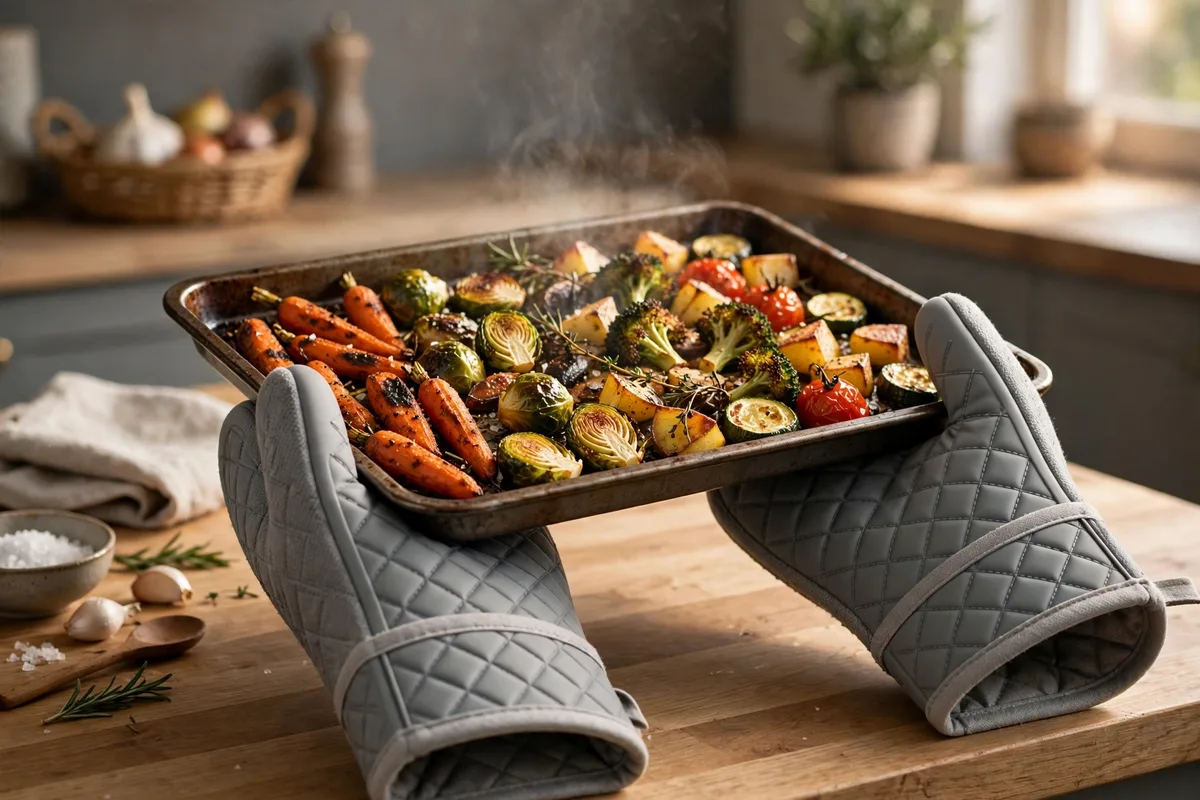
Homwe built its name on the simple proposition that a silicone mitt should come as a pair, at a fair price, with the specifications printed plainly: heat resistance the maker rates to 450°F, a silicone exterior with a raised grip pattern, and a quilted cotton-poly lining for comfort. The rating sits a step below the OXO’s ceiling and covers every temperature a home oven produces — home ovens top out at 500–550°F at the element, but pans you grip are rarely above the mitt’s working range in the seconds a lift takes, which is the honest context for the number.
In use, owners praise the grip texture and the lining’s comfort, and the pair’s arrival as a pair — the two-mitt rotation the deep-dive’s wet-mitt rule demands is satisfied out of the box. The mitts are longer than budget norms, covering the wrist properly, and the silicone flexes more readily than the stiff slabs of the category’s bottom shelf. Longevity reports run to years of regular service, with the lining, as ever, the first component to tire.
Canadian availability is online and easy, at a per-mitt price the leaders cannot match. For the household equipping a kitchen from scratch — or replacing the scorched cotton pair that should have retired in 2022 — Homwe is the value answer in silicone, and the guide’s most-bought recommendation.
Homwe’s generous sizing has an unlisted beneficiary: the second cook. A mitt sized for the larger hand in the house fits both cooks passably, while a snug designer mitt often fits one — and parties are cooked by whoever can be drafted.
Yay · Pros
- Sold as a pair at a value price
- 450°F maker rating; quilted lining
- Long cuff; flexible, grippy silicone
Hmm · Cons
- Lining thinner than the OXO’s
- Sizing runs generous — small hands swim
- Brand support is online-only
Best for: Value buyers who want silicone performance in pairs Skip if: You broil at maximum constantly and want the highest ceiling available
3. KitchenAid Asteroid Oven Mitt Set — Best cotton classic
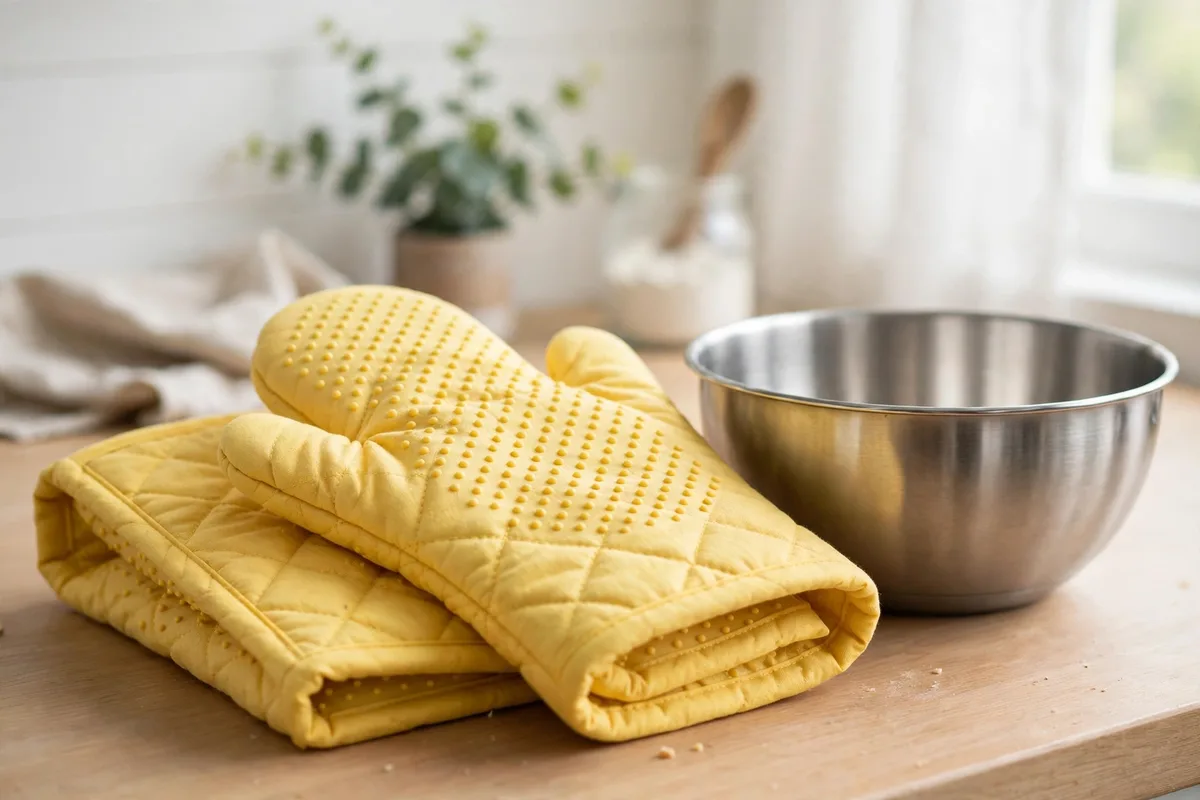
The Asteroid mitts are the quilted-cotton tradition done properly: a heavy cotton shell with silicone grip dots across the palm, a quilted insulating lining, and the flexibility that makes fabric mitts feel like an extension of the hand rather than a prosthetic. KitchenAid rates the design for the standard home-oven range (the line’s documentation centres on 500°F-class protection), and the silicone print answers cotton’s traditional weakness — grip — with a palm that holds a sheet pan honestly when dry.
The tradition’s terms apply in full, and the guide states them without apology: cotton insulates beautifully while dry and turns dangerous when wet, because water flashes to steam against hot metal. Asteroid owners who keep the rule — two mitts, always a dry one ready — get years of comfortable service and a mitt that machine washes when the sauce wins. The colours and the price (pairs, sensibly) make them the kitchen’s cheerful workhorses.
Canadian availability is total. Choose the Asteroid if your hands dislike silicone’s stiffness, your cooking is oven-standard rather than broiler-extreme, and your household can be trusted with the dry rule. It is the classic, correctly built — which in this category is a genuine recommendation.
The Asteroid’s cotton has one more traditional virtue: it is silent. No silicone squeak on enamel, no rigid shell knocking the oven’s edge — a small thing at midnight when the house is asleep and the bread is finally done.
Yay · Pros
- Quilted comfort; silicone grip print on the palm
- Flexible, natural hand feel
- Machine washable; sold in pairs and colours
Hmm · Cons
- Cotton’s rules: never use it wet
- Heat ceiling below the silicone leaders
- Insulation thins with years of washing
Best for: Traditionalists who prefer fabric’s feel and flexibility Skip if: Your kitchen discipline cannot guarantee a dry mitt — choose silicone
4. Grill Armor Extreme Heat Gloves (Aramid, Pair) — Best for grilling (aramid gloves)
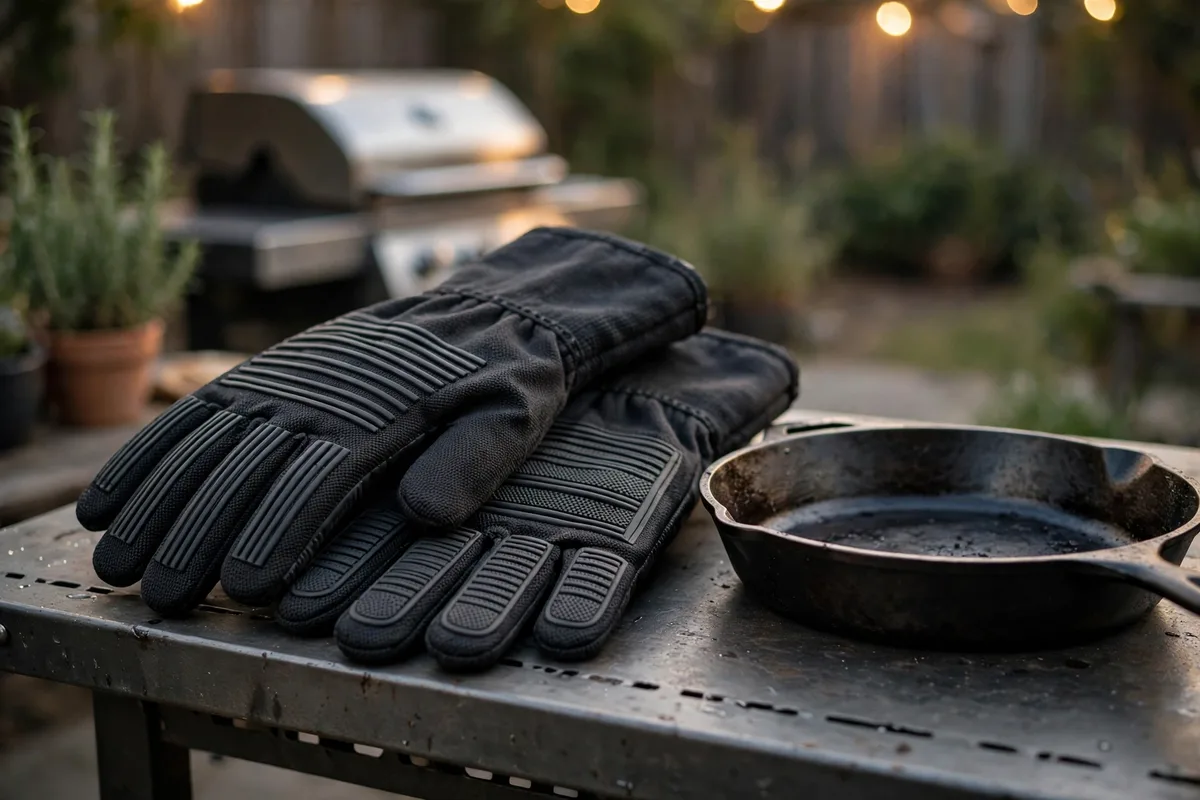
Grill Armor’s gloves are built on the aramid fibres of firefighting gear — the maker rates them to 932°F, the highest figure in this guide — in a five-finger glove with silicone grip strips across the palms and fingers, and a cuff that reaches toward the elbow. The glove format changes what hands can do: adjust a damper, reposition a grate, grip a chimney starter or a cast-iron handle with actual fingers, all at temperatures where a mitten’s clumsiness becomes the risk. For live-fire cooking, dexterity is safety, and this is the category’s dexterity champion.
The honest context for the headline number: aramid gloves protect by insulation like everything else, and at grill temperatures the working window is seconds-to-tens-of-seconds, not a licence to hold a grate indefinitely. What the rating buys is confidence at flare-up moments and on cast iron that has sat over coals — the lifts that define grilling. The gloves also serve oven duty happily, though their non-waterproof knit absorbs grease over a season in a way silicone mitts shrug off.
Canadian availability is online and straightforward. For the household whose cooking year includes a grill, a smoker or a fire pit — the [[1]] guide’s other audience — these gloves are the correct hand protection, and the oven mitts above are their indoor partners.
Grill Armor’s cuff length proves itself at the smoker, where the reach is long and the metal is everywhere: the forearm coverage that seems excessive at the grill grate is exactly right at the firebox door.
Yay · Pros
- Aramid rated to 932°F per the maker
- Five-finger dexterity with silicone grip
- Long cuff protects the forearm
Hmm · Cons
- Gloves insulate less per second than thick mitts at extremes
- Not waterproof — grease soaks in over time
- Overkill for a muffins-only oven
Best for: Grillers and smoker hands who need fingers, not a mitten Skip if: Your work is oven pans only — mitts are faster on and off
5. Five Two Silicone Oven Mitt (by Food52) — Best design pick
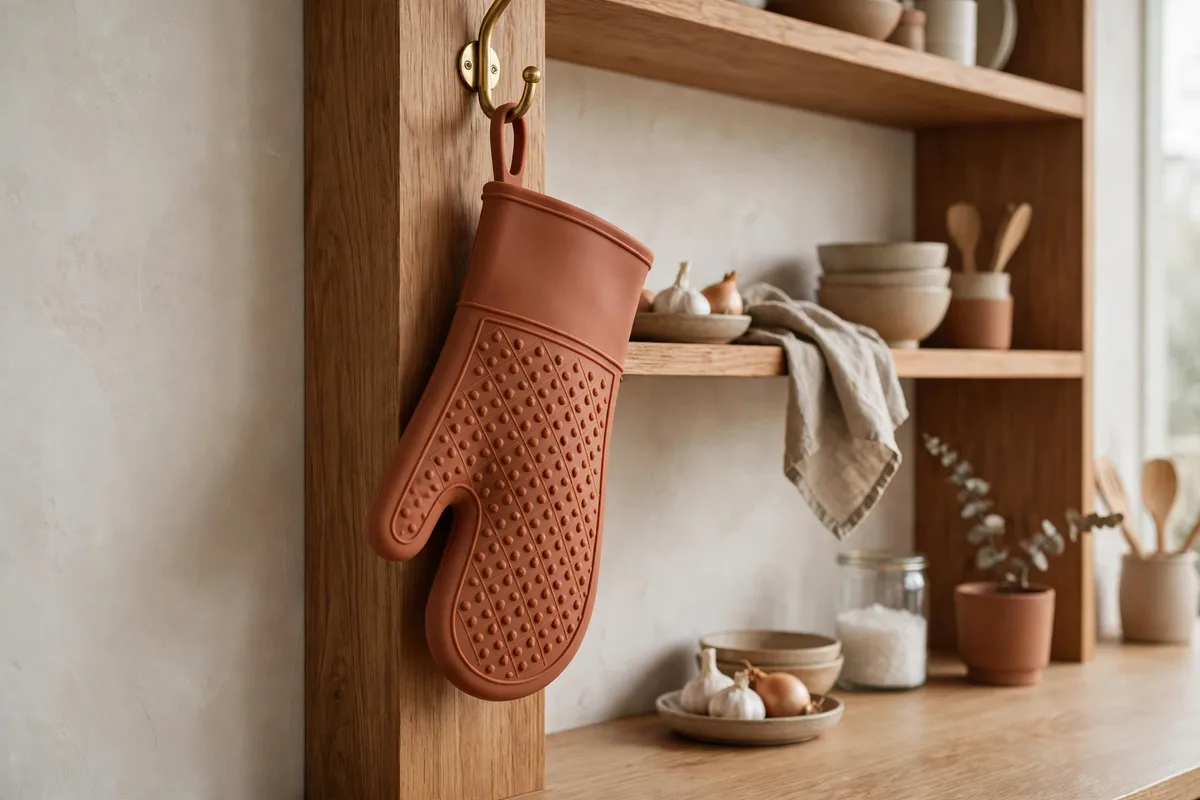
Five Two — Food52’s house brand — asked what an oven mitt would be if a design studio obsessed over it, and the answer is a silicone mitt with a considered silhouette, a soft terry-style lining, and colours that coordinate with a kitchen rather than a workshop. The performance specification is the class standard done right: silicone rated for home-oven extremes, a textured palm for grip, and a hanging loop integrated like it was drawn, not added. It is the mitt that lives on a hook as part of the kitchen’s look, which — since visibility drives use — is a safety feature in disguise.
In service it matches the leaders on lifts and lining comfort; the cuff runs slightly shorter than the OXO’s, the honest trade of the design’s proportions, and the price carries the studio’s premium. Owner reports describe the familiar silicone virtues — rinse-clean, water-immune, grip that does not fade — with the lining holding up well across wash cycles.
Canadian availability runs through Food52’s shipping and occasional domestic retail. Buy it when the kitchen is a designed space and the mitt will live in view; the protection is the category’s standard, and the pleasure of looking at it daily is the feature you are paying for — a legitimate line item in a room you live in.
The Five Two’s hook presence has a measurable effect owners report without quite naming: a mitt that hangs in sight gets used instead of the tea towel that hangs nearer — and every tea-towel substitution avoided is the category’s whole purpose, quietly fulfilled.
Yay · Pros
- Design-studio looks; lives beautifully on a hook
- Standard-setting silicone grip and rating
- Soft lining; rinse-clean care
Hmm · Cons
- Premium price for a mitt
- Colour range sells out in Canada
- Slightly shorter cuff than the leaders
Best for: Design-led kitchens wanting silicone with style Skip if: You want the longest cuff or the lowest price
Heat ratings read literally: what 500°F on a mitt actually promises
An oven mitt’s temperature rating describes the surface temperature the mitt can contact briefly — typically a few seconds of grip — not a temperature it can hold indefinitely, and the distinction is the whole honesty of the category. A mitt rated to 500°F protects you while you move a roasting pan from oven to counter; it does not make you immune while you stand holding it, because insulation slows heat transfer rather than stopping it. Every mitt in this guide buys you working seconds — roughly 10 to 20 at the top of its range, fewer as the material ages — and the correct use is to plan the landing spot before you lift, not to admire your grip strength mid-carry.
Wet insulation is the category’s dangerous secret: water conducts heat far faster than the dry fibres or silicone it displaces, so a damp cotton mitt on a hot pan can steam-scald the hand it was protecting. This is silicone’s strongest safety argument — it sheds water entirely — and the rule for cotton households is absolute: a wet mitt is a towel, and a towel on a 450°F Dutch oven is an injury with extra steps. Keep two mitts in rotation so a dry one is always available.
Steam is the third vector the ratings ignore: lifting a lid toward your forearm vents a jet of steam that no mitt’s palm rating addresses, which is why cuff length is a safety specification, not a style. The extra inches on a long mitt protect the wrist and forearm during exactly that moment — reaching deep into an oven, tilting a lid, steadying a tray — and grill gloves extend the same logic to the elbow for live-fire work.
Grip is the unmeasured specification that decides real-world safety: a mitt that lets a greased sheet pan rotate in your hand fails at any temperature. Silicone’s textured surfaces grip metal best, especially with the slight moisture of kitchen hands; cotton grips adequately when dry and loses authority when greasy; aramid gloves grip like work gloves because they are work gloves. Match the grip to your heaviest, slipperiest regular lift — for most households, the enamelled Dutch oven, full.
And the lifespan honesty: insulation compresses and thins with years of heat cycles, silicone eventually stiffens at flex points, and cotton chars incrementally at its hot spots. A mitt is a consumable with a multi-year fuse, not an heirloom — inspect for thin spots, cracks and scorch-weakened patches each season, and retire generously. The hand inside is the only irreplaceable tool in the kitchen.
The two-mitt rotation deserves repeating as a system, not a tip: one mitt in use, one mitt dry and waiting, swapped the moment the working mitt gets wet, greasy-slick or heat-soaked. Professional kitchens run gloves this way because the failures all arrive through a compromised mitt, never a fresh one — and the entire system costs one extra mitt, which is why this guide’s value pick is sold as a pair.
Oven mitt questions, answered
Can a 500°F-rated mitt really handle a 500°F pan?
For a few seconds of contact, yes — that is what the rating means: the mitt’s surface can touch 500°F (260°C) cookware long enough to move it safely, typically 10 to 20 seconds of working grip before heat soaks through. It is not a hold-indefinitely rating. Plan your landing spot first, and treat every hot lift as a short, deliberate trip.
Are silicone oven mitts better than cotton ones?
Silicone wins on grip, waterproofing and heat ceiling, and it never suffers the wet-mitt steam burn that makes damp cotton dangerous. Cotton and aramid win on flexibility, dexterity and comfort for long sessions, and aramid gloves beat everything for grill work. Most serious kitchens end up with both: silicone mitts for oven duty, gloves for the grill.
Is it safe to use a wet oven mitt or towel?
No — this is the most dangerous habit in the category. Water conducts heat rapidly and flashes to steam against hot metal, so a wet mitt or towel can scald faster than a bare-handed grab would warn you. Always use a dry mitt; if yours gets wet mid-service, swap it before the next lift. Silicone mitts avoid the problem entirely because they do not absorb water.
How long should oven mitts be?
For oven-only duty, standard 13-inch mitts cover the hand and wrist adequately. Choose 15-inch or longer mitts — or grill gloves — if you reach deep into ovens, lift lids that vent steam toward your arms, or work a grill or smoker: the forearm is where steam and flare-ups land, and cuff length is the protection.
Oven mitts or oven gloves — which is safer?
Gloves give you fingers: you can handle tools, adjust dampers, and grip oddly shaped items, which is why grillers prefer them. Mitts are faster to slip on and off and usually insulate a touch better per dollar for simple pan lifts. Kitchens that do both jobs usually own both — mitts by the oven, gloves by the grill — as this guide’s picks reflect.
How do I clean oven mitts, and when should I replace them?
Silicone mitts rinse or wipe clean and many are dishwasher safe per their makers. Cotton mitts machine wash (air dry to protect the insulation) — and a stained mitt is a cosmetic issue, not a safety one. Replace any mitt whose insulation feels thin, whose silicone cracks at the flex points, or whose cotton shows scorch-weakened patches; heat protection fades before looks do.
Sizing, the specification nobody lists, deserves the closing paragraph: a mitt should admit the whole hand with a finger’s width to spare — insulation works by loft, and a mitt stretched tight over a large hand compresses its own protection exactly where the grip closes. Households with very different hand sizes do better with two pairs in two sizes than one compromise pair, which is another quiet argument for the value picks in this guide: at their price, correct sizing for both cooks costs less than one premium mitt in the wrong size.
And a final safety habit that costs nothing: say the lift before you make it. Professional kitchens call their hot pans aloud — ‘hot pan, behind you’ — because most burns involve a second person, a turned elbow, a handle left pointing into the walkway. Turn handles inward, announce the carry, and the best mitt in this guide becomes what it was always meant to be: the backup for a system that rarely needs it.
The short version
Buy the OXO silicone mitt for the best all-round protection, or the Homwe pair for the same idea at a value price. The KitchenAid Asteroid is the cotton classic (keep it dry), the Grill Armor gloves are the grill’s aramid answer, and the Five Two is the design pick. Whichever you choose: dry mitt, planned landing, and retire it when the insulation thins — your hands are the kitchen’s irreplaceable tool.
Last updated: November 18, 2026. We refresh this guide each season and whenever a pick is replaced by a better one.