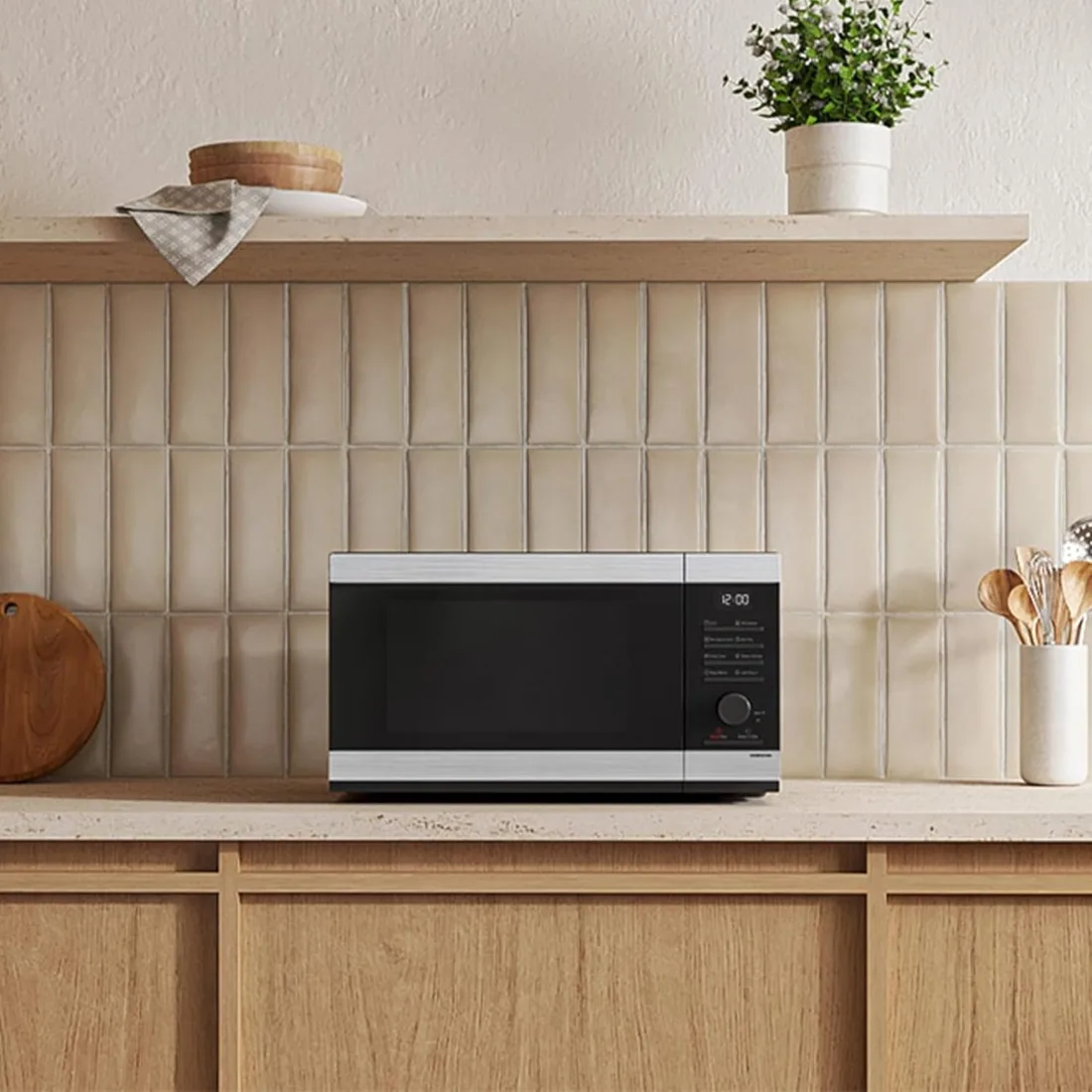
A microwave is the appliance nobody researches — until the old one dies mid-week and a replacement gets grabbed in a hurry. That is a shame, because the differences are real: an inverter model defrosts chicken without cooking its edges, a sensor model reheats leftovers without being told a time, and the wrong box will not fit your counter no matter how good it is. This guide compares the five countertop microwaves we would point Canadian and US readers to in 2026, organised by the job each one does best.
Start with size, not features. Measure the counter spot — width, depth, and the height under your cabinets — then read the picks. Every pick below lists its real outside dimensions, because “1.2 cu. ft.” tells you nothing about whether the thing fits.
Countertop Microwaves at a Glance
| Model | Size & power | Best for | Standout feature |
|---|---|---|---|
| Panasonic NN-SN67KS | 1.2 cu. ft. · 1,200W | Even cooking and defrosting | True inverter power + Genius Sensor |
| Toshiba EM131A5C | 1.2 cu. ft. · 1,000W | Most households | Humidity sensor reheats and a mute button |
| Toshiba ML-EC42P | 1.5 cu. ft. · 1,000W | Replacing two appliances | Microwave + air fryer + convection in one |
| BLACK+DECKER EM031MB11 | 1.1 cu. ft. · 1,000W | Tight budgets | Full size and full power, plain controls |
| Comfee’ EM720CPL | 0.7 cu. ft. · 700W | Dorms and small spaces | Tiny footprint, mute function, ECO mode |
How We Researched This Guide
CookSmartPicks is a research-based guide. We do not run a test kitchen, and we never claim hands-on testing we have not done. For this guide we compared manufacturer specifications, retailer listings in Canada and the USA, owner reviews, and independent coverage, then ranked the picks by the things that matter day to day. Product photos are the makers’ own listing photos.
Where a product carries scores in this guide, they are CookSmartPicks scores — our editorial judgement from that research, on a 10-point scale — unless a published third-party score is named and attributed. Our full method is on the How We Research page.
How we score
The scores in this guide are CookSmartPicks’ own editorial ratings. We set them from our research of the expert reviews and sources listed in this post — they are our ratings, not scores quoted from another publication.
1. Panasonic NN-SN67KS — Best for Even Cooking
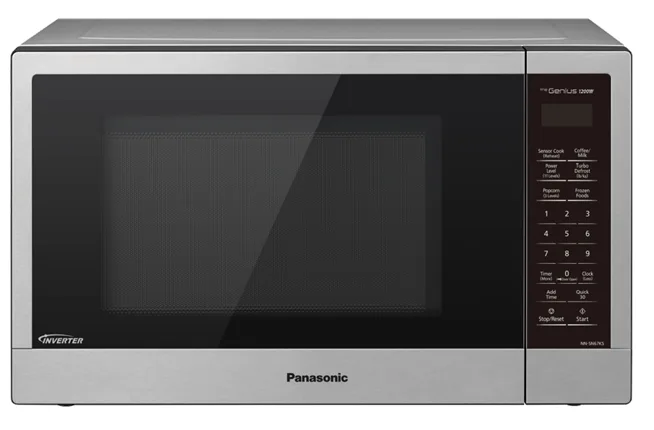
The Panasonic is the one to buy if you actually cook in your microwave rather than just reheating coffee. Its inverter power supply delivers a true, steady stream of energy at lower settings instead of pulsing full power on and off, so frozen chicken thaws evenly, sauces do not split, and a plate of leftovers heats through without cold spots in the middle and lava at the edges. At 1,200 watts it is also the strongest microwave on this list.
The Genius Sensor handles the guesswork: it measures the steam coming off the food and adjusts the time itself, with sensor settings for the foods people actually make — oatmeal, soup, rice, pasta, vegetables and more. The box is about 20.7 inches wide, 15.8 deep and 12.25 high, which is usefully shallower than most 1.2 cu. ft. rivals, and the 13.4-inch turntable takes a family-size dinner plate or a medium casserole.
Yay · Pros
- True inverter power — the most even heating and defrosting here
- Genius Sensor cooks and reheats by measuring steam, not timers
- 1,200W — faster than the 1,000W pack, and package times run short, not long
- Shallower than most 1.2 cu. ft. models at about 15.8 inches deep
Hmm · Cons
- Costs more than the sensor-only models below
- No mute button — the beeps stay on
- Membrane keypad picks up fingerprints and needs a firmer press
Best for: cooks who defrost meat often and anyone tired of cold-centre leftovers. Skip if: you need silence at night — pick a Toshiba or the Comfee’ instead.
2. Toshiba EM131A5C — Best All-Rounder
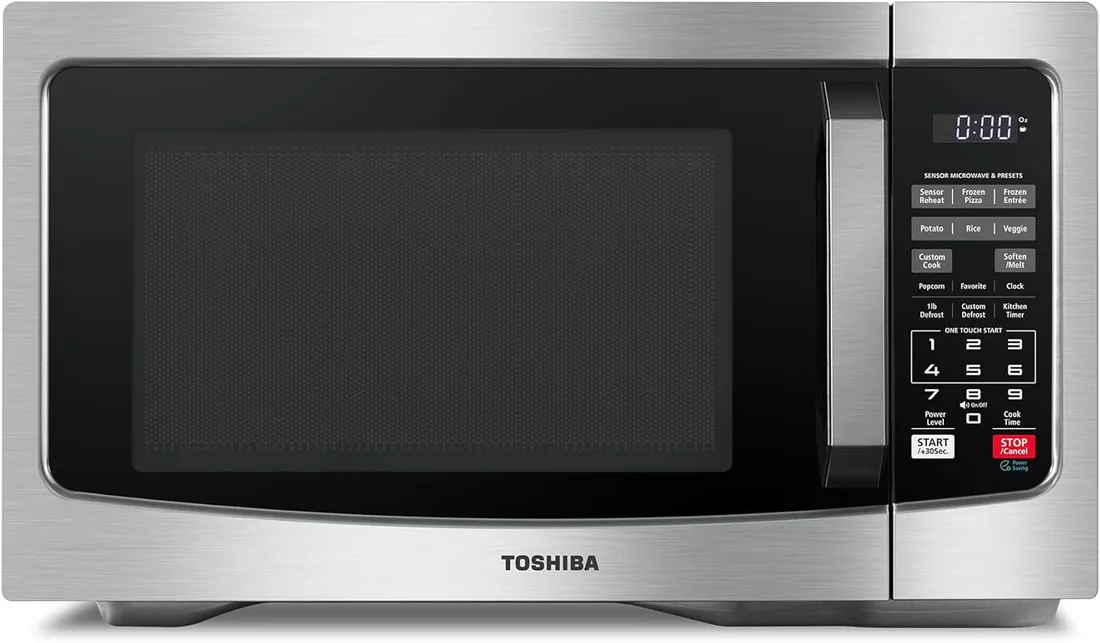
If one microwave has to suit a whole household, this is it. The EM131A5C is a 1.2 cu. ft., 1,000-watt model with a smart humidity sensor that handles reheating and cooking by feel rather than by timer — sensor menus cover the everyday list, and there are 12 auto menus in total. One honest note on wattage: a few older listings call this a 1,100-watt microwave, but Toshiba’s own manual and current spec tables say 1,000 watts of output, and 1,000 watts is the number that matches package cooking times, so it is the number we use.
Two smaller things lift it above the pack. The mute function silences the keypad and end-of-cooking beeps — gold in an open-plan home at 11 p.m. — and ECO mode cuts standby draw. Outside it measures about 20.5 inches wide, 17.1 deep and 12.8 high, so check your depth: it is a touch deeper than the Panasonic. The 12.4-inch turntable fits a dinner plate with room to spare.
Yay · Pros
- Sensor reheat that genuinely works for leftovers and pizza
- Mute function for the beeps — rare at this level
- 1,000W output matches packaged-food times exactly
- ECO mode trims standby power
Hmm · Cons
- No inverter, so low-power cooking pulses like a normal microwave
- Deeper than the Panasonic — measure your counter
- The door handle style splits opinion; it is a pull, not a button
Best for: most families — it is the easiest recommendation on this page. Skip if: you defrost several times a week and want inverter smoothness.
3. Toshiba ML-EC42P — Best Microwave + Air Fryer Combo
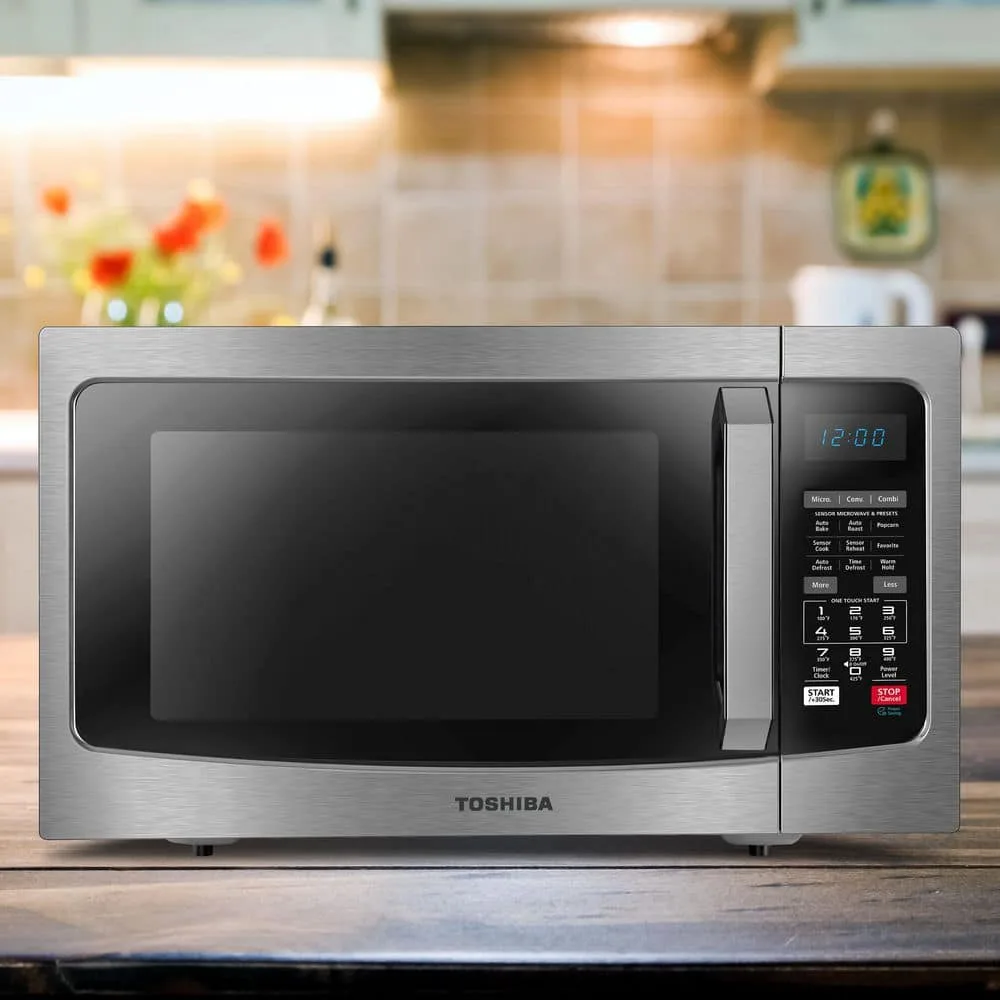
This is the space-saver play: one big box that microwaves, air fries, bakes with convection and runs a combination mode that uses microwave speed with convection browning. At 1.5 cu. ft. with a 13.6-inch turntable it swallows a whole chicken or a 12-inch pizza, the microwave side runs 1,000 watts, and it keeps the family tricks from the model above — a smart sensor, a mute function and position memory so the turntable stops with your mug handle facing you.
Now the honest part, in numbers: this unit is about 21.8 inches wide, 21.4 deep and 12.9 high, and it weighs over 45 pounds. That depth is real counter depth — on a standard 24-inch counter it nearly reaches the edge before the door opens. Measure twice. If it fits, it can retire a separate air fryer; if your kitchen is small, the two smaller Toshibas above plus a basket air fryer will serve you better.
Yay · Pros
- Four appliances in one footprint — microwave, air fryer, convection, combo
- Big 1.5 cu. ft. cavity fits a whole chicken or 12-inch pizza
- Sensor cooking, mute function and turntable position memory
- Air fry mode crisps with far less oil
Hmm · Cons
- Very deep (about 21.4 inches) and heavy — the counter math is unforgiving
- Air frying is slower than a dedicated basket air fryer
- More modes means a busier control panel to learn
Best for: small kitchens with deep counters, renters, and anyone replacing two appliances with one. Skip if: your counter is shallow, or you air fry several times a week and want a real basket.
4. BLACK+DECKER EM031MB11 — Best Budget Pick
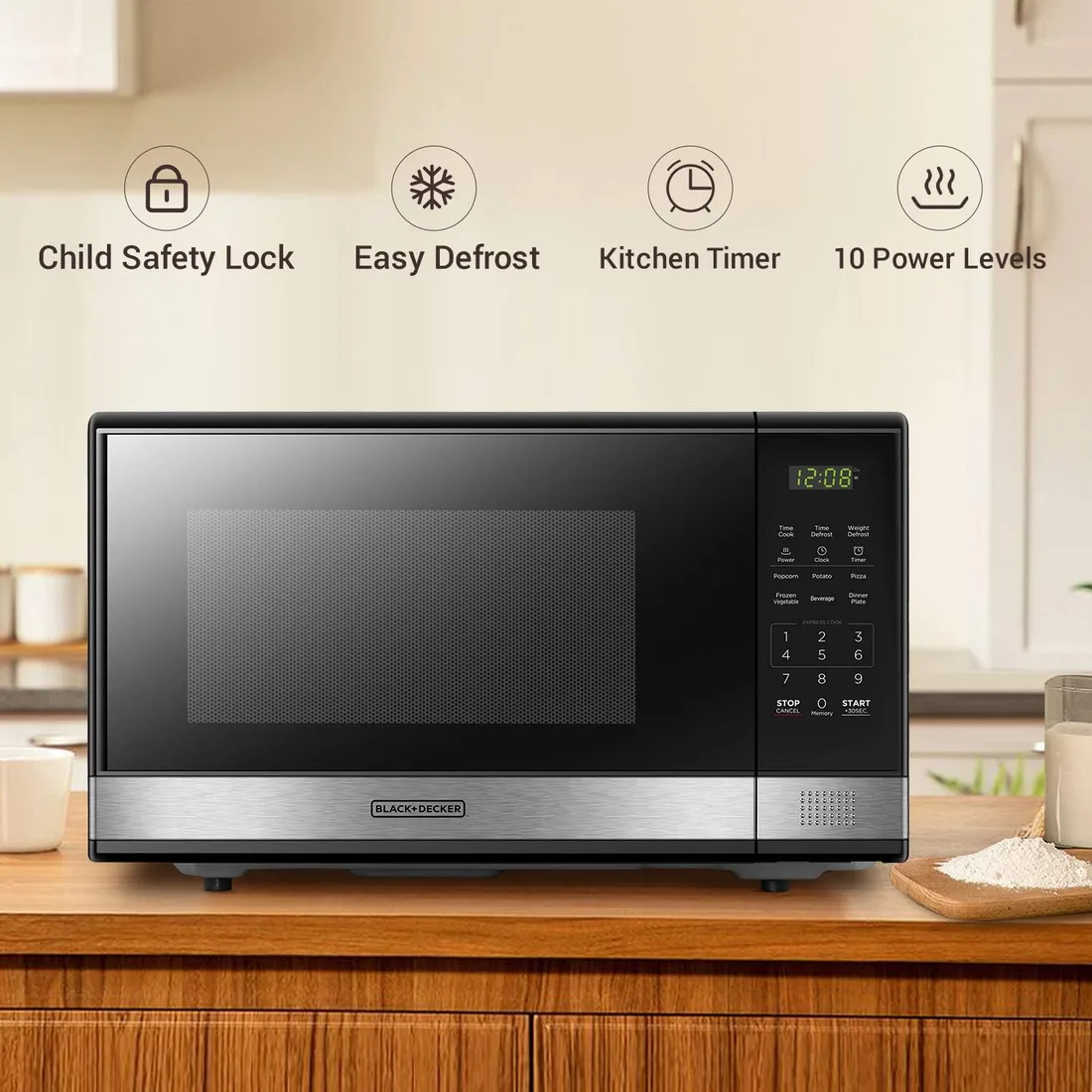
Budget microwaves usually cheat on size or power. This one does neither: 1.1 cu. ft. and a full 1,000 watts, so a family dinner plate fits and packaged meals cook in the time printed on the box. You get 10 power levels, express-cook buttons, weight and time defrost, a kitchen timer and a child safety lock — the complete basic set, with nothing weird missing.
What you give up is sensing and silence. There is no humidity sensor, so reheating is by time and power level the old-fashioned way, and there is no mute — it beeps like microwaves have always beeped. The controls are a simple membrane pad that anyone in the house can work out without a manual. For a first apartment, a rental, or a family that just wants the thing to heat food, that trade is exactly right.
Yay · Pros
- Full 1.1 cu. ft. size and full 1,000W at a budget level
- Simple controls the whole house can use
- Express cook, defrost by weight or time, child lock
- Turntable fits a standard dinner plate
Hmm · Cons
- No sensor cooking — reheats are manual
- No mute function
- Plain styling next to the stainless picks above
Best for: first apartments, rentals, and anyone who wants size and power without paying for smarts. Skip if: you reheat leftovers daily and would use sensor cooking every time.
5. Comfee’ EM720CPL — Best for Dorms & Small Spaces
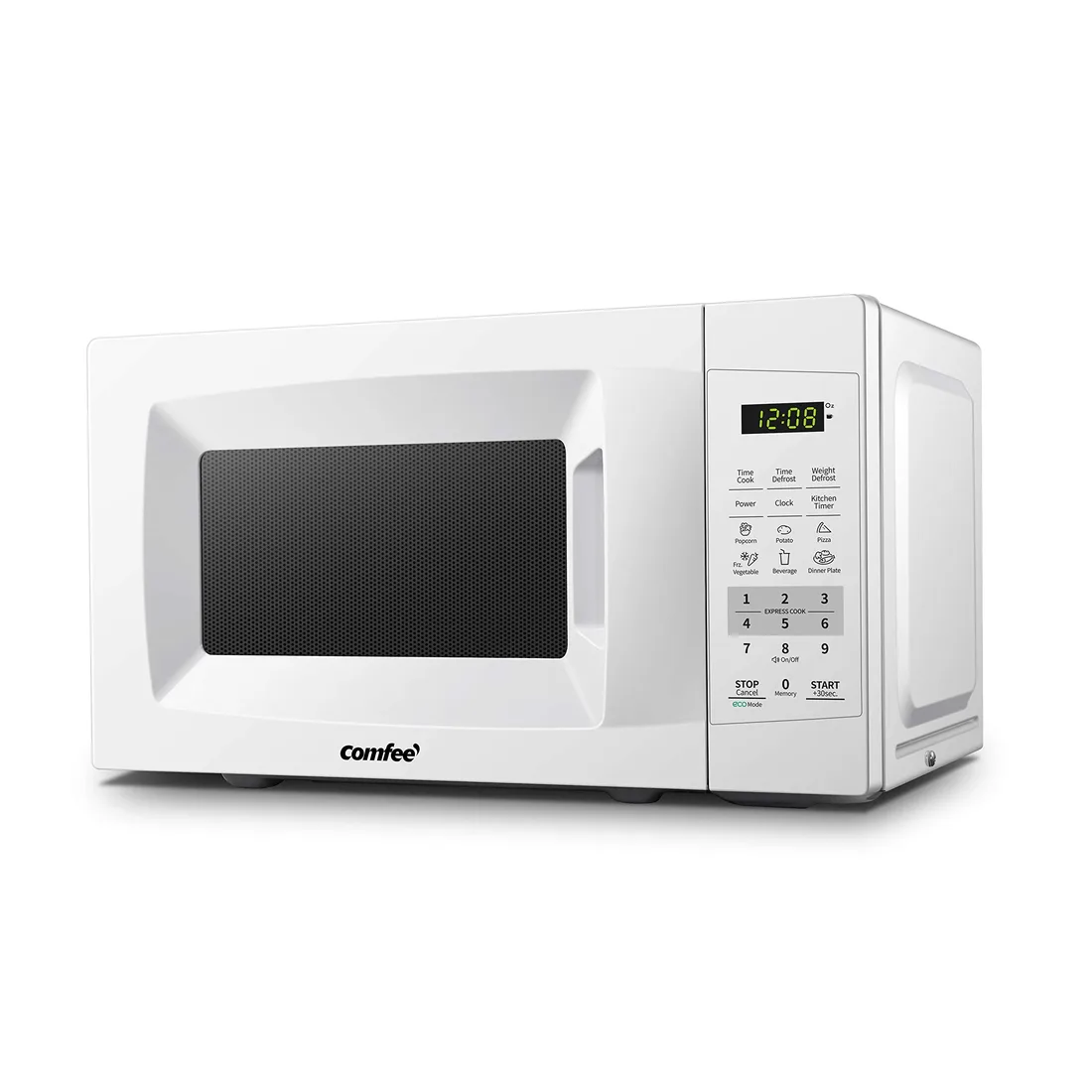
The little one. At 0.7 cu. ft. and about 17.3 inches wide, the Comfee’ fits the spots the others cannot — a dorm room, a small apartment counter, an office kitchenette, a camper. Power is 700 watts, which reheats drinks, noodles and single portions happily; just know the deal: family-size frozen meals will take about a third longer than the box says, because the box assumes 1,000 watts.
Two features make it the dorm pick over other tiny microwaves. The mute function (hold the sound on/off button for three seconds) silences every beep — your roommate will thank you — and ECO mode turns the display off to halve standby power. Eleven power levels and one-touch buttons for popcorn, pizza and the usual suspects cover student cooking completely.
Yay · Pros
- Genuinely small — fits counters and rooms the others cannot
- Mute function silences all beeps: dorm and night-shift friendly
- ECO mode cuts standby power in half
- One-touch presets for the foods students actually make
Hmm · Cons
- 700W heats noticeably slower than the 1,000W models
- Too small for a family dinner plate or a big casserole
- Basic build and a lightweight door feel
Best for: students, small apartments, offices, and anyone cooking for one. Skip if: you cook family meals — step up to the 1.1 or 1.2 cu. ft. picks.
How to Choose: Size First, Then Power, Then Smarts
Size. Measure your counter before anything else, and measure depth twice — door swing and plug included. As a rule: 0.7–0.9 cu. ft. serves one person reheating small portions; 1.1–1.2 cu. ft. is the family size; 1.5 cu. ft. and up is for big dishes and combo machines, and it needs a deep counter to match.
Power. Packaged foods are timed for roughly 1,000 watts. At 700 watts add about a third more time; at 1,200 watts start checking early. Wattage is printed inside the door of your current microwave — check it before you shop and you will know what “faster” or “slower” means for you.
Smarts. An inverter (Panasonic) is about evenness — defrosting and gentle cooking. A sensor (the Toshibas, and Panasonic’s Genius Sensor) is about not thinking — it judges doneness by steam or humidity. A mute button is about peace at night. None is essential; all are used daily once you have them. Pick the one that matches your actual habit, and skip the rest.
Frequently Asked Questions
What size microwave do I need for a family?
A 1.1 to 1.2 cu. ft. model is the sweet spot for most families: it fits a dinner plate, a medium casserole and a big bowl of soup, without eating the whole counter. Go bigger (1.5 cu. ft. and up) only if you regularly heat large casserole dishes — and measure first, because the bigger boxes are also much deeper.
Why do package cooking times never match my microwave?
Because most packaged foods write their times for a microwave of around 1,000 watts. Cook the same meal in a 700-watt dorm model and it needs roughly a third more time; in a 1,200-watt inverter model it finishes sooner and heats more evenly. Check your wattage on the label inside the door, and adjust times to match — that one habit fixes most 'my microwave is bad' complaints.
What does an inverter microwave actually do differently?
A normal microwave can only switch its power fully on and fully off, so '50% power' means blasts of full power with rests between. An inverter delivers a true, steady lower power. Food defrosts without cooked edges, butter melts instead of exploding, and delicate things like fish and custards cook evenly. If you defrost often, it is the single feature most worth paying for.
How much space does a countertop microwave really need?
Measure the box, then add room to breathe: most models need about an inch on the sides and top and a few inches behind for the vents, and the door swings wider than the unit itself. Depth is the measurement that catches people out — a 1.5 cu. ft. combo can be over 21 inches deep before you count the plug and the door. Our counter-depth notes under each pick use the real outside numbers.
Can I turn the beeping off?
On several picks here, yes. The Toshiba EM131A5C and ML-EC42P and the little Comfee' all have a mute or sound on/off function that silences the keypad and the finished-cooking beeps. If you heat food late at night in a small apartment or a dorm, put a mute button on your must-have list — it is a small feature you will use every single day.
The Verdict
Most households should buy the Toshiba EM131A5C: right size, right wattage, sensor reheating and a mute button. Buy the Panasonic NN-SN67KS instead if you defrost and cook delicate food often — the inverter earns its keep. The ML-EC42P is the one-box answer if it fits your counter, the BLACK+DECKER is the honest budget buy, and the little Comfee’ owns dorms and small spaces. Whichever you choose, measure the depth first — more microwave regrets are about inches than about watts.
Short on cleanup help as well as counter space? The best countertop dishwashers guide covers compact machines for small kitchens.